Rusland, EU og sanktionerne

Af Jens Jørgen Nielsen
Betragtninger 7. august, 2014

Vi lever i en interessant tid. Og den er ikke kedelig. Mange faste forestillinger ændrer sig. Det slår mig, at EU politikere og ditto amerikanske ved meget lidt om både Rusland og verden. Som EU borger kan jeg med beklagelse konstatere, at EU ikke har nogen politik i forhold til Rusland. Og højstemt forargelse og at snakke amerikanerne efter munden tæller ikke som en egentlig politik.

Hvilke forestillinger har EU politikerne haft om slutspillet i Ukraine? Hvilke forestillinger har de haft om virkningerne af sanktionerne? Hvilken viden og forståelse af hvilket land Rusland er, har de samme politikere haft?

Det er som om dæmonisering af Putin har gjort det ud for en politik. Jeg opfordrer ikke her til at man skal elske Putin. Men jeg opfordrer for det første til at finde ud af, hvad man ønsker med Rusland og for den sags skyld også med Ukraine. For det andet, at man gør sig overvejelser over, hvad sanktionerne betyder på både det lange og korte sigt.

Hvad har mangelen på overvejelser over egne interesser og mangelen på analyse af sanktionernes virkning ført til? Read More »

TFF PressInfo: Cold War warnings 1998 – 2014

By Jan Oberg

Jan Oberg

Lund, Sweden August 11, 2014

Quality research leads to better predictions

One criteria of quality research is that it predicts the future better than incompetent research.

Because TFF is independent of governments and coroporations it doesn’t have to take political considerations or exclude certain theories, concepts or values. This free research enabled it over the years to make fairly precise predictions about for instance former Yugoslavia, the Iraq war and East-West relations.

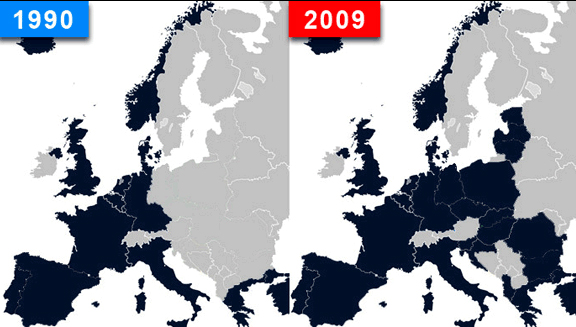
In 1998 – 16 years ago – we warned that NATO’s expansion would lead to future problems with Russia. Read it here.

NATO should never have been expanded

We backed this prediction up with 46 arguments and argued that so many other things would be wiser than containing Russia from the Baltic republics to Georgia – a strategy pursued by Bill Clinton in contravention of all promises given to the Soviet Union/Russia at the end of the Cold War about ten years earlier.

That counterproductive and insensitive expansion has now hit Ukraine. A new Cold War is gathering over Europe. It should have been predicted by advisers, intelligence agencies, big research institutes and columnists.

But it wasn’t.

At the end of the Cold War, NATO/the West got everything it could ever wish – and without war. But it wanted more: keeping Russia down, making NATO bigger and “peace-making” as well as finding new enemies to keeping its Military-Industrial-Media-Academic Complex (MIMAC) alive and well: Saddam, Milosevic, the Muslim world, terrorism and – now re-cycling – Russia.Read More »

TFF PressInfo: Wow, Hillary Clinton as moral philosopher

By Jan Oberg, TFF director

Jan Oberg

Lund, Sweden July 31, 2014

Responsibility for wars and killing

A number of Western/NATO politicians – Hillary Clinton foremost among them – and media people have recently introduced a new ethical principle in international affairs:

When A delivers weapons to B, A is responsible for what B does with these weapons. The former Secretary of State and perhaps future U.S. President presents this new ethical principle here on CNN.

This makes a lot of sense to me. Look at it this way:

Here is a young confused boy who has little to look forward to – and less to lose – because his country is falling apart in nasty civil war. He’s been told by some commander, or by his President, that he must hate the enemy; he gets paid for killing off as many as he can. And so he does.

He believes also in what he’s been promised: Fame as a hero upon return – that is, if he returns – and a comfortable life.

So he kills people, Read More »

The West is threatening Russia

By Jonathan Power

What would the conservative president, Ronald Reagan, have done if the Ukraine debacle had happened on his watch? I suspect he would have made sure it didn’t devalue relations between the US and Russia.

It wasn’t him nor his vice-president, George W.H Bush, who inflamed relations with a post-Cold War Russia, it was his successor the liberal, Bill Clinton, who, together with a supine EU membership, decided to expand NATO right up to Russia’s doorstep, despite a solemn US promise given personally to the Soviet president, Mikhail Gorbachev, by George H. W. Bush’s secretary of state, James Baker, that it wouldn’t.

And today President Barack Obama won’t say clearly and out loud that the US doesn’t expect that Ukraine will ever join NATO, a move that could de-escalate the crisis faster than you could say: “At last Obama understands where President Vladimir Putin is coming from”.Read More »

Aage Bertelsen (1901 – 1980) – Danish educator for peace

By Jan Oberg & Johan Galtung*

Lund and Kuala Lumpur, July 2014

Introduction

He was a tall man and a great man, a visionary, pacifist, civil resister, educator and philosopher. He took life more seriously than most and he could be playful and fun like a child. His life’s guiding principle was ”Engage in your time!” and while he wrote and talked a lot he also did it. His name was Aage Bertelsen, he was born in Denmark in 1901 and died on August 15, 1980.

Bertelsen’s imprint on history is two-fold. First, with his wife Gerda he was a prime mover of one of the groups, the Lyngby Group, which organised the rescue of altogether 7.220 Danish Jews into safety in Sweden in October 1943 during the German occupation of Denmark – more here. The Lyngby Group – Lyngby is north of Copenhagen – got about 1.000 of these in safety by organising their nightly transport onboard small fisher boats over the Sound between Denmark and Sweden.

In this he deserves a place in international contemporary history for its humanity, civil courage and as an example of non-violent struggle against occupation.

Secondly, Bertelsen was an educator of and for peace. His life work educational efforts included his family and friends, his pupils over 22 years at the Aarhus Cathedral School in Aarhus, Denmark, the general public as well as national and international leaders.

He lived in pre-Internet times and very little is publicly available today about this renaissance man. From two rather different, but compatible, perspectives we’ve taken it upon us to remind the world about him – friends and colleagues of his as we happen to be.

Headmaster Aage Bertelsen in 1961 Photo: Elfeldt, Copenhagen


Why now, over 30 years after his death? Read More »

Five Palestinian futures

By Richard Falk

For years, perhaps going back as far as the Madrid Peace Conference of 1991, influential international debate on the future of Palestine has almost exclusively considered variations on the theme of a two-state solution. The American Secretary of State, John Kerry, stampeded the Palestinian Authority and Israel into negotiations that ‘failed’ even before they started a year ago. At least Kerry was prudent enough to warn both sides that this was their do or die moment for resolving the conflict.

It was presumed without dissent in high places anywhere that this two-state outcome was the one and only solution that could bring peace. Besides the parties themselves, the EU, the Arab League, the UN all wagered that a resolution of the conflict required the establishment of a Palestinian state. Even Benjamin Netanyahu became a reluctant subscriber to this mantra in his 2009 speech at Bar-Ilan University, although always in a halfhearted spirit.Read More »

TFF PressInfo: If militarism continues, humankind is doomed

By Jan Oberg

Both NATO and the EU has just announced that their members will now invest more in the military. It’s indicative of the lack of creativity in both organisations, it is self-defeating and counter-productive.

But have you seen it put on top of any agenda and debated? You haven’t, it is so normal – and the argument is that we are threatened. That’s called fearology: Making tax payers pay even more by making them scared.

The military sector is a parasite on society

The military sector produces much less employment than the civilian per invested dollar. It’s a huge burden on the economy because it swallows creativity, research and development badly needed to solve humankind’s real problems.

Weapons don’t belong to a market, there is no competition – the state is the only buyer – and thus tax payers must cover the systematic cost overruns.

We are told that there is economic crisis and we must cut down on hospitals, schools and human care everywhere. But this we can afford?

But what if the military did solve our problems?Read More »

Worse world or better world?

By Jonathan Power

War is all over the place. It seems. Not just Syria and Iraq but now inside Pakistan. Not to mention Somalia and Sudan. Yet paradoxically there has never been less war.

Sweden’s Uppsala University Conflict Data program is about to publish its results for 2013. It reports that the number of conflicts in the world increased by one between 2012 and 2013 – pace all the press and TV coverage which sometimes gives the impression that half the world is going up in smoke.

Since the Cold War ended the number of conflicts claiming more than 1,000 deaths has declined by 50%. There were 15 conflicts of this size in the early 1990s. Today there are only seven.

In 2013 six peace agreements were signed – which is two more than the year before.

The number of democratic countries was 69 at the end of the Cold War. Today there are around 120. The number of autocracies has declined in that time from 62 to 48.

The American foreign policy elite appears unaware of these trends. Read More »

TFF PressInfo: What to do now in Iraq?

By Jonathan Power

June 17th 2014

Is it “you reap what you sow”? The US electorate that voted twice for President George W. Bush should ask itself the question. The growing strength of ISIS and Jabhat al-Nusra, represents a grave threat to the future of the Middle East and the US has no one to blame but itself.

ISIS (The Islamic State of Iraq and al-Sham), it is being said, could eventually reconfigure the Middle East if it is able to seize significant chunks of Iraq and Syria, the Arab world’s two strategic centrepieces, spanning the Mediterranean to the Persian Gulf.

ISIS has begun setting up a proto-state in parts of Syria and Iraq, with its own courts, police and public services. According to the well-informed Middle East watcher, Robin Wright, “ISIS has become the most aggressive and ambitious extremist movement in the world. It is also the most deadly and the most accomplished, dwarfing its parent, al-Qaeda, in influence and impact”.

US policymakers understand from painful experience that military aid will not simply pressure Iraq’s Shia prime minister, Nurial al-Maliki, with his autocratic sectarianism, to make serious concessions to Iraqi Sunnis, and thus help dry up the waters in which ISIS swims.

But what else can President Barack Obama do? Read More »

TFF PressInfo – Why Obama’s speech should make us think

By Jan Oberg

Lund, Sweden – May 29, 2014

In a speech by the President of the United States of America – read by millions in all corners of our world in minutes – rest assured that every single word has been weighed with utmost care.

With this in mind, Obama’s speech can be analysed as both offending to the rest of us and – exceptionally – weak.

It caused no enthusiasm among the future army officers he spoke to and no enthusiasm among leading Western media.

I will argue that

• Intellectually and morally the speech doesn’t have the basics – full of contradictions and imbued with unbearable self-praise.

• While there is a recognition of ”mistakes” such as ”our” war in Iraq and a potential step-back from interventionism, there is neither an adequate analysis of the past nor of what the future may need in terms of leadership.

• Little had I anticipated that my analysis in the TFF PressInfo on ”Psycho politics in the age of imperial decline” just a few days ago would be confirmed so quickly and so strongly. Read More »