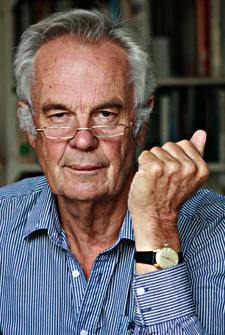
Japan and the world community

By Johan Galtung

From Osaka, Kyoto

Japan could have been a leading world power today.

Not a 19th century colonial-imperial-military power, but a peace power like Switzerland, only much bigger. If its political leaders had embraced the peace constitution with Article 9 – finally nominated for the Nobel Peace Prize – depriving Japan of the right to war with the same enthusiasm of its population. A recent public opinion poll showed 2/3, 63%-64% opposing collective defense as well as revision of A9.

It is not that A9 – which is against war, not for peace – is perfect. Betrayed by politicians “interpreting” and used as a comfortable sleeping pillow by the peace movement people, two solid pillars should have been added, like defensive defense and positive peace.Read More »

The New World Order?

By Richard Falk

There is no more reliable guardian of entrenched conventional wisdom than The Economist. And so when its cover proclaims ‘the new world order,’ and removes any ambiguity from its intentions, by its portrayal of Putin as a shirtless tank commander with menacing features.

No such iconography accompanied the last notable invocation of the phrase ‘new world order’ by George H. W. Bush in mobilizing support for a forcible response to the Iraqi invasion and annexation of Kuwait in 1990, the dirty work of Saddam Hussein. Read More »

America – a failed state?

By Johan Galtung

Depends, of course, on the criteria. A state has an inside towards its citizens, and an outside toward the state system. Depends on domestic and foreign policy, in other words. That means it can fail in two ways, by not catering to its citizens and by not coming to terms with other states. Actually the two are closely related as often pointed out: a regime (running the state) may compensate for failure at home by victories abroad. And, conversely, compensate for failures abroad by taking good care of its citizens. And, success at home used to mobilize grateful citizens for patriotic wars abroad.

America, or the USA rather, at present does not take good care of its citizens. A recent study cited in Nation of Change, More Evidence That Half of America Is in or Near Poverty, 24 March 2014, by Paul Buchheit: The Center on Budget and Policy Priorities estimates that an average family of three needs $48,000 to meet basic needs, very close to the median family household income of $51,000. Since the 1950s the food costs have doubled, housing costs tripled, medical costs are six times higher, and college tuition eleven times–four key basic needs. Food, housing, health care, child care, transportation and taxes consume very close to the median income–not counting college education–hence, “half of America is in or near poverty”.

And that bottom half of the US population own only 1.1% of the nation’s wealth – the same as the 30 richest Americans – with s=zero wealth for the bottom 47%. Nothing to fall back upon. Safety net measures such as Medicare and Medicaid, food stamps, public housing and soup kitchens help. But many are not able to benefit from them and they are all threatened politically.

Add the risk to security through suicide-homicide-accidents; a major cause being the handguns, easily available. Add the decreasing retirement benefits to many due to the losses through speculation. And black families suffer worst, including income decline.

All of this makes the major source of identity, the American Dream, once accessible to so many from far and nearby, wither away. However, how about the land of the free, the free country? Of freedom of speech there is plenty as long as nobody, except NSA, listens. Of economic freedom to use money to make more money there is also plenty, for those who have money. Result: a muzzled society of inequity.

Then the foreign policy. With close to 250 interventions abroad since Thomas Jefferson, the amount of hatred in search of violent revenge – blowback, “unintended consequences” – must be considerable. “We have never been so safe”, some say today, due to the “war on terrorism” and NSA spying at home and abroad. But revenge can find its new and very creative ways, as it did on 9/11. US foreign policy has put Americans at considerable risk at home and abroad when traveling.

Recently that belligerent foreign policy has also been remarkably unintelligent. Within a decade the USA has managed to deliver Iraq to its shia majority–Iran’s dream come true thanks to Bush Jr–and Libya and soon, probably, Syria to Al Qaeda, a sunni Arab movement–thanks to Obama. And Afghanistan to status quo, thanks to both.

We have been here before. Big Powers treating citizens well, mobilizing them for warfare, first successfully, then sliding downhill losing wars and citizen satisfaction. Names not to general US liking come up: France under Napoléon, Germany under Hitler. A book just came out by a former French prime minister, Leonel Jospin, Le mal napoleonéen, the napoleonic evil. In the beginning he solidified the Revolution with great benefits for people, did much to reconcile the two parts of France; the civil code. Then came an authoritarian and corrupt phase (“Napoléon, Quel Désastre!”, Le Nouvel Observateur, 6 March 2014, p. 91), then the empire, crowning himself in 1804, brilliant battles (see Paris metro stations)–and then Waterloo in 1815. The End.

And after that, a France stumbling from one crisis to the next.

Under Hitler ordinary Germans came to life with jobs, identities and freedoms that families lower down had never enjoyed; easily mobilized, with Kriegsbegeisterung, to restore Germany’s place in the world. Brilliant battles; like Napoléon, he tried to beat, losing in The End.

The three cases share one important factor: neither Hitler, nor Napoléon, nor the USA knew when to stop expanding, but followed the script to the end. Hitler could have stopped in 1940, not attacking Russia; Napoléon in 1807 after his successful battles; the USA in 1945, coming to an understanding with Russia rather than Churchill.

Russia. Russia survived Napoléon and Hitler, occupying both capitals after tremendous losses. Right now, if Putin knows where to stop, Russia will survive the USA too. Occupy Washington? Maybe not.

What that very same Washington could do instead is very obvious but not so easy given the many at the top of the USA who want both more belligerence and more inequity, without brakes and reverse gear.

Stop warfare, organize peace conferences with all parties, also those indeed not to Washington’s liking, understand what they want, search for a new order meeting all legitimate goals–including those of the USA–reasonably well. Open for reconciliation by acknowledging mistakes, open for some compensation. Lift the bottom of US society up, starting with the poorest of the poor; stop speculation–the twin brother of warfare–,reverse basic needs costs by having more people growing their food in cooperatives, public housing. Learn public health from Western Europe; make college inexpensive all over by inviting retired experienced professors to teach. So simple, but running against a stonewall of entrenched ideology. USA as its own worst enemy.

America a failed state? No doubt about it, like Napoléon’s France and Hitler’s Germany. Read More »

China and the US compete at sea

By Jonathan Power

Beijing, April 1st 2014

Both Russia and China feel themselves under threat from the US – and their people are clearly behind their governments on this.

Not without reason. Nato has pushed itself up to Russia’s borders. China feels encircled by US naval deployments armed with nuclear weapons in the East China and South China seas together with the US’s wide network of defence relationships with China’s neighbours. If it came to war the US could incinerate many Chinese cities before China realized it was under attack and could launch its own modest armoury of nuclear missiles.

China may be a capitalist state now but many of its views are still hostage to old time Marxist views which leads many to think that the West seeks to exploit the rest of the world. This leads them to conclude that as China rises the US will feel compelled to resist- ironically a conclusion which many conservative Western analysts share.

The balance of power is beginning to shift in China’s favour. It has been able to redeploy forces, once in the north aimed at Russia, to other parts of China. It is increasing its defence budget rapidly, albeit from a low base. However, it spends only 2% of its national income on defence as against the US’s 4.7% and its spending is only one fifth of America’s.Read More »

The obsolescence of ideology: Debating Syria and Ukraine

By Richard Falk

I have been struck by the unhelpfulness of ideology to my own efforts to think through the complexities of recommended or preferred policy in relation to Syria, and more recently, the Ukraine. There is no obvious posture to be struck by referencing a ‘left’ or ‘right’ identity. A convincing policy proposal depends on sensitivity to context and the particulars of the conflict.

To insist that the left/right distinction obscures more than it reveals is not the end of the story. To contend that ideology is unhelpful as a guide for action is not the same as saying that it is irrelevant to the public debate. In the American context, to be on the left generally implies an anti-interventionist stance, while being on the right is usually associated with being pro-interventionist. Yet, these first approximations can be misleading, even ideologically. Liberals, who are deliberately and consigned to the left by the mainstream media, often favor intervention if the rationale for military force is primarily humanitarian.

Likewise, the neocon right is often opposed to intervention if it is not persuasively justified on the basis of strategic interests, which could include promoting ideological affinities. The neocon leitmotif is global leadership via military strength, force projection, friends and enemies, and the assertion and enforcement of red lines. When Obama failed to bomb Syria in 2013 after earlier declaring that the use of chemical weapons by the Assad regime was for him a red line this supposedly undermined the credibility of American power.

My point is that ideology remains a helpful predictor of how people line up with respect to controversial uses of force, although relying on ideology is a lazy way to think if the purpose is to decide on the best course of action to take, which requires a sensitivity to the concrete realities of a particular situation. Such an analysis depends on context, and may include acknowledging the difficulties of intervention, and the moral unacceptability of nonintervention. Read More »

Far from good enough, Mr. Putin !

By Johan Galtung

History matters, not only law; like how Crimea and Abkhazia-South Ossetia–basically Russian-Orthodox–became Ukrainian-Georgian. Two Soviet dictators, Khrushchev and Stalin, attached to Ukraine and Georgia, so decided, by dictate. The local people were not asked, nor were Hawaiians when the USA annexed their Kingdom in 1898–by dictate.

The first referendum in Crimea was held last Sunday, 16 March 2014: an overwhelming No to Ukraine and Yes to the Russian federation.

Khrushchev’s 1954 transfer of Crimea was within the Soviet Union, and under Red Army control. But the Soviet Union collapsed and the Red Army became the Russian army; the conditions were no longer valid. George W. Bush wanted Ukraine and Georgia to become NATO members, moving the Russian minorities two steps away from Russia. Nothing similar applies to the other Russian minorities in the former Soviet republics. They are people living on somebody else’s land, not people living on their own land.

What happened to Crimea was a correction of what had become a basic mistake. Although Russia moving into eastern Ukraine could be–as the West says–invasion-occupation-annexation. But highly unlikely.

Unless civil war breaks out between Ukraine West and East and the Russian minority in the East–Donetsk–is in danger. Russia will not stand by watching, just as NATO would not if something similar happened close to the Polish border in Lvov.

This simply must not happen; nevertheless it is getting close.Read More »

Putin and his Crimea speech

By Jonathan Power

March 25th 2014

President Vladimir Putin’s speech to both houses of the Russian parliament last week got bad notices. Anne Applebaum, the experienced Russian-watcher, wrote in her column in the Washington Post that it was “an imperial rant” and went on to say that “Nato should moves its forces from Germany to the alliance’s eastern borders”. Most Western governments also gave their own misleading interpretations of Putin’s speech.

In this column I’m not going to defend Putin up and down the hill. I profoundly reject the way the absorption of Crimea into Russia was carried out. One can’t mount a referendum on an issue as important as this with two weeks’ notice – the Scots have been discussing their planned referendum, set for later this year, for years.

Moreover, this referendum only had two questions: whether the voters wanted to go back to Russia or whether they wanted increased autonomy. It didn’t ask if voters wanted to remain part of Ukraine.Read More »

TFF PressInfo: The manufactured story about Iran’s nuclear program

By Farhang Jahanpour

As Iran and the world powers resume nuclear talks in Vienna with the hope of reaching a comprehensive agreement over Iran’s nuclear program by mid-July, the Israelis and their lobbyists in Washington are intensifying their efforts to scuttle the talks. In addition to all the efforts in the US Congress to impose additional sanctions on Iran, thus bringing the talks to a premature end, there are indications that Israel and her friends are continuing with various acts of sabotage against Iranian nuclear facilities.

In 2010, the so-called Stuxnet virus temporarily disrupted the operation of thousands of Iranian centrifuges. At least five Iranian nuclear scientists have been assassinated. Iran has also said that it has discovered tiny timed explosives planted on centrifuges but has disabled them before they could go off. On Monday 17 March 2014, Iran said that an alleged attempt to sabotage one of its nuclear facilities had involved foreign intelligence agencies that had tampered with imported pumps. However, in addition to all those acts of sabotage, there seems to be an intensive effort to manufacture a crisis by means of false intelligence.

Prior to the devastating Iraq war that destroyed the country and killed upwards of half a million people, not to say anything of thousands of Coalition forces who were killed and the two trillion dollars that was spent, a number of neocons bent on the invasion of Iraq manufactured various false reports in order to mislead the public and pave the way for the war.

On September 8, 2002, Michael R. Gordon and Judith Miller published a story in the New York Times that openly alleged that Saddam Hussein had intensified his quest for a nuclear bomb. They wrote: “In the last 14 months, Iraq has sought to buy thousands of specially designed aluminum tubes, which American officials believe were intended as components of centrifuges to enrich uranium… Bush administration officials say the quest for thousands of high-strength aluminum tubes is one of several signs that Mr. Hussein is seeking to revamp and accelerate Iraq’s nuclear weapons program.”

The unsuspecting public was misled by that false intelligence and the result was one of the longest and most disastrous wars in US history.

How the manufactured crisis was manufactured

In his latest groundbreaking book, entitled A Manufactured Crisis: The Untold Story of Iran Nuclear Scare, the historian and investigative journalist Gareth Porter catalogs a long list of false reports manufactured by Israeli intelligence agencies in order to mislead the public and pave the way for a war against Iran. (1)

Read More »

Ukraine, Crimea, Georgia: The West and Russia

By Johan Galtung

This article was also published and sent out as TFF PressInfo in March 2014

There is much in a name. Ukraine means borderland.

The position of the extreme West–like US neocons–is clear: get all into NATO, encircling, containing, defeating Russia. Some in Ukraine and Georgia share that goal. The less extreme West would focus on EU membership, both being European countries. Some of them, in turn, might focus on loans as there is much money to be made. Thus, Bosnia-Hercegovina had $9 billion debt before the EU take-over as “high authority”; now $107 billion. “Austerity” around the corner.

The position of Russia as expressed by Putin and Lavrov: no way. Crimea will revert to Russia after it was given to Ukraine in 1954 by Khrushchev–himself born in Kalinovka, Ukraine in 1894, his wife a Ukrainian–possibly mainly for economic reasons as his son at Brown University R.I., USA argues.

However, Ukraine is not only a borderland but also two countries between Poland and Russia. The Polish-Lithuanian Commonwealth of 1569 and the Austria-Hungarian Empire once covered most of Ukraine; so did czarist Russia and Soviet Union in their heydays. More importantly, the dividing line of the Roman Empire from 395, confirmed by the schism between Catholic and Orthodox Christianity in 1054, is reflected in Ukraine’s extremely complex history. The result is unmistakable: moving east the Catholic attachment yield to the Orthodox and Ukrainian to Russian. When Poland became a member of EU and even of NATO, the handwriting for Ukraine was on the wall; bringing to mind Polish First Marshal Pilsudski’s Odessa-Black Sea ambitions after WW-I.Read More »

Terrorists with nuclear weapons?

By Jonathan Power

US aviation authorities banned the carrying of toothpaste on planes heading to the Sochi Winter Olympics for fear they might contain a deadly explosive. Apparently such is the creativity of the modern terrorist.

Other departments of the US government rather more seriously worry about the transfer of nuclear materials to a terrorist group fit for an improvised “dirty bomb” (where explosives are wrapped with radiological materials) capable of bringing panic to a city, although it would only destroy not more than a block. Some go further and fear a small nuclear bomb could be smuggled in.Read More »