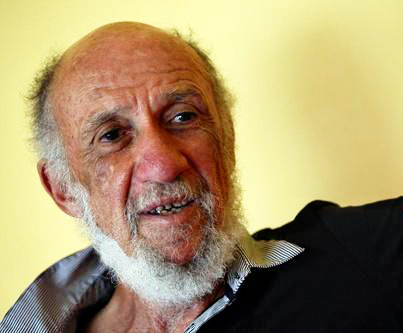
About (pre-)Fascism: Israeli and US style

By Richard Falk

Recently I participated in a conference on global inequality and human rights held at the University of Texas in Austin, a lively quite cosmopolitan city. During the lunch break I was talking with a young PhD student from Israel who had just presented an informative paper on inequality in the Philippines. I asked her about her career plans and how it was like to be living in Israel these days. She told me that she was married to an Israeli and planned to return to finish her studies in Tel Aviv after a fellowship year at UT.

I tried to engage her in conversation about evolving Israeli attitudes toward the Palestinians and the related failed diplomacy, but she seemed rather uninformed and perhaps even disinterested as if the peace agenda was not really present in her active consciousness. Then all at once she said something that surprised me. “I am not looking forward to returning to Israel, it is becoming a fascist state.”

What made this strong statement surprising was that it contrasted with the blandness of everything that had preceded it. I asked inquisitively, neither agreeing nor disagreeing, “What makes you say that?”

She pondered the question as if it had come to her from the wild blue yonder. It seemed as if she had never thought about it before, and maybe it was just a spontaneous assertion that she was articulating for the first time. After a pause, she answered somewhat hesitantly: “Because the army is the most powerful and admired institution in Israel, and the government controls everything, it is acting as a totalizing force.”

I suppose that gets you to Franco-style fascism that prevailed for so long in Spain, but not the more virulent forms of fascism associated with Mussolini’s Italy and especially Hitler’s Germany.

I agreed with the young woman about the hegemony of the armed forces, both institutionally and psychologically, but I was less sure about the totalizing reach of the government. Read More »

TFF PressInfo # 372: Drop the Just War theory and abolish nuclear weapons!

By Mairead Maguire

Press Release 19th April, 2016

Nobel Peace Laureate, Mairead Maguire, co-founder of The Peace People and TFF Associate, says from Rome:

“I believe we are at an important and hopeful turning point in human history – from violence to nonviolence and from war to peace”

Laity and religious meeting in Rome appeal to Pope Francis to share with the world an encyclical on nonviolence and just peace and for the church to no longer use or teach ‘Just War theory’

It was a joy for me to join eighty people from around the world meeting in Rome 11-12th April, 2016, to contribute to the important discussion ‘Nonviolence and Just Peace Contributing to the Catholic Understanding of and Commitment to Nonviolence’.

Members of the three day event co-hosted by the Pontifical Council for Justice and Peace and the International Catholic Peace Movement Organization, Pax Christi, strongly called on Pope Francis ‘to share with the world an encyclical on nonviolence and Just Peace; and on the Church to ‘no longer use or teach ‘just war theory’; and continue advocating for the abolition of war and nuclear weapons’.

The statement of Appeal to the Pope also said:

‘We believe there is no ‘just war’. Too often the ‘just war theory’ has been used to endorse rather than prevent or limit war. Suggesting that a ‘just war’ is possible also undermines the moral imperative to develop tools and capacities for nonviolent transformation of conflict’.

The gathering in Rome consisted of lay people, theologians, members of religious congregations, priests and bishops from Africa, the Americas, Asia, Europe, the Middle East, and Oceania and the welcoming address was given by Cardinal Turkson of the Pontifical Council for Justice and Peace, who read a Statement from Pope Francis.

The Final Statement Read More »

Review of “The Need for a New Economic System”

Review of John Avery’s book by Dorothy Guyot

A Scientist Presses for Action on Many Fronts: A review of the book

The Need for a New Economic System
By John Scales Avery
Selected Works Volume 1, 291 pages
Irene Publishing
Sparsnäs, Sweden 2015

The Need for a New Economic System by John Scales Avery is an important book for everyone concerned over the future of humanity. The urgent voice of the book stems from Dr. Avery’s seeing the discontinuity between the loving care that people bestow on their children and their failure to reduce the harm to their children from a destructive economic system, climate change, resource depletion, and war.

This book of advocacy demonstrates the need for solutions to problems created under the present economic system. Political-economic analyses of the causes of the problems and of solutions are outside of the scope of the book. Scattered through the book are a few general policy suggestions. At the center is Avery’s assessment sector by sector of the critical problems that must be solved to avert disasters.

The book first demonstrates the impossibility of sustaining growth economies on our finite planet. The central three chapters analyze the damage from climate change and war. Globalization, population growth, and the food crisis are the last problems Avery analyzes.

He builds toward his conclusions by sketching the nineteenth century cooperative movement and Gandhian economics. The concluding chapter revisits the problems to advocate change.

The premise of the book is that when people face up to the extent and nature of world problems, people can act creatively and effectively.

John Avery is thinker and writer. Read More »

John Avery’s CV

John Scales Avery

John Scales Avery received a B.Sc. in theoretical physics from MIT and an M.Sc. from the University of Chicago. He later studied theoretical chemistry at the University of London, and was awarded a Ph.D. there in 1965.

He is now Lektor Emeritus, Associate Professor, at the Department of Chemistry, University of Copenhagen.

Fellowships, memberships in societies
Since 1990 he has been the Contact Person in Denmark for Pugwash Conferences on Science and World Affairs. Member of the Danish Peace Commission of 1998. Technical Advisor, World Health Organization, Regional Office for Europe (1988- 1997). Chairman of the Danish Peace Academy, April 2004-.

You’ll find a lot about this eminent scholar at Wikipedia. Avery is also a leading peace researcher and activist – “Since 1990, Avery has been the Contact Person for Denmark the Pugwash Conferences on Science and World Affairs. In 1995, Avery was part of a group that shared in the Nobel Peace Prize for their work in the 1990s in organizing the Pugwash Conferences on Science and World Affairs.

In 1998, Avery was elected to the Danish Peace Commission. During the years 1988-97, Avery was the Technical Advisor at the World Health Organization, Regional Office for Europe. In 2004, Avery became the Chairman of the Danish Peace Academy.

In his usual humble and plain style John tells the story of his life – his personal life, his scholarly life and his peace life – here.

Publications
Dr. Avery seems to have ben writing day and night throughout his life – here is his amazing list of books, chapters and articles on world affairs.

In early 2016, Irene Publishing – run by TFF Associates Jørgen Johansen and Majken Jul Sørensen – published Avery’s Collected Essays as well as The Need For A New Economic System.

John joined TFF as TFF Associate in March 2016.

How ought we treat each other?

By Johan Galtung

Upon receiving the Gandhi-King-Ikeda Community Builder Prize

Atlanta, 31 Mar 2016

Dear President, dear Dean of Morehouse College, Ladies and Gentlemen,

I am deeply honored by the prize from a college in Georgia, in the US South, that has been and is a beacon in the struggle from dominion to dignity in race relations. The civil rights movement is an American Revolution, like the feminist movement it inspired–aiming at parity and dignity for all. To refuse sharing the spoils of exploiting Reds and Blacks and poor Whites with London was far from a revolution.

This college shaped Dr Martin Luther King Jr. I had the honor of meeting him twice here in Atlanta in 1960–working on desegregation without violence in Charlottesville, VA–and in 1964 in Oslo when he received the Nobel Peace Prize. This College made him use Gandhi’s clinging to truth through nonviolent struggle, satyagraha, lifting 20 million Blacks into dignity. There is a backlash: Blacks are again shot at, and used as slave labor in prisons. The struggle continues.

Building communities. There are at least two of them, the community of people, and the community of states. I will deal with both and share with you in this speech the basic ideas of TRANSCEND mediation – an NGO of more than 500 invited members, comfortable with our mantra, “Peace by Peaceful Means”. Transcend means going beyond.

Let us approach answering the question through some words on how we ought not treat each other.

It is all in our thought habits, the deep culture of our thinking. In the West we think in simple dichotomies, like positive/negative, good/bad, even evil. Either one or the other, not in-between, neither-nor, both-and. And we very easily fall into the trap of seeing ourselves as only good, and someone else as only bad, steered by God or Satan. The road to narcissism, self-love and paranoia, seeing threats everywhere, is short. Victory! not solution.

AND Narcissism + Paranoia = Psychosis, the psychiatric diagnosis.

To escape from this thought habit use ancient Chinese habits. Yin/Yang. They also think positive/negative, good/bad; but add more levels, like the positive and negative in the positive and negative, the good and bad in the good and bad. That opens for identifying the negative in Self and the positive in Other; for positive-peaceful, not negative-violent relations. Not either-or; but both-and, neither-nor.

The TRANSCEND formula: focus on the positive, good in everybody including yourself; but keep the negative, bad in the back of the mind to improve it and as possible danger, to Self and-or Other.

Then create projects linking good with good; first as vision, then reality.Read More »

Boko Haram in Nigeria

By Jonathan Power

If there is one man in Africa who combines kindness, authoritarianism of right and rationed proportions with nevertheless a deep commitment to democracy, business proficiency learnt on his now large-scale farms, political nous that outsmarts all competitors, a demanding Christian belief, honed while he was in prison for 3 years under the military dictatorship and a not overdone portion of charisma, it is Olusegun Obasanjo, the man who returned Nigeria, Africa’s most populated country and largest economy, to democracy twice and was himself the elected president for 8 years from 1999 to 2007.

No wonder a majority of Nigerians consider the Obasanjo years as the best in Nigeria’s history.

I have to say in my 40 years of being a writer on foreign affairs and interviewing over 60 heads of government he is the one who has impressed me the most, for sheer brainpower, idealism and wisdom.

Boko Haram, the Islamic fundamentalist group who has terrified the poor northern part of Nigeria – and are believed to have close contact with ISIS – came on to the scene after Obasanjo was out of office. Still, he has been very much in touch with the situation and twice, at least, tried to arbitrate between the movement and the government. This is what he had to say to me recently about the situation:

“Boko Haram is not simply a menace based on religion or one directed to frustrate anybody’s political ambition. It is essentially a socio-economic problemRead More »

TFF PressInfo # 367: Will the EU become a criminal union tomorrow?

By Jan Oberg

The EUropean Union – a criminal? The EU that has peace as it’s top goal and received Nobel’s Peace Prize? The EU with Schengen and Dublin? The EU with “European” values, humanism and mission civilisatrice that tells others how to live in accordance with international law and in respect for human rights?

We live in times where little shall surprise us anymore. The answer to the question – will EU become a criminal in international law terms? – will be answered on March 17 and 18 when the EU Council meets to decide whether or not to carry through the agreement with Turkey about how to handle refugees.

Amnesty International knows what it is all about. AI uses words such as “alarmingly shortsighted”, “inhumane”, “dehumanising”, “moral and legally flawed” and “EU and Turkish leaders have today sunk to a new low, effectively horse trading away the rights and dignity of some of the world’s most vulnerable people.”

And “By no stretch of imagination can Turkey be considered a ‘safe third country’ that the EU can cosily outsource its obligations to,” says Iverna McGowan, Head of Amnesty International’s European Institutions Office.

When Amnesty International expresses itself this way, we should listen very very carefully. I do and I’ve signed Amnesty’s Open Letter to Swedish prime minister Löfvén protesting that Sweden too may join this inhuman and law-violating agreement with Turkey. Hurry up, it is tomorrow!

Behind every refugee stands an arms trade, stands militarism. Read More »

TFF PressInfo # 363: Can we give meaning to the destruction of Syria?

By Jan Oberg

Five years ago

In 2011 when it all began, an educated conflict analyst or otherwise conflict competent person would have said about the conflict in Syria that it was a very complex thing, caused by history, environment, traumas, external factors, the economic situation, etc. And that al-Assad and his government was certainly an important reason but far from the only one.

The conflict expert would have warned against at last four ways of thinking:

a) any interpretation that put all the good people on one side and all the bad people on the other – because there are no conflicts in the world with only two such parties;

b) any idea that the conflict could be solved by siding with the presumed good ones and going against the bad one(s);

c) every attempt to ‘weaponise’ the conflict and increase the level of violence, the duration of the conflict and the human suffering;

d) any and every idea that foreigners would know better than the Syrians themselves – government, opposition and citizens in civil society – what should be a solution.


Finally – the professional conflict and peace worker would have maintained that you can’t make peace by asking one person – not even brilliant ones like Kofi Annan or Staffan di Mistura – with a small team around him and some shuttle diplomacy to succeed with facilitation, consultations, brainstorming, proposal-making, mediation and, finally, some kind of negotiations leading to a peace agreement in what is undoubtedly one of the most complex and ‘hard’ conflicts on earth.

Peace-making requires a completely different approach to not just be a pawn in the wider war game – a game that according to Al-Jazeera today encompasses some 900 military groups – add to that government forces and all the political and civil groups that don’t carry weapons: 1500?

Five years later – at least 250.000 dead people, 3 million refugees and 6,5 million internally displaced people, cities, economy, cultural heritage destroyed – anyone can see that no one listened to such simple conflict rules of thumb.

Conflict and peace illiteracy

The self-appointed and completely un-educated, peace-makers of the international community – presidents, prime and foreign ministers of the US, NATO, Russia, etc. – did about everything else.

It seems to not even occur to them or to the media that Read More »

Human Rights – A permanent challenge

By Johan Galtung

Concluding Remarks, Colloque, Université Catholique Lyon, 5-6 Feb 2016

The Universal Declaration of Human Rights of 10 December 1948 – the two Conventions of 16 November 1966 are international law – was edited by a committee of Men; Older, White, Bourgeois, Lawyers, French: MOWBLF!

Nothing about women’s and children’s rights; wait till the 1980s.

The perspective focuses on individuals, not collectives, peoples.

There are no rights to access to toilet, nor to sexuality: well-mannered bourgeois do such things but do not talk or write about it. Art. 27.2 even protects remuneration for professionals like themselves.

The “human rights=legal claims” discourse defines underdog goals but is silent on topdog goals: status quo. Their justification: “If they rise, they will treat us the way we treated them”. Revenge. In a conflict discourse, all parties have to be heard, for solutions.

But the legal discourse is DMA–Dualist-Manichean-Armageddon; two parties, rights vs wrongs, final battle in the Supreme Court. No accommodation to legitimate concerns of the losing side. The winner takes all.

And they were French. What does, or did, that mean? Read More »

Time for an original US foreign policy

By Jonathan Power

There are three schools of thought in American foreign policy- two you have heard about and a third that is relegated to the background.

The first and arguably the most prominent is the neo-conservative.

These people, in the days of the Soviet Union, were the rabid anti-communists who wanted to beat the Soviet Union into the ground with vastly increased spending on defence. Today they are the ones who supported the extreme right wing agitators who overthrew the middle-of-the-road president of Ukraine, Wiktor Yanukovich. They supported President George Bush’s wars in Iraq and Afghanistan and want President Barack Obama to intervene in Syria.

The second is the liberal.

Liberals have always wanted to seek nuclear arms limitations with Moscow. They wanted an end to apartheid in South Africa. But many of them also believe in directly interfering in a country that is carrying out inhumane policies. They persuaded President Barack Obama to intervene in Libya’s civil war which left a political mess that has become a haven for ISIS. Some of them have argued for intervention in Syria’s civil war. They also, in tandem with the neo-conservatives, successfully persuaded Obama to pursue an anti-Russian policy in Ukraine.

Then, third, there are the “realists”.

People like the late greats: George Kennan, Hans Morgenthau, Reinhold Niebuhr and Walter Lippmann. In many ways Obama is a realist, although not consistently. He has succumbed to both liberal and neo-conservative advice.

The realists don’t get much airtime. Their advice is usually pushed aside Read More »
