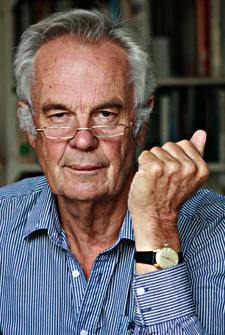
At the UN – Two empires crumbling: U.S. and Israel

By Johan Galtung

There is History in the UN 29 November 2012 vote: 138 YES to giving Palestine the UN status as “nonmember observer state”, only 9 NO, and 41 abstentions. Beyond Middle East politics the vote also mirrors the limits to the US global, and the Israeli regional, empires: 138 defy their grip and favor change, 41+9=50 do not, for various reasons. A crucial vote on a crucial issue is a crucial test. Who wants what?Read More »

Cultivating peace, preventing violence

By Johan Galtung

… was the title of the Symposium at Virginia Tech in Blacksburg, Virginia-USA 17-19 Nov 2012. An example of the blossoming wave of peace studies all over the US; inter-disciplinary and international. Most papers were given by very promising students on most aspects of peace studies. It is inconceivable that this will not have a major impact on US foreign policy in a generation or so, particularly with the demographic shift from the WASP (White Anglo-Saxon Protestant) males voting Romney to the negations of all of that, including Blacks, Latins and women voting Obama. And with that shift the idea of a Chosen People with a Promised Land and a Covenant with the Almighty making them exceptional and indispensable, above the law of ordinary states, will slowly die.Read More »

Sociocide, Palestine and Israel

By Johan Galtung

Testimony for Russell Tribunal on Palestine – New York City, 7 Oct 2012

Honorable Members of the Jury!

Sociocide is a new concept that has not found its place in positive international law. But Genocide, the unspeakable crime of massive killing of members of a genus, a nation, for no other reason than membership, has. And Ecocide, the unspeakable crime of killing Mother Earth who nourishes us all, is finding its place via the constitutions of some countries in Latin America.

Sociocide, the killing of a society’s capacity to survive and to reproduce itself, should become equally and prominently a crime against humanity.Read More »

SABONA – from the Kindergarten to world politics

By Johan Galtung

Kongsvinger is a small town in Eastern Norway, close to Sweden, with a small dedicated group working in kindergartens, elementary and more advanced schools to convey conflict and social skills to children from one to twelve years old. Recently they presented their experiences for a very grateful audience of children, teachers and parents.

Enters a teddy-bear, a key ‘person’. Child 1 grabs the bear and beats Child 2 shouting, “He is mine!” The teacher reports: “Of course I could scold, saying beating is not allowed. But that is not good enough.” So I said, “He is neither his nor yours, but the kindergarten’s. You wanted to hug him? OK, but no beating. You could have asked”.Read More »

Sustaining peace after war

By Jonathan Power

When it comes to creating a peace in Afghanistan sufficient for the US and NATO to pull their troops out with some degree of confidence in the country’s future stability history offers conflicting lessons.

The mantra is that war-shattered states must be guided into a liberal democracy and a market-orientated economic system.

Yet there is much evidence that the process of political and economic liberalization can sometimes do more harm than good in states that have just emerged from civil war. Liberalization doesn’t always foster peace. Both democracy and capitalism are built on a paradox – the notion that societal competition can limit inter-communal competition and dampen conflict.Read More »

Conspiracies: Theories and hypotheses

By Johan Galtung

Conspiracies exist. They are a part of social reality, have always been, and will always be; as confirmed conspiracy theories, as unconfirmed conspiracy hypotheses, as suspicions, as allegations.

As usually conceived of, conspiracies involve several persons or actors; the plan of action is kept secret or at least not made public, except afterwards if it is successful. Conspiracies are about power[i] – economic-cultural-political-military — and are usually negative for somebody.

Let us start by criticizing this definition.Read More »

Ten Years of AKP Leadership in Turkey

By Richard Falk

Nothing better epitomizes the great political changes in Turkey over the course of the last decade than a seemingly minor media item reporting that Prime Minister Recep Tayyip Erdogan and his wife Emine Erdogan attended a private iftar dinner (the ritual meal breaking the Ramadan fast each evening) by the invitation of the current Turkish Chief of Staff, General Necdet Özel, at his official residence. It was only a few years earlier that the military leadership came hair trigger close to pulling off a coup to get rid of the AKP leadership. Of course, such a military intrusion on Turkish political life would have been nothing new. Turkey experienced a series of coups during its republican life that started in 1923.

The most recent example of interference by the military with the elected leadership in Turkey took place in 1997 when Prime Minister Necmettin Erbakan sheepishly left office under pressure amounting to an ultimatum, outlawed his political party, and accepted a withdrawal from political activity for a period of five years in what amounted to a bloodless coup prompted by his alleged Islamic agenda. Unlike the prior coups of 1960, 1971, and 1980 when the military seized power for a period of time, the 1997 bloodless coup was followed by allowing politicians to form a new civilian government. Really, looking back on the period shortly after the AKP came to power in 2002 the big surprise is that a coup did not occur. Read More »

Understanding the global threat against sacred spaces

Chaiwat Satha-Anand, TFF Associate
Chairperson, Strategic Nonviolence Commisssion, Thailand Research Fund
Senior Research Fellow, TODA Institute of Global Peace and Policy Research

On August 6, 2012, the neo-Nazi Wade Michael Page walked into the gurudwara (Sikh temple) of Wisconsin in Oak Creek and murdered 6 people including the temple president. He was killed by the police in the incident.

While the Sikhs in the US had suffered from discrimination since they started coming to the United States in the early 20th century: they were driven out of Bellingham, Washington, in 1907; and out of St. John, Oregon in 1910, this most recent Oak Creek killing sparked global outcries from Washington DC to New Delhi. In India, members of Sikh communities staged protest demonstrations in several cities including New Delhi and Jammu, Kashmir.
There are many ways to understand this abominable incident. Read More »

Fighting with non-violence

By Scilla Elworthy
From April 2012

I’m very pleased to have TFF Associate Scilla Elworthy speak to you here. She’s been a dear friend and colleague since 1987 and doesn’t need any introduction except perhaps: Here comes wise, soft-spoken Scilla in a formidably powerful way: Attack the problem to be solved, never attack the people. Scilla’s way of doing it is in the true spirit of Gandhi’s advise: Be the change you want to see!
The power of non-violence is concrete, visible, it is there to be employed.
And so, there is hope!

– Jan Oberg

http://video.ted.com/assets/player/swf/EmbedPlayer.swf