TFF PressInfo # 367: Will the EU become a criminal union tomorrow?

By Jan Oberg

The EUropean Union – a criminal? The EU that has peace as it’s top goal and received Nobel’s Peace Prize? The EU with Schengen and Dublin? The EU with “European” values, humanism and mission civilisatrice that tells others how to live in accordance with international law and in respect for human rights?

We live in times where little shall surprise us anymore. The answer to the question – will EU become a criminal in international law terms? – will be answered on March 17 and 18 when the EU Council meets to decide whether or not to carry through the agreement with Turkey about how to handle refugees.

Amnesty International knows what it is all about. AI uses words such as “alarmingly shortsighted”, “inhumane”, “dehumanising”, “moral and legally flawed” and “EU and Turkish leaders have today sunk to a new low, effectively horse trading away the rights and dignity of some of the world’s most vulnerable people.”

And “By no stretch of imagination can Turkey be considered a ‘safe third country’ that the EU can cosily outsource its obligations to,” says Iverna McGowan, Head of Amnesty International’s European Institutions Office.

When Amnesty International expresses itself this way, we should listen very very carefully. I do and I’ve signed Amnesty’s Open Letter to Swedish prime minister Löfvén protesting that Sweden too may join this inhuman and law-violating agreement with Turkey. Hurry up, it is tomorrow!

Behind every refugee stands an arms trade, stands militarism. Read More »

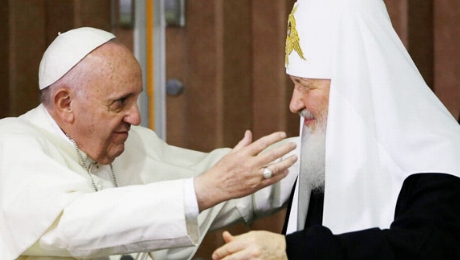
A pope, a patriarch, a spiritual revolution

By Johan Galtung

The first editorial here at Transcend of March 3 2008, “50 Years of Fidel Castro” celebrated a political revolution that changed the world, and spelt the end of US-Western imperialism. This editorial celebrates a spiritual revolution that may also change the world, spelling the end of Western materialism, and spread from there.

We are talking about processes, not events, and of structures and cultures more than of actors.

Again, Cuba played a major role, as meeting place between two major parts of Christianity, Catholic and Orthodox. In the Great Schism of 1054 they had excommunicated each other; and the Roman empire had split Catholic/Orthodox in 395. Fidel’s Catholic brother and successor Raúl was a condition for this historic meeting for peace; so was the meeting between Putin–an Orthodox Christian–and Francis in June 2015. However, not many pairs of brothers rival the two Castros in shaping history.

They met, Pope Francis of the Catholic Church and Patriarch Kirill of Moscow and all Russia – after earlier meetings between popes and the patriarch of Constantinople – with a Joint Declaration on 12 Feb 2016 in 30 articles. There were 17 quotes from the Bible; showing that they are “brothers in the Christian faith”, “pained by the loss of unity”, “divided by wounds caused by old and recent conflicts”. Not from the Bible are the many references to “the Most Holy Mother of God, Virgin Mary, and the saints we venerate”. Problematic for Protestants.

The bulk of the Joint Declaration is about the fate of Christians in the Middle East, meaning mainly Orthodox; like “the Metropolitans of Aleppo, Paul and John Ibrahim, who were taken in April 2013, to make every effort to ensure their prompt liberation”. However, together they “invite our Churches in Ukraine to work towards social harmony”.

They also jointly argue strongly against abortion and euthanasia, and in favor of “respect for the dignity of the individual called into being according to the Creator’s plan”. Do not destroy God’s creation.Read More »

TFF PressInfo # 365: Denmark to attack in Syria – too

By Jan Oberg

Something is rotten in the State of Denmark and the world will increasingly see it. It’s an unpleasant combination of Islamophobia, militarism and a peculiar ethical and intellectual self-destructive obedience to US/NATO all wrapped up in a pseudo-humanitarian flag.

It’s important that intellectuals criticise the policies of their native country and not only and politically correctly criticise that of others. In the case of Danish foreign and security policy it is fairly easy to do so provided you are supported neither by that country’s state nor its corporations.

Denmark to be aggressor in Syria – too

On March 4, 2016 a large majority of Danish political parties agreed to send F16s and special forces to Syria. The decision is likely to soon be confirmed by the Danish parliament.

The most important decision any government can take is the one to go to war. But that sort of thing is now routine in H.C. Andersen’s anything but idyllic rogue state. When the Danish MPs decided that Denmark should bomb in Libya an MP told me that they did so on the basis of 1,5 A4 pages memo drafted by the Ministry of Foreign Affairs.

So here Denmark is off again, this time to Syria. It’s the 6th time – Serbia in 1999, Afghanistan 10/7 2001, Iraq occupation power 2003-2007 – under non-convicted war criminal prime minister Anders Fogh Rasmussen who was rewarded by an academic title in the U.S. and then kicked upwards to the post of NATO’s S-G and in which capacity he took responsibility (without any later regret later for that or Iraq) for the pulverisation of Libya way beyond the UN mandate; then a second time in 2014-15 in Iraq bombing against ISIS/Daesh. And now Syria.

All these wars have been exemplary political and moral fiascos – if not deliberate killing missions for strategic and naked power reasons.

In none of these conflicts has Denmark that boasts an active foreign policy taken any constructive initiatives of the type that is needed – mediation, consultation, negotiations, large-scale humanitarian aid, violence-prevention, reconciliation or presented any innovative thoughts, peace plans or similar.

In no case has it argued for a large international peace-keeping presence, e.g. UN and/or regional organisations with predominantly civilian elements. And in no case has it dared criticise U.S. foreign policy in even the mildest of words.

Denmark’s humanitarianism flies F16

Prime minister Løkke Rasmussen’s argument for aggression on Syria now Read More »

TFF PressInfo # 363: Can we give meaning to the destruction of Syria?

By Jan Oberg

Five years ago

In 2011 when it all began, an educated conflict analyst or otherwise conflict competent person would have said about the conflict in Syria that it was a very complex thing, caused by history, environment, traumas, external factors, the economic situation, etc. And that al-Assad and his government was certainly an important reason but far from the only one.

The conflict expert would have warned against at last four ways of thinking:

a) any interpretation that put all the good people on one side and all the bad people on the other – because there are no conflicts in the world with only two such parties;

b) any idea that the conflict could be solved by siding with the presumed good ones and going against the bad one(s);

c) every attempt to ‘weaponise’ the conflict and increase the level of violence, the duration of the conflict and the human suffering;

d) any and every idea that foreigners would know better than the Syrians themselves – government, opposition and citizens in civil society – what should be a solution.


Finally – the professional conflict and peace worker would have maintained that you can’t make peace by asking one person – not even brilliant ones like Kofi Annan or Staffan di Mistura – with a small team around him and some shuttle diplomacy to succeed with facilitation, consultations, brainstorming, proposal-making, mediation and, finally, some kind of negotiations leading to a peace agreement in what is undoubtedly one of the most complex and ‘hard’ conflicts on earth.

Peace-making requires a completely different approach to not just be a pawn in the wider war game – a game that according to Al-Jazeera today encompasses some 900 military groups – add to that government forces and all the political and civil groups that don’t carry weapons: 1500?

Five years later – at least 250.000 dead people, 3 million refugees and 6,5 million internally displaced people, cities, economy, cultural heritage destroyed – anyone can see that no one listened to such simple conflict rules of thumb.

Conflict and peace illiteracy

The self-appointed and completely un-educated, peace-makers of the international community – presidents, prime and foreign ministers of the US, NATO, Russia, etc. – did about everything else.

It seems to not even occur to them or to the media that Read More »

Human Rights – A permanent challenge

By Johan Galtung

Concluding Remarks, Colloque, Université Catholique Lyon, 5-6 Feb 2016

The Universal Declaration of Human Rights of 10 December 1948 – the two Conventions of 16 November 1966 are international law – was edited by a committee of Men; Older, White, Bourgeois, Lawyers, French: MOWBLF!

Nothing about women’s and children’s rights; wait till the 1980s.

The perspective focuses on individuals, not collectives, peoples.

There are no rights to access to toilet, nor to sexuality: well-mannered bourgeois do such things but do not talk or write about it. Art. 27.2 even protects remuneration for professionals like themselves.

The “human rights=legal claims” discourse defines underdog goals but is silent on topdog goals: status quo. Their justification: “If they rise, they will treat us the way we treated them”. Revenge. In a conflict discourse, all parties have to be heard, for solutions.

But the legal discourse is DMA–Dualist-Manichean-Armageddon; two parties, rights vs wrongs, final battle in the Supreme Court. No accommodation to legitimate concerns of the losing side. The winner takes all.

And they were French. What does, or did, that mean? Read More »

Time for an original US foreign policy

By Jonathan Power

There are three schools of thought in American foreign policy- two you have heard about and a third that is relegated to the background.

The first and arguably the most prominent is the neo-conservative.

These people, in the days of the Soviet Union, were the rabid anti-communists who wanted to beat the Soviet Union into the ground with vastly increased spending on defence. Today they are the ones who supported the extreme right wing agitators who overthrew the middle-of-the-road president of Ukraine, Wiktor Yanukovich. They supported President George Bush’s wars in Iraq and Afghanistan and want President Barack Obama to intervene in Syria.

The second is the liberal.

Liberals have always wanted to seek nuclear arms limitations with Moscow. They wanted an end to apartheid in South Africa. But many of them also believe in directly interfering in a country that is carrying out inhumane policies. They persuaded President Barack Obama to intervene in Libya’s civil war which left a political mess that has become a haven for ISIS. Some of them have argued for intervention in Syria’s civil war. They also, in tandem with the neo-conservatives, successfully persuaded Obama to pursue an anti-Russian policy in Ukraine.

Then, third, there are the “realists”.

People like the late greats: George Kennan, Hans Morgenthau, Reinhold Niebuhr and Walter Lippmann. In many ways Obama is a realist, although not consistently. He has succumbed to both liberal and neo-conservative advice.

The realists don’t get much airtime. Their advice is usually pushed aside Read More »

Religious Fundamentalism-Extremism-Violence

By Johan Galtung

To navigate these difficult conceptual waters we need some rules. Here are three suggestions (the violence can be direct – as sometimes prescribed by the Abrahamic religions – or structural as by Hinduism):

1. Anchor “religious fundamentalism” in religious scriptures taken literally according to the fundamentalists, not as “interpreted”;
2. Anchor “extremism” in violent action, verbal or physical;
3. Anchor “religious extremism” in violent action justified-legitimized by religious scriptures, by fundamentalists or not.

Fundamentalism has to do with inner faith, belief. Extremism has to do with outer violence against Other, and against Self (like flagellation for being a sinner). Keep them separate. And be careful.

We can have fundamentalism without extremism. The fundamentalist may believe much, beyond the beliefs of others, yet not cross the border to violence. We may say: let him-her do so; it is not obvious that fundamentalists are more violent than non-fundamentalists.

We can have extremism without fundamentalism. Most people exercising violence believe in nothing, beyond “doing their job”.

There are two criteria for “religious extremism”:Read More »

TFF PressInfo # 361: The real news about Nobel’s Peace Prize is here, and it isn’t Trump

By Jan Oberg

Lund, Sweden, February 11, 2016

Thanks to tabloidization – a concept rapidly integrated into even quality mainstream media – you’ve probably heard that Donald Trump has been nominated for the Nobel Peace Prize 2016.

Well, that prize has been thrown out to so many who didn’t qualify according Alfred Nobel’s will – not even with a very liberal interpretation.

But there are two things you may not have seen which have very far-reaching implications and are much more news worthy.

Court case against the Nobel Foundation

One is that three individuals and an NGO filed a brief to open a court case against the Nobel Foundation – and thus implicitly the Nobel Committee in Oslo – to the Stockholm District Court in December 2015 – all about it here.

It’s never happened before and is the result of 8 years of intensive research and public information that you can read about at the Nobel Peace Prize Watch – NPPW.

Its focal case is the prize awarded to the EU about which Desmond Tutu and others have stated that the EU was “obviously not one of champions of peace that Nobel had in mind.”

Open list of nominees for 2016 who do qualify

The other one is that a list has been published of 25 qualified nomineesRead More »

On NATO S-G Stoltenberg’s wish for dialogue and NATO’s 2015 report

By Jan Oberg

February 9, 2016

Commenting on NATO S-G Jens Stoltenberg’s wish for dialogue with Russia – a bit odd after all the other provocative initiatives he has spearheaded the last good year or so.

I felt like saying something more general about this outdated paradigm – and why it is dangerous for us all – referring also to the Russell-Einstein Manifesto of 1955.

You may also see it as my statement countering the NATO Annual 2015 Report which lacks every intellectualism, theoretical/conceptual clarity, empathy, peace thinking and – naively – equates military build-up with ‘security’.

Around the world: Problems and remedies

By Johan Galtung

Let us have a look, and see what can be done.

[1] Economies. NYSE is falling; China is consuming, with problems; the West blames China, not itself, for all. The truth is over-reliance on one commodity, oil-gas, hitting vulnerable economies doubly. Steep fall in price: $120-130 to $30-20, close to 1973 from $1 to $10. Steep fall in demand for that globally toxic product; a sign of rationality (but, the other globally toxic product, derivatives for speculation?) The currencies of oil-producers tumble. stocks fall; in Norway to the tune of half the state budget in three weeks (Finansavisen 21Jan 2016).

And over-reliance on trade with vulnerable economies.

Remedies: To become less vulnerable, through [1] more self-reliance nationally and locally, indeed for basic needs like food, [2] fully-fledged economies with primary-secondary-tertiary-quaternary (care for people and nature) sectors. Simple, sustainable rules.

Beyond that: import-export, but with a wide range of countries.

[2] Inequality: The Master, Atkinson’s, analysis of the catastrophic consequences, both high up and low down, is the best. Spiritual aspect is hopelessness, apathy with no project low down; high up ego-centrism devoid of solidarity as project. Sick societies. In 2010 388 persons owned as much as half of humanity, in 2014 80, end 2015 62 (Oxfam).

Remedies: Lift the bottom up, FDR New Deal, welfare states, the Chinese way. Publish the ratio CEO:workers earnings; make above 10:1 illegal, punish, boycott. More cooperatives with CEO-workers rotation.

[3] The third industrial revolution: robotization. Frankenstein’s monster is coming. Another consequence will be massive unemployment.

Remedies: Humans, sapiens-faber-ludens, are creative, productive and playful. We are all three. But we may need life-long guaranteed income for all, covering all basic needs. Humans will reconquer the production, wrestle it from unnecessary-unwanted robots, and enjoy life.

[4] Davos. There they are, those who brought us these problems. Read More »