Peace State Iceland – Meaning what?

By Johan Galtung
May 2, 2016

Dear Members of the Iceland Allthing Foreign Affairs Committee,

I have been asked to come to Iceland to answer that question; thanks indeed for inviting me to address you. And to apologize, as a Norwegian, for our occupation of Iceland 1262-1386 instead of sending mediators to help settle your civil war. Our century long colonization does not become better because Denmark colonized you five centuries, 1386-1918; and more deeply. But you are now your own, with a wonderful language and literature; right now with a problematic economy and polity.

Reykjavík has a very good name internationally as the venue of the 11-12 October 1986 summit meeting of the Cold War superpowers. The meeting of US President Ronald Reagan and the Soviet Secretary General Mikhail Gorbachev at Höfdi did not by itself end with an agreement. But it was the beginning of the end of the Cold War three years later, and as such made world history.

So why not build on that, making a Reykjavik Mediation Center, RMC, politically and internationally independent, and on Iceland’s location between West and East, USA and Russia? Look at the map.

For Reykjavík to invite USA and Russia, with Kiev and Donetsk. Maybe also Brussels, in the sense of NATO and EU. Issue: the conflict in and around Ukraine–meaning “at the border”, between two nations, Catholic-Ukrainian and Orthodox-Russian; with much hatred and violence.

Very dangerous, some speak of a Third World War coming. Inviting them would be a signal of world concern, offering a venue for open talks without conditions. Iceland has little mediation capacity today, but Icelanders would be present and learn from the occasion.

Add to this an invitation to the UN to station UN Peacekeeping Forces in Iceland, using the vast vacant lands between Keflavík and Reykjavík for training. That would add peace as a source of income to fisheries and tourism, and lift Iceland out of its Third World economy.

A peace state helps itself by helping others. Nevertheless, two problems:

First, a peace state can neither be allied to a state that killed more than 20 million in 37 countries since WWII nor member of an offensive alliance. Either the USA and NATO become more defensive or Peace State Iceland has to distance itself, gradually, carefully; keeping good relations. Iceland’s security would be better served by using Keflavík for UNPKF than for USA-NATO, and by solving conflicts.

Second, if you want to help solving conflicts start with your own. Read More »
TFF PressInfo # 371: If Obama visits Hiroshima (Part 2)

By Richard Falk

Part 1

In Prague, Obama significantly noted that “..as the only nuclear power to have used a nuclear weapon, the United States has a moral responsibility to act.” [emphasis added]

In the 1996 Advisory Opinion of the International Court of Justice (ICJ) on the legality of the threat or use of nuclear weapons, the judges unanimously concluded that there was a legal responsibility to seek nuclear disarmament with due diligence. The language of the 14-0 ICJ finding is authoritative: “There exists an obligation to pursue in good faith and bring to a conclusion negotiations leading to nuclear disarmament in all aspects under strict and effective international control.”

In other words, there is a legal as well as a moral responsibility to eliminate nuclear weapons, and this could have made the Prague call for a world without nuclear weapons more relevant to present governmental behavior.

The Prague speech while lauding the NPT never affirmed the existence of a legal responsibility to pursue nuclear disarmament. In this respect an official visit to Hiroshima offers Obama a golden opportunity to reinvigorate his vision of a world without nuclear weapons by bringing it down to earth.

Why is this? Read More »

Review of “The Need for a New Economic System”

Review of John Avery’s book by Dorothy Guyot

A Scientist Presses for Action on Many Fronts: A review of the book

The Need for a New Economic System
By John Scales Avery
Selected Works Volume 1, 291 pages
Irene Publishing
Sparsnäs, Sweden 2015

The Need for a New Economic System by John Scales Avery is an important book for everyone concerned over the future of humanity. The urgent voice of the book stems from Dr. Avery’s seeing the discontinuity between the loving care that people bestow on their children and their failure to reduce the harm to their children from a destructive economic system, climate change, resource depletion, and war.

This book of advocacy demonstrates the need for solutions to problems created under the present economic system. Political-economic analyses of the causes of the problems and of solutions are outside of the scope of the book. Scattered through the book are a few general policy suggestions. At the center is Avery’s assessment sector by sector of the critical problems that must be solved to avert disasters.

The book first demonstrates the impossibility of sustaining growth economies on our finite planet. The central three chapters analyze the damage from climate change and war. Globalization, population growth, and the food crisis are the last problems Avery analyzes.

He builds toward his conclusions by sketching the nineteenth century cooperative movement and Gandhian economics. The concluding chapter revisits the problems to advocate change.

The premise of the book is that when people face up to the extent and nature of world problems, people can act creatively and effectively.

John Avery is thinker and writer. Read More »

John Avery’s CV

John Scales Avery

John Scales Avery received a B.Sc. in theoretical physics from MIT and an M.Sc. from the University of Chicago. He later studied theoretical chemistry at the University of London, and was awarded a Ph.D. there in 1965.

He is now Lektor Emeritus, Associate Professor, at the Department of Chemistry, University of Copenhagen.

Fellowships, memberships in societies
Since 1990 he has been the Contact Person in Denmark for Pugwash Conferences on Science and World Affairs. Member of the Danish Peace Commission of 1998. Technical Advisor, World Health Organization, Regional Office for Europe (1988- 1997). Chairman of the Danish Peace Academy, April 2004-.

You’ll find a lot about this eminent scholar at Wikipedia. Avery is also a leading peace researcher and activist – “Since 1990, Avery has been the Contact Person for Denmark the Pugwash Conferences on Science and World Affairs. In 1995, Avery was part of a group that shared in the Nobel Peace Prize for their work in the 1990s in organizing the Pugwash Conferences on Science and World Affairs.

In 1998, Avery was elected to the Danish Peace Commission. During the years 1988-97, Avery was the Technical Advisor at the World Health Organization, Regional Office for Europe. In 2004, Avery became the Chairman of the Danish Peace Academy.

In his usual humble and plain style John tells the story of his life – his personal life, his scholarly life and his peace life – here.

Publications
Dr. Avery seems to have ben writing day and night throughout his life – here is his amazing list of books, chapters and articles on world affairs.

In early 2016, Irene Publishing – run by TFF Associates Jørgen Johansen and Majken Jul Sørensen – published Avery’s Collected Essays as well as The Need For A New Economic System.

John joined TFF as TFF Associate in March 2016.

Remembering the 1916 Rising

By Mairead Maguire
Nobel Peace Laureate, Co-Founder Peace People, Ireland and TFF Associate

When the President of Ireland, Michael D. Higgins, the Irish Military, Government Members, and many Irish people gathered in Dublin, on Easter Sunday 27th March, 2016 to remember the Easter Rising of l9l6, some of his challenging words were addressed to the young generation.

He encouraged them ‘to imagine and to dream‘ and he said ‘we wish them well as they make music and continue to dream’. The Leaders of l9l6 had political hopes and dreams. President Higgins said ‘For the leaders of l9l6, their political hopes and aspirations for what a free Irish Republic might be, were linked to a rich Irish culture which they cherished and promoted.

Within that vision, their ancient Irish language and culture, informed by our history and migration, was central to everything for which they hoped and fought.’

I believe the men of l9l6 had a democratic right to their dreams of Irish self-determination and to work for Irish Freedom, but the violent method by which they fought for freedom was ethically and morally wrong. Read More »

Experiencing aesthetically the concept of peace

By Elías Abraham Foscolo

Aesthetics – being shaped by the senses – means art. And vice versa. Beauty is the main factor to recognize as the aesthetical component within an artistic experience. Whichever may be the artistic environment experienced – music, dance, theatre, film, poetry – the concept of the aesthetics is associated to the subjective capacity of experiencing the outside world and the way that impacts inside the person.

Indeed, it is an experimental process aiming to resonate with the beauty of the universe – word beauty here as metaphoric approach of peace; hence a type of beauty which aesthetically aims to be eternal, pure and human. Following this idea, an aesthetic experience of beauty is related to identifying an inner peace and such a process is an authentic artistic desire to be touched by the act of love.

Actually that is what empowers and makes the person aware of who she or he truly is; and in consequence allows the unfolding of his/her own peace and artistic inner potential.

For me the aesthetics of the art is a synonym of the aesthetics of peace.

John Paul Lederach makes explicit this: [How do we practice the aesthetics of peacebuilding? Like art itself, there is no single technique by which it can be pursued and at the same time it cannot be created without discipline].

Lederach connects the aesthetics of peacebuilding with the aesthetics of the artsRead More »

Searching for the good town

By Johan Galtung

Alfaz, Spain

You are young people on an EU mission exploring good towns that do not generate violence; 50 of you from 11 towns in 10 countries–and Alfaz del Pi is on the list. Rightly so, with 105 nations represented–No. 1 Spaniards, No. 2 English, No. 3 Norwegians–with conflicts over incompatible goals, yes, but hurting and harming each other, violence, no. Remarkable.

A simple theory: if a town makes you feel well, at ease–“it is so easy to live here”, many people say–then something seeps into you and makes you nonviolent. If the town, your habitat, a key context in your life, hits you badly, then aggression seeps into you, violence may follow, and often across racial or ethnic faultlines.

So, what is the secret of the good town? There is much to learn from Alfaz; here is a short list summarizing our experiences:

• small enough for people to know each other and care for each other;
• big enough to offer the necessary goods and services; shops etc.;
•people both live and work here-neither only dormitory nor only work;
•something for the spirit, like a Casa de Cultura with much going on;
•something for the body, like sports arenas of all kinds, nice walks;
•a good natural climate, beauty and green inside and around the town;
•a good human climate, people with smile and laughter in the streets;
•plenty of good diverse cafeterias-restaurants at all price levels;
•plenty of cultural offers like local cinema Royal Opera telecast;
•not much inequality, class difference with West-East ends far apart.

The Alfaz my family happened to visit in 1969 was indeed small, with women in black and flies dominating the rush hour traffic. For a bulb we had to go to that Sodoma-Gomorrah called Benidorm (but just people have been located, it has not been destroyed). With a hidden strength: Read More »

Realpolitik versus Realistic Politics

By Johan Galtung

School of Conflict Analysis and Resolution – Arlington, VA, USA – April 11, 2016

Classical Realpolitik is the priority in US foreign relations. Let force decide issues, if possible by threat, if necessary by fighting to the end.

The two traditional nominees for the US Presidency, Cruz and Clinton, both advocate open violence; Cruz by “carpet bombing” and by patrolling Muslim neighborhoods making use of force credible, Clinton by standing by her past record of bombing Muslim countries.

Trump, distancing himself from both Clinton belligerence and Cruz patrolling, deepens underlying conflicts in a most unfortunate way by stirring up prejudice and discrimination against Muslims and Mexicans. He wants a fence, built by Mexico, forcing them out.

Sanders is so focused on US domestic inequality that he remains vague on foreign policy. However, he might steer US discourse as well as foreign policy by arguing more positive policies; examples below.

Net conclusion: the two official candidates, Clinton and Cruz, are more similar than they are to their intra-party rivals. Paul Krugman (INYT 5/6 Mar 2016) throws the official Republican (former) candidate Rubio “con artist” for Donald Trump back at Ryan-Cruz-Rubio. And Thomas Friedman, “Only Trump can trump Trump” (INYT 10 Mar 2016), says that should Trump become the nominee and elected, he has a lot of space to maneuver towards the center, away from his extreme positions. “He will have no problem playing the moderate unifier”.

Nevertheless, Trump may already have helped gravediggers dig his grave.

Both Clinton and Cruz have credibility problems. Democrats may find Clinton’s turn toward the left incredible and prefer Sanders as more genuine; Republicans may find Cruz’ Tea Party extremism incredible and prefer Trump. With Sanders-Trump unavailable, high abstention?

However, in the US delegatocracy, very cleverly crafted to protect the USA against democracy, alternatives may still appear/be drafted.

US Realpolitik has led to more than 20 million killed in 37 countries after WWII, while the US relative economic, military – not cultural – position in the world declines. This should lead to a search for something realistic, solving problems rather than adding new problems to the old; solidifying the US position.

What does it take to make US foreign policy more realistic? New ways of thought more than political decisions and economic allocations.

Identify the positive, good in the other big world actors, Russia-India-China-Islam-EU-Africa-Latin America, learn from positives, and link their good to the US good, for cooperation and harmony.

To promote peace, cooperation must be equitable – mutual and equal benefit – and harmony must be based on empathy – deep understanding of others. Know the shadows of history, Read More »

How ought we treat each other?

By Johan Galtung

Upon receiving the Gandhi-King-Ikeda Community Builder Prize

Atlanta, 31 Mar 2016

Dear President, dear Dean of Morehouse College, Ladies and Gentlemen,

I am deeply honored by the prize from a college in Georgia, in the US South, that has been and is a beacon in the struggle from dominion to dignity in race relations. The civil rights movement is an American Revolution, like the feminist movement it inspired–aiming at parity and dignity for all. To refuse sharing the spoils of exploiting Reds and Blacks and poor Whites with London was far from a revolution.

This college shaped Dr Martin Luther King Jr. I had the honor of meeting him twice here in Atlanta in 1960–working on desegregation without violence in Charlottesville, VA–and in 1964 in Oslo when he received the Nobel Peace Prize. This College made him use Gandhi’s clinging to truth through nonviolent struggle, satyagraha, lifting 20 million Blacks into dignity. There is a backlash: Blacks are again shot at, and used as slave labor in prisons. The struggle continues.

Building communities. There are at least two of them, the community of people, and the community of states. I will deal with both and share with you in this speech the basic ideas of TRANSCEND mediation – an NGO of more than 500 invited members, comfortable with our mantra, “Peace by Peaceful Means”. Transcend means going beyond.

Let us approach answering the question through some words on how we ought not treat each other.

It is all in our thought habits, the deep culture of our thinking. In the West we think in simple dichotomies, like positive/negative, good/bad, even evil. Either one or the other, not in-between, neither-nor, both-and. And we very easily fall into the trap of seeing ourselves as only good, and someone else as only bad, steered by God or Satan. The road to narcissism, self-love and paranoia, seeing threats everywhere, is short. Victory! not solution.

AND Narcissism + Paranoia = Psychosis, the psychiatric diagnosis.

To escape from this thought habit use ancient Chinese habits. Yin/Yang. They also think positive/negative, good/bad; but add more levels, like the positive and negative in the positive and negative, the good and bad in the good and bad. That opens for identifying the negative in Self and the positive in Other; for positive-peaceful, not negative-violent relations. Not either-or; but both-and, neither-nor.

The TRANSCEND formula: focus on the positive, good in everybody including yourself; but keep the negative, bad in the back of the mind to improve it and as possible danger, to Self and-or Other.

Then create projects linking good with good; first as vision, then reality.Read More »

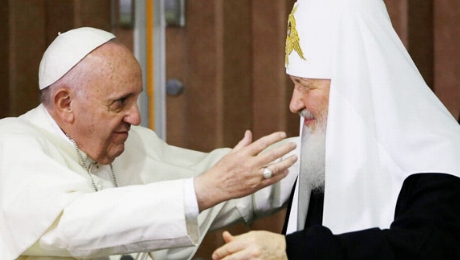
A pope, a patriarch, a spiritual revolution

By Johan Galtung

The first editorial here at Transcend of March 3 2008, “50 Years of Fidel Castro” celebrated a political revolution that changed the world, and spelt the end of US-Western imperialism. This editorial celebrates a spiritual revolution that may also change the world, spelling the end of Western materialism, and spread from there.

We are talking about processes, not events, and of structures and cultures more than of actors.

Again, Cuba played a major role, as meeting place between two major parts of Christianity, Catholic and Orthodox. In the Great Schism of 1054 they had excommunicated each other; and the Roman empire had split Catholic/Orthodox in 395. Fidel’s Catholic brother and successor Raúl was a condition for this historic meeting for peace; so was the meeting between Putin–an Orthodox Christian–and Francis in June 2015. However, not many pairs of brothers rival the two Castros in shaping history.

They met, Pope Francis of the Catholic Church and Patriarch Kirill of Moscow and all Russia – after earlier meetings between popes and the patriarch of Constantinople – with a Joint Declaration on 12 Feb 2016 in 30 articles. There were 17 quotes from the Bible; showing that they are “brothers in the Christian faith”, “pained by the loss of unity”, “divided by wounds caused by old and recent conflicts”. Not from the Bible are the many references to “the Most Holy Mother of God, Virgin Mary, and the saints we venerate”. Problematic for Protestants.

The bulk of the Joint Declaration is about the fate of Christians in the Middle East, meaning mainly Orthodox; like “the Metropolitans of Aleppo, Paul and John Ibrahim, who were taken in April 2013, to make every effort to ensure their prompt liberation”. However, together they “invite our Churches in Ukraine to work towards social harmony”.

They also jointly argue strongly against abortion and euthanasia, and in favor of “respect for the dignity of the individual called into being according to the Creator’s plan”. Do not destroy God’s creation.Read More »