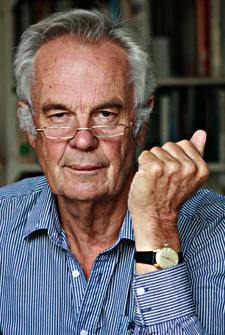
Good peace proposals quite often works!

By Johan Galtung

Kuala Lumpur: Perdana Global Peace Foundation, 25 August 2013: “Global Peace Efforts: What Went Wrong & What Next?”

The TRANSCEND NGO Mediation Network just turned 20, and our experience is clear: a good peace proposal quite often works.

To mention some out of 30 positive experiences: we have had a hand in launching peace studies and peace journalism; improving race relations in Charlottesville, VA; in ending the Cold War through bridge-building between Norway and Poland, the idea of a Conference for Security and Cooperation in Europe and nonviolence; in improving North-South relations through South-South cooperation and then relinking with North on a basis of equity–this from the early 1960s.

Later on there have been contributions to peace on the Korean peninsula (first unify the nation, then perhaps the countries), the Kurdish issue (a Kurdistan as a confederation of human rights-based autonomies in the four countries), ending the longest war in Latin America, Ecuador/Peru (a two-state condominium up in the Andes with a natural park, later a joint economic zone); in tripartite peace in the Caucasus; in solutions for bullying in schools; in judicial mediation; in the problem of settlers in Zimbabwe; conciliation Germany/Herero, Turkey/Armenians, Denmark/Islam; and so on and so forth, up till now.

Our conspicuous failures include Read More »

Egypt: Polarization and genocide

By Richard Falk

In these morbid days, there are some home truths that are worth reflecting upon.

What Happened to Tahrir Square?

In retrospect, ‘’the January 25th Revolution’ in Egypt is ‘a revolution’ that never was, which has now been superseded by ‘a counter-revolution’ that was never possible. Why? The dislodging of a Mubarak dynasty in 2011 did not even achieve ‘regime change’ much less initiate a transformative political process. There was no revolution to counter. Even more modest hopes for political reform and humane governance were doomed from the start, or at the latest, when Ahmet Shafik, the overtly fulool candidate of the discredited Mubarak regime polled almost 50% of the vote in the presidential election runoff against Mohamed Morsi in June 2012.

What then was Tahrir Square?

Part project (getting rid of Mubarak and sons), part fantasy (hoping that the carnivalistic unity of the moment would evolve into a process of democratic state-building), part delusional experiment (believing that the established order of Mubarak elites and their secular opponents would be willing to rebuild a more legitimate political and economic order even if it meant that they would be transferring significant power and status to the Muslim Brotherhood).

The 2011 turn to ‘democracy’ in Egypt always contained a partially hidden condition: the Muslim Brotherhood was welcome to participate in an electoral process so long as its support was not so great as to give it a majoritarian mandate. Read More »

Five theses about Assange-Manning-Snowden

By Johan Galtung

[1] The leaks are not about “whistle-blowing”, but a nonviolent, civil disobedient, fight against huge social evils.

Whistle-blowing, warning, presupposes that somebody can be warned, in fact wants to be warned, and is in a position to do something. Obviously those who can do something about US foreign policy, who have the power–legislative, the Congress, particularly the Senate; executive, State Department-Pentagon-White House; judiciary the Supreme Court; economically the giant banks; culturally the mainstream media – know perfectly well what is going on: these are all efforts to hang on to imperial economic, military, political and cultural power. But they do not want change. And those who want a change, a major part of the US population, allied populations and most of the rest of the world have been warned, but are to a large extent powerless. So they believe; but see thesis [5].

The whistle-blowing discourse is much too optimistic. Read More »

Reinventing Fascism

By Johan Galtung

The atrocious Second World War left behind lasting damage by lowering our standards for what is marginally acceptable. War is bad; but if it is not nuclear, the limit has not yet been reached. Fascism is bad; but if it does not come with dictatorship and the elimination of a category of people, the limit has not yet been reached. Hiroshima, Hitler, Auschwitz are deeply rooted in our minds, distorting them.

Hiroshima makes us disregard the state terrorism against German and Japanese cities, killing citizens of any age and gender. And Hitler and Auschwitz make us disregard fascism as the pursuit of political goals by means of violence and the threats of violence. It takes two to make a war, by whatever means. But it takes only one to make fascism, against one’s own people, and/or against others.

What is the essence of fascism? Read More »

Palestine/Israel: On political precondition

By Richard Falk

To the extent that diplomacy solves international problems it depends on the satisfaction of the political preconditions that must be met for negotiations between sovereign states to reach sustainable and benevolent results. To clarify the point, in situations where there is a clear winner and loser, political preconditions are irrelevant, as the winner can dictate the terms, either imposing them as was done after World War II in response to the unconditional surrender of Germany and Japan, or offering proposals on a ‘take it or leave it’ basis.

This is what Israel has attempted to do over the course of the twenty years that the Oslo Framework, the Roadmap, and the Quartet, have provided the ground rules for diplomacy with respect to Israel/Palestine negotiations.Read More »

The deep crisis of democracy

By Johan Galtung

Partyocracy-Technocracy-Autocracy-Bankocracy…?

There is a crisis in the Western or more particularly the Indo-European political system – for reasons to be made clear. The system is referred to as “democracy”, meaning rule with the consent of the ruled; of, by and for the people. In practice this is interpreted as multi-party national elections for a national assembly, and majority rule in its two major forms, presidential and parliamentary democracy. The minority is given the role as “loyal opposition”.

The sovereign, people, are given choices not between positions on issues, but “platforms”, issue-bundles; and not between candidates, but candidate-bundles, “lists”, designed not by the parties, but by executive committees, officers, even by one officer, the boss. And this choice the sovereign can make only once every four years when a power window opens one or two days, 8-10 hours, called elections.

The system is better referred to as partyocracy than democracy, a reason that we often talk about “political class”, “political elites”, etc. Read More »

Forget ‘normal’ politics

By Richard Falk

Political life is filled with policy choices that are made mainly on the basis of calculations of advantage, as well as reflecting priorities and values of those with the power of decision. In a constitutional framework of governance the rule of law sets outer limits as to permissible outcomes. The legitimacy of the decision depends on adhering to these procedural guidelines, and the fact that if the societal effects turn out badly it can be corrected by altering the ‘law.’

Of course, all sorts of special interests behind the scene manipulate this process, and the public debate mirrors these pressures. The results of highly contested policy choices usually reflect the power structure (class, race, ideology) more than they do the outcome of rational detached assessments of the public good.

At present, the national public good in the United States is being held hostage to the lethal extremism of the gun lobby as led by the National Rifle Association (NRA), Read More »

The demand for a new political order in China

By Jonathan Power

The rubber stamp congress of China’s communist party is over. There have not been any surprises. The script was pre-written, the actors were in place and the show went on.

I suspect most Chinese don’t care a damn about the details- how the leaders are selected, how economic policy is fine tuned, the approval of the budget and so on. What the masses see is the momentum of the wave of economic progress which seems to lift most boats, albeit at the price of a widening in income distribution and the very poor being left behind. But if you are a villager do you care much if middle class town dwellers have a new car if you can buy a motorbike, a fridge, better furniture and a TV.

However, a growing middle class, many of them highly educated, do care. They don’t like being told what to do by edict. Most of them keep their public mouths shut although they open up in private. But as time passes and their numbers swell this passivity will not last. The system will be increasingly questioned. The big secret worry for the leadership must be that the communist party will just collapse one day as it did in Russia and Eastern Europe, an event which hardly any western politician, academic or journalist predicted.Read More »

Beyond words: Poet’s lament

By Richard Falk

Poetry at its finest stretches the expressiveness of language beyond its prior limits, not necessarily by its choice of words, but through the magical invocation of feelings embedded deeply within consciousness. Yes even poetry has its own frontiers that if crossed lead to a word-less terrain littered with corpses of atrocity, what Thomas Merton and James Douglass have soulfully identified for us as the realm of ‘the unspeakable,’ and then are brave enough to explore forbidden terrain.

When we do not respect the unspeakable by our silence we domesticate the criminality of the horror that human beings are capable of inflicting on one another, and give way to the eventual emergence of normalcy as has happened with nuclear weapons detached from the happenings of Hiroshima and Nagasaki.Read More »

Towards a Gandhian geopolitics: A feasible utopia?

By Richard Falk

There has been serious confusion associated with the widespread embrace of ‘soft power’ as a preferred form of diplomacy for the 21st century. Joseph Nye introduced and popularized the concept, and later it was adopted and applied in a myriad of settings that are often contradictory from the perspective of international law and morality.

I write in the belief that soft power as a force multiplier for imperial geopolitics is to be viewed with the greatest suspicion, but as an alternative to militarism and violence is to be valued and adopted as a potential political project that could turn out to be the first feasible utopia of the 21st century.Read More »