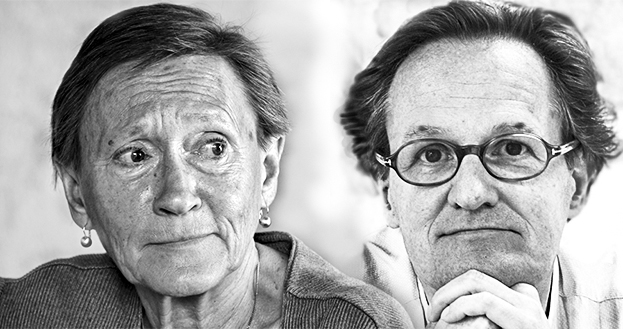
Our 30 years with peace – And what happened to world peace? Part I

By Christina Spannar & Jan Oberg, TFF founders

Part I

TFF was established on September 12, 1985. We think that it’s 30th Anniversary is a fitting occasion to reflect on what has happened in the big world and in our lives with the foundation.

It is also a piece of Lund’s research history in general and of peace research and education in particular.

Motivation

The 1980s was a decade of gross changes in Europe, the struggle against nuclear weapons in particular.

Lund University was predominantly about education and single research projects – while TFF could be more of an experimental playground. We wanted to do truly free research and not negotiate with higher levels at, say, the university what to do where, in which countries to work and what to say to the media.

Peace has always been controversial and there were – and remain – enough examples of places that become ‘mainstream’ and routine – rather than experimental and radically ’alternative.’

What we did not know back in 1985 was that Lund University wanted to get rid of all inter-disciplinary academic endeavours – women, environmental, human rights and peace studies – and closed down the Lund University Peace Research Institute of which Jan had been the director since 1983, in November 1989.

Being a private undertaking

The HQ is the first floor of a two-family house in a villa area of Lund. Visitors, board members etc. have held seminars there, eaten and often stayed with us. Board members were colleagues and personal friends and new board members were recruited from Associates who were also personal friends, like-minded colleagues or mentors one way or the other.
Our children and other friends were often involved in the things TFF did – including printing newsletters in the basement, gathering them, putting them in envelopes and fix address labels.

Goals

The permanent top priority has been to promote the UN Charter norm that ‘peace shall be created by peaceful means’ (Article 1).
This was promoted through traditional book-based research and later field work – i.e. conflict analyses and mediation and peace plans – in conflict zones, but also through intense public outreach/education such as newsletters, media participation, press releases – and, from 1997, the Internet and then social media.

Secondly, we wanted to integrate theory and practice. While it is good to do basic research in the laboratory, what is peace research really worth if it is never applied to real life’s tough situations?

The first five years we did book projects like everybody else in the trade. But in September 1991 TFF went on its first peace mission to former Yugoslavia. It is safe to say that we were among the first to embark on that in-the-field philosophy and practice it – with all the problems and risks that it entailed.

Foundation and management

The word ‘foundation’ does not mean that we had an endowment to start out with – and funding has been a constant problem every day and year ever since. And getting worse over time.
But it meant flexibility and – being and remaining small – quickly adapting to a changing world.

Being our own and not part of Lund University was another advantage – and a drawback in terms of finding funds. TFF had to build its own reputation from scratch rather than piggyback on that of the university’s. It was quite tough but also more rewarding in the long run.Read More »

TFF PressInfo # 330 – Iran’s Nuclear Deal: A great achievement, but hard work ahead

By Farhang Jahanpour

The announcement of the nuclear deal between Iran and six world powers is a rare moment in history that gives us hope and provides a basis for optimism.

By contemplating what the alternative would have entailed, any agreement, no matter how defective, is a great achievement and has to be welcomed.

However, the indications are that, as the Iranian Foreign Minister Mohammad Javad Zarif has declared at a joint press conference with the EU High Representative for Foreign Affairs, there has been a win-win agreement that will benefit everyone. In short, they have made history.

Ms. Mogherini said: “It is a decision that can open the way to a new chapter in international relations. I think this is a sign of hope for the entire world.” The Iranian foreign minister echoed those sentiments and described the deal as “a historic moment”.

He continued: “Today could have been the end of hope, but now we are starting a new chapter of hope.” Zarif rightly pointed out that the deal has ended an unnecessary conflict. As the TFF Associate Gareth Porter has shown in his book of the same title, it was in fact “A Manufactured Crisis”.

It should be remembered that Iran had been ready since 2003 to reach a nuclear deal when she agreed to ratify the Additional Protocol and voluntarily suspended enrichment for two years. The Bush Administration killed that deal by illegally stating that, contrary to the NPT regulations, Iran was not allowed to have any enrichment on her soil. Read More »

The nemesis of race

By Johan Galtung

We have been revisited, not only Charleston SC, not only the USA; the whole world by the shocking massacre in the iconic Emanuel Church. It hit this aging Norwegian male deep in the heart; once a young man, sociology professor at Columbia University, NY, as American as any with that passport, deeply involved in the desegregation conflict in Charlottesville, VA. Like millions others now trying to come to grips with this enormity of history moving backward to comprehend, searching for “how could it have been avoided”; any solution anywhere?

Using an old tested method, “what does this remind me of”, Anders Behring Breivik, a fellow Norwegian, came up. On 22 July 2011, first a bomb at a government building killing seven, then a massacre of young laborites at an island, killing 69 more. Having researched the case, I see him located in a triangle with his pure, blond and blue-eyed Norway of believers in true Christianity in one corner, threatened by Muslim invasion; the traitors to that society–the Labor government, the laborites in the second, and in the third corner those who stand up, do something against the Muslim menace: Israel, the hard Zionists.

Obsessed, it worked in and on him till the calling comes, only I have understood this, it falls upon me to do the unspeakable, to unleash history from its shackles by forcing people to see the Truth, starting with the enemy in our own camp, not Muslims, the traitors.

The psycho-pathology driving him was not childhood traumas but conflict polarization, Read More »

On Violence: Suicide, homicide and both/and

By Johan Galtung

Violence is to harm and hurt body, mind, spirit, even lethally, suicide, homicide, genocide (“cide”, from Latin “caedere”, falling). The focus here is on body violence, “sui” standing for Self, “homi” for Other. They do not exclude each other, they can be combined.

We have in mind US shootings-killings in recent decades, often at schools, spraying Others with bullets, in the end also Self, at his own hand or somebody else’s, with a gun. The killing by somebody else may or may not have been expected, but exposure to such extreme risk makes intention likely. In short, homicide and suicide. Both-And.

Hitler sacrificed millions of Germans and committed suicide.

We are used to seeing suicide as the consequence of life being intolerable: “I am better off leaving this world”; and homicide as other(s) being intolerable, “the world is better off without you”. These tragic, aggressive outcomes of double frustration may be rooted in unsolved problems and conflicts (dilemmas, disputes). Seeing it that way the “both-and” category makes sense: “I am a total failure; but you people betrayed me and deserve to be severely punished”.

Suicide can be combined with individual or collective homicide. The latter should not be confused with Durkheim’s distinction between egoistic suicide on behalf of oneself only, and altruistic suicide, Read More »

TFF PressInfo 319 – Burundi: Early warning and violence prevention

Jan Oberg

By Jan Oberg

See also TFF PressInfo 320.

The world’s leading countries are busy with ongoing conflicts and wars in areas of strategic importance to them. Organisations that work with humanitarian issues and post-war healing have exhausted their capacities long ago. It’s repair work but it must be done.

So there is hardly any capacity in the world to do what would be much more productive: Prevention of violence (yes, not of conflict but of violence). For decades there has been talk of early warning – but if it works at all, there is little or no early listening and even less early action.

If it all worked as it ought to, the world would have a violence-prevention machinery in place and it would, these very days, plan what to do before a catastrophe descends upon a small, beautiful African country – poor, mal-developed and of no strategic significance to bigger powers. That is, it would do a genuine humanitarian intervention to save lives in time.

The world’s neglect of Burundi

Since the genocide in the two neighbouring countries, Rwanda has probably been mentioned 100 times when Burundi was mentioned 1. Rwanda got the diplomatic attention, the investments, the aid, the Hollywood movies and books. Annually when the world commemorated the genocide that took place in both countries, everybody talked about Rwanda as if Burundi didn’t exist. One reason apart from sheer ignorance is that ”only” 300.000 were killed in Burundi’s genocidal civil war while three times more in Rwanda. About Burundi’s civil war.

Children in Muramviya, Burundi © Jan Oberg

Every year the development aid given to Burundi was around or less than 50% of what donor countries had pledged. Today, the two capitals Bujumbura and Kigali are like two different worlds. The best the world has done for Burundi was the remarkable UN mission which, regrettably, the Burundian government always wanted somehow to get rid of.

It can be argued the consequences of this relative neglect by the world are now becoming visible.

Combine that with the last few days of rioting against President Nkurunziza’s extremely dangerous manoeuvring to be elected for a third term and you have a situation that may soon present itself as yet another major human tragedy the world failed to do anything about before it was too late.

With the accumulated experience from TFF’s projects in Burundi from 1999-2012*, I believe there are extremely strong reasons to produce not only lame, standard diplomatic statements but to take action to prevent a new catastrophe.Read More »

Hitler and Stalin: Two Europeans

Johan Galtung

By Johan Galtung

Hitler was about race, Stalin about class. Their theories were based on one contradiction: Aryans vs non-Aryans for one; workers vs capitalists/landowners for the other. The ills of their countries followed from the contradictions at the top of their verbal pyramids. As Western intellectuals they tried to explain much from one axiom. Thus, to Hitler bolsheviks and plutocrats were both mainly Jewish.

Their utopias were contradiction-free, by cleansing; ethnic for Hitler, class for Stalin. Only Aryans; all others killed-expelled-marginalized by the power of the NSDAP, National-Socialist German Labor Party for one; all capitalists/landowners killed-expelled-marginalized by the power of the vanguard of the proletariat CPSU(B), the Communist Party of the Soviet Union (Bolshevik) for the other.

So similar that one may ask: did they imitate each other? Like armies becoming similar by fighting, so also the machines for reshaping societies in the European civil war 1917-1945 (plus minus some years?).

There is another, better explanation: if the theory is pyramidal, so also the practice, the policy machinery. The ultimate power should be in the hands of those licensed as ultimate truth-holders. Those lower down have to learn the smaller, specific truths and enact them.

That pattern identity, isomorphism, between theory and practice pyramids came from the same source in Germany and Russia: Churches, of two opposed Christianities: truth by revelations, articles of faith, commandments on top; enacted by pyramids with popes-patriarchs on top.

Stalin was even trained as Orthodox priest, changing from Christ revealing the truth about God the Father, to Marx revealing the truth about History. And Hitler? Martin Luther’s rabid anti-Semitism and axiomatic Christianity (catechism) played a major role. Why Germans? Very gifted in axiomatics–dictatorship easily follows by isomorphism.

Two genocidal secularisms poured into old Church bottles.Read More »

TFF PressInfo # 314: From preventing to making peace in Ukraine

By Jan Oberg

Jan Oberg

Lund, Sweden, March 13, 2015

If the parties continue this way, there will be no peace in Ukraine but probably war in Europe. With a little out-of-the-box thinking, we could move in a safer direction.

You’ve heard everybody involved in the Ukraine conflict solemnly declare that there is no military solution.

And what do they all do? Right, they militarise the situation further, use bellicose language, speak bad about each other, take provocative steps, use propaganda and flex their military muscles. It’s thoughtprovokingly thoughtless.

These men – sorry, but the are all men – who are competent in war and other violence run our world. They are conflict and peace illiterates embedded with MIMACs – Military-Industrial-Media-Academic Complexes – which exist in both Russia, EU, NATO and the U.S.

It’s not about evil – they are probably all good spouses, nice to their children or grandchildren and enjoy literature, painting or music in their few hours of leisure. But the system they operate inside is as evil as it is dangerous for us all, for the world’s future.

Their problem – and thus your and my problem – is that they just don’t have a clue about peace-making. No education, institutions or advisers in civilian conflict-management.

And since they lack that they fall back on the convenient but proven illusion that peace will come if we just force “the other” to back down.

And since there is no lack of (tax payers’) money to fund weapons (only to fund social and cultural development) and these weapons are on the government shelves that’s what they use – instead of their intelligence and empathy. 

Far fetched?

If you think so, take a look at these facts:Read More »

The Von Weizsäckers, Germany’s Kennedys

By Johan Galtung

Johan Galtung

President Richard von Weizsäcker passed away 31 January and was very much celebrated in Germany for his brilliant presidency to normalize a Germany with a troubled past, even divided on top of that. But, by and large leaving out his global perspectives mentioned below.

His brother Car Friedrich was a nuclear physicist turned peace activist with a wonderful peace program, in one word: Weltinnenpolitik, world domestic policy (well, it depends on the country, some domestic policies are better than others; I would go for a Swiss coalition governance, federalism, direct democracy).

The president’s nephew Ernst Ulrich is an energy-environment leader, in Germany and through the UN in the world.

I have/had the privilege of knowing them all, and my tribute to Carl Friedrich when he passed away is an editorial dated 2 July 2012. Richard kindly sent greetings to the symposium on “Peace Studies and World Domestic Policy” on the occasion of my 80th birthday.

President John F. Kennedy also had a brother, Robert F. Kennedy; both murdered in (by?) the USA. The president’s nephew, Robert F. Jr., recently published three articles at Other News. Information That Markets Eliminate where, in a position to know, he tells the story of the USA-Cuba past: “JFK’s secret negotiations with Fidel”, “Sabotaging U.S.-Cuban detente in the Kennedy Era” and the future: “We have so much to learn from Cuba”. The titles say it all: efforts, thwarted by CIA; time to catch up.Read More »

The Western freedom of expression hypocrisy

By Johan Galtung

Johan Galtung

Society is tri-partite: State, Capital, and People with their associations, the Civil Society. There is hard-won and applaudable freedom of expression for People, directed at the State and its feudal predecessors, Clergy and Aristocracy. But how about Capital?

Consider this. Somebody can pay for access to the media – papers, radio, TV – with total freedom of expression of strong views, filling pages and hours of reading space and listening-viewing time; one way. Uncontradicted, nobody writing or voicing contrary views, sowing doubts, coming up with data to the contrary, values, theories against. One-way flow of expression, and not merely a flow of bla-bla words but to induce behavior, even changing behavior; aimed at getting inside readers-listeners-viewers, capturing their spirit to issue new commands to their bodies. Could a tyrant dictator ask for more?Read More »

I am not a Dane

By Jan Oberg

Jan Oberg

NO to being included in the Denmark of the Government and Parliament

Written in the wake of the official Danish reactions to the tragic, horrific murders in Copenhagen of a Danish film director and a Jewish Danish guard outside the synagogue in Copenhagen on Saturday February 14 – a crime committed by a 22 years old Danish Muslim with a heavy criminal record and one foot in Denmark and one in a Palestinian refugee camp in Jordan.

I’m a Danish citizen. I’ve worked for the UN Charter norm of peace by peaceful means for 40 years. Have been a member of the Danish government’s Commission for Disarmament and Security all through the 1980s. I’ve worked in war and conflict zones in Somalia, all parts of Yugoslavia, Burundi, Iraq, Georgia, Iran.

I have friends and colleagues in many countries and cultures. I know things can be seen in more than one way – and how the West may also be perceived from the outside.

I will use my freedom of expression and wisdom of expression and our democracy to struggle against the warring Denmark which Prime Minister Helle Thorning-Schmidt insists that we Danes shall all be united around.

Denmark is not only a victim. It has also caused many victims.

It has violated international law and participated in mass murders on the Iraqi and other people, innocent people. On the initiative of then prime minister Fogh Rasmussen it has fought a cultural battle (kulturkamp) not with but against other cultures – related to the Muhamad caricatures. His government was also responsible for dragging Denmark into being an occupation power during four dark years in Iraq – and thus co-responsible for today’s situation there. Likewise in Afghanistan and Libya.

Over a couple of decades Denmark has developed a political xenophobia which I would never have thought even remotely possible a couple of decades ago because of basic values such as welfare for all, solidarity, equality, peoples’ colleges, philosopher poet Grundtvig, disarmament, the compassion for the Jews in October 1943, the fundamental belief in human dignity and tolerance.

The Danmark which the Prime Minister demagogically includes ”all we Danes” in and insists that we all be united around in her misplaced, all-motherly manner, is not the Denmark I want to be included in.

If so, I am not a Dane these days.

I want a Denmark for peace by peaceful means – and in that struggle we dissidents may meet, however few or many we seem to be.

But I draw my line at a national(istic) forced inclusion in the warring, xenophobic and segregated Denmark that has been created the last few years.

And this is not easy for me to write.