Nonviolent Geopolitics: Law, Politics, and 21st Century Security*

By Richard Falk

In this short essay, my attempt will be to articulate a conception of a world order premised on nonviolent geopolitics, as well as to consider some obstacles to its realization. By focusing on the interplay of “law” and “geopolitics” the intention is to consider the role played both by normative traditions of law and morality and the “geopolitical” orientation that continue to guide dominant political actors on the global stage.

Such an approach challenges the major premise of realism that security, leadership, stability, and influence in the 21st century continue to rest primarily on military power, or what is sometimes described as “hard power” capabilities. [1]

From such a perspective international law plays a marginal role, useful for challenging the behavior of adversaries, but not to be relied upon in calculating the national interest of one’s own country. As such, the principal contribution of international law, aside from its utility in facilitating cooperation in situations where national interests converge, is to provide rhetoric that rationalizes controversial foreign policy initiatives undertaken by one’s own country and to demonize comparable behavior by an enemy state. This discursive role is not to be minimized, but neither should it be confused with exerting norms of restraint in a consistent and fair manner.

My intention is to do three things:

• to show the degree to which the victors in World War II crafted via the UN Charter essentially a world order, which if behaviorally implemented, would have marginalized war, and encoded by indirection a system of nonviolent geopolitics; in other words, the constitutional and institutional foundations already exist, but inert form;

• to provide a critique of the realist paradigm that never relinquished its hold over the imagination of dominant political elites, and an approach has not acknowledged the obsolescence and dangers associated with the war system;

• and, finally, to consider some trends in international life that make it rational to work toward the embodiment of nonviolent geopolitics in practice and belief, as well as in the formalities of international law.Read More »

Peace Economics: Making Money Doesn’t Need to Hurt

By Jelena Mair

Business and Peace are not mutually exclusive. Business does play a crucial role in society. More so, business impacts and depends upon its surrounding. It impacts the
social well-being of people and planet, whether intentionally or unintentionally, both locally and globally through the chosen ways of operation and production.

Equally, does business play a key role in contributing to economic development, peace and stability in the areas where it operates. Business provides jobs and revenue to local markets; sets examples of sustainable business practices and can provide support for various social programs through strategic social investment.

In short, business is an inherent aspect of our society, and therefore, if we are striving for a more peaceful and sustainable world, for-profit private enterprises are the most crucial actors in achieving this goal. Read More »

Joelle Rizk’s CV

Joëlle Rizk became a TFF Associate in December 2009, served as TFF Board member 2010-February 2014 and is now again TFF Associate.

jmrizk@outlook.com

Joëlle Rizk comes from Lebanon. She holds a B.A. in International Affairs and Diplomacy and an M.A. in Peace and Conflict Studies.

Joëlle has worked with civil society in Lebanon on governance, peace building, reintegration, and development. She has worked on transnational security with Isticharia for Strategic Studies in Lebanon and the Middle East as a program analyst, and with the United Nations Development Program in Afghanistan as an International Consultant.

Joëlle is co-author of The Battle for Khorasan (2010), a book studying the conflict in Afghanistan and the rise of Islamic militancy in relation to geostrategic interests in the region.

From 2011 to 2013, she worked as Program Associate of the EastWest Institute Regional Security Program, where she managed the Abu Dhabi Process in Afghanistan and Pakistan, and the Amu Darya Basin Network in Afghanistan and Central Asia.

Joëlle Rizk became a TFF Associate in December 2009 and served the TFF Board from 2010 till 2014. Joëlle consults with the award winning REVOLVE Magazine on Natural Resources Development, and with Brehon Advisory on the Middle East and Central Asia.

She currently works as Delegate of the International Committee of Red Cross.

Phone +961-76-905050 & +93-773-747873

E-mail jmrizk@outlook.com

Blog: Linkedin

Updated May 2014

Som broar över mörka vatten – ett integrationsprojekt

Av Christina Spännar & Vibeke Bing

Kanske du associerar TFF med Jugoslavien, Burundi, Irak, Iran, ickevåld och fredsdebatt? Men vi har i tre år också arbetat med frågor kring integration med tonvikten lagd på ensamkommande barn från Afghanistan. Insatsen här har letts av författarna av denna projektsammanfattning.

Vi är stolta över att nu publicera bloggen Som Broar Över Mörka Vatten där allt material finns. Projektet har finansierats av Arvsfonden.

“När vi åkte gummibåt över Turkiets hav till Samos i Grekland greps vi av Grekiska poliser. Poliserna kastade alla våra kläder i havet och gjorde små hål i vår båt.” Ali

“På kvällen satt vi i en båt. Vi åkte till Grekland. På vägen till Grekland fick vi problem med båten. En polisbåt kom och klippte sönder en del av motorn. Vi paddlade med händerna och fyra åror.” Hassan

Vi lever i en märklig tid. Framför våra ögon pågår en stor migrationsvåg av ensamma barn. Något liknande har inte hänt sedan de finska vinterkrigsbarnen kom till Sverige på 40-talet.

De barn, som utan föräldrar, nu flytt hit undan krigets fasor har gjort en annan resa. De kommer från länder vi inte vet mycket om. Vilka är dessa barn och ungdomar, vad tänker de på och hur är livet i Sverige? Vi har lärt känna och lyssnat till några av dem. De är alla från Afghanistan.

Hur deras berättelser kommit till och vad de har att säga kan man läsa i denna rapport, som summerar tre års projektarbete. Här kan man också få veta hur vi sökt arbetsformer som kan underlätta den svåra etableringsfasen.

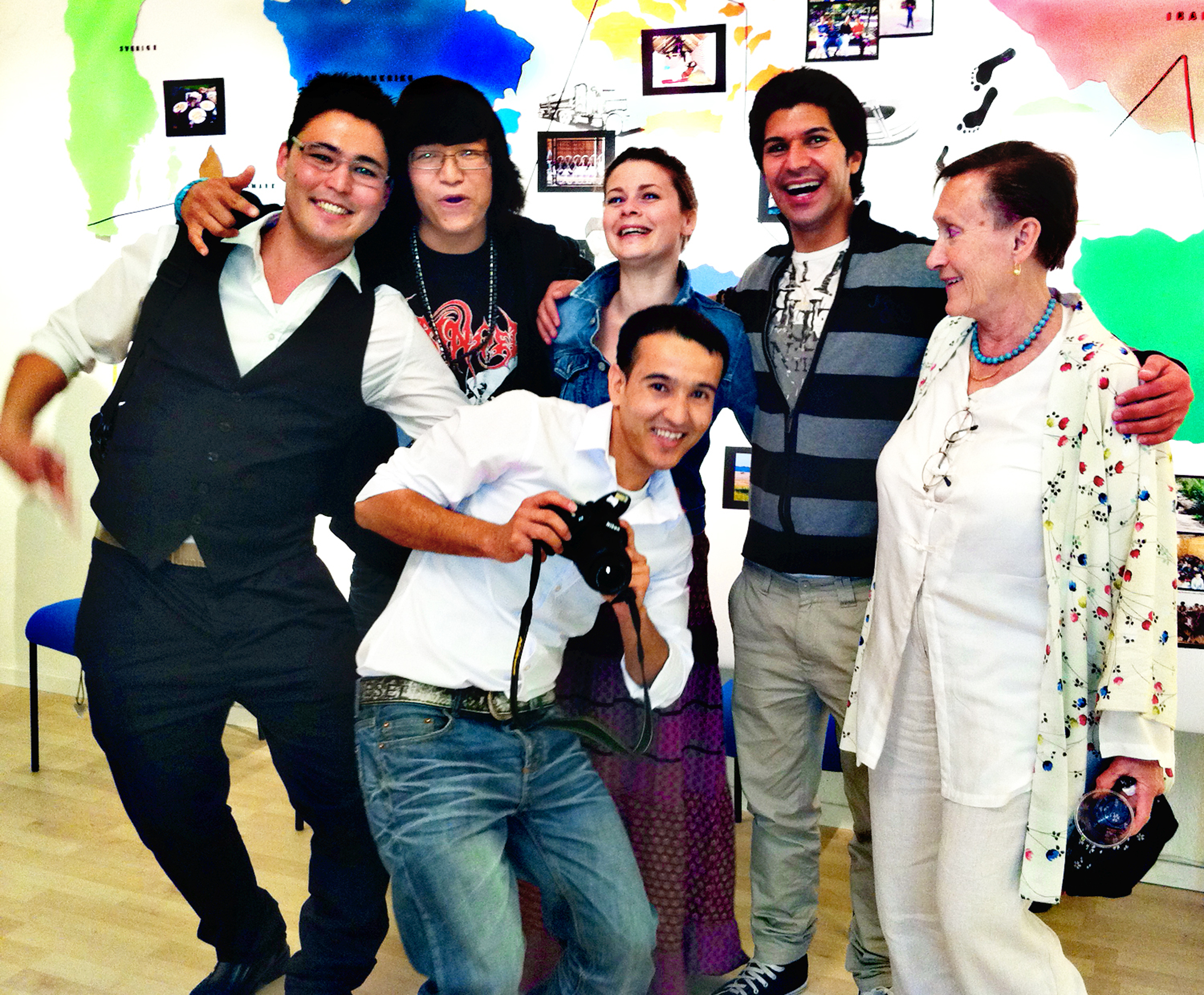
Vid öppnandet av en utställning

Vi berör också det komplicerade i att återförenas som familj.

Vi vänder oss till alla som arbetar med barn, ungdomar och föräldrar. Men också till alla som är nyfikna på vad som sker i vår samtid.
Känns läsningen tung – bläddra vidare till pojkarnas berättelser och det öppnas en ny värld.

En av de unga sammanfattar vår tid tillsammans såhär:

– “Jag har fått hjälp, ni har fått hjälp, vi hade kul!”

Det är bara att instämma!

Vibeke Bing
Projektledare, folkhälsovetare
vibeke@vibekebing.se
076-6451147
0304-663396

Christina Spännar
Projektledare, sociolog
christina.spannar@telia.com
070-1450171
046-129249

Sammanfattning av projektet

Som broar över mörka vatten – ett integrationsprojekt har haft som övergripande syfte att stärka människor i övergångsskeden i livet. Målgrupper har varit nyblivna föräldrar, ensamkommande flyktingbarn/ungdomar samt föräldrar som kommit till Sverige som flyktingar eller som anhöriginvandrare till ensamkommande flyktingbarn och ungdomar.

De övergångsskeden som stått i fokus är att bli förälder och att migrera. I det senare fallet handlar det om att bryta upp från ett socialt sammanhang och finna sig till rätta i ett nytt. I migrationsprocessen ingår ofta också att återförenas som familj efter år av splittring.

Projektet kan liknas vid ett träd, Read More »

TFF PressInfo: The manufactured story about Iran’s nuclear program

By Farhang Jahanpour

As Iran and the world powers resume nuclear talks in Vienna with the hope of reaching a comprehensive agreement over Iran’s nuclear program by mid-July, the Israelis and their lobbyists in Washington are intensifying their efforts to scuttle the talks. In addition to all the efforts in the US Congress to impose additional sanctions on Iran, thus bringing the talks to a premature end, there are indications that Israel and her friends are continuing with various acts of sabotage against Iranian nuclear facilities.

In 2010, the so-called Stuxnet virus temporarily disrupted the operation of thousands of Iranian centrifuges. At least five Iranian nuclear scientists have been assassinated. Iran has also said that it has discovered tiny timed explosives planted on centrifuges but has disabled them before they could go off. On Monday 17 March 2014, Iran said that an alleged attempt to sabotage one of its nuclear facilities had involved foreign intelligence agencies that had tampered with imported pumps. However, in addition to all those acts of sabotage, there seems to be an intensive effort to manufacture a crisis by means of false intelligence.

Prior to the devastating Iraq war that destroyed the country and killed upwards of half a million people, not to say anything of thousands of Coalition forces who were killed and the two trillion dollars that was spent, a number of neocons bent on the invasion of Iraq manufactured various false reports in order to mislead the public and pave the way for the war.

On September 8, 2002, Michael R. Gordon and Judith Miller published a story in the New York Times that openly alleged that Saddam Hussein had intensified his quest for a nuclear bomb. They wrote: “In the last 14 months, Iraq has sought to buy thousands of specially designed aluminum tubes, which American officials believe were intended as components of centrifuges to enrich uranium… Bush administration officials say the quest for thousands of high-strength aluminum tubes is one of several signs that Mr. Hussein is seeking to revamp and accelerate Iraq’s nuclear weapons program.”

The unsuspecting public was misled by that false intelligence and the result was one of the longest and most disastrous wars in US history.

How the manufactured crisis was manufactured

In his latest groundbreaking book, entitled A Manufactured Crisis: The Untold Story of Iran Nuclear Scare, the historian and investigative journalist Gareth Porter catalogs a long list of false reports manufactured by Israeli intelligence agencies in order to mislead the public and pave the way for a war against Iran. (1)

Read More »

Failure of US leadership wrecking bilateral relationship

By Shastri Ramachandaran

By Shastri Ramachandaran

With India-US ties hitting a nadir, Shastri Ramachandaran takes a look at what went wrong in big power diplomacy

The world’s two largest democracies may have much in common. But far from common interests prevailing over contentious issues, India-US relations are in for an uncommon spell of stresses and strains. These are unlikely to ease any time soon in an election year, regardless of Washington’s about-turn in cosying up to Narendra Modi.

Political changes in India cannot banish overnight the causes and conditions in the US responsible for the souring of what was, until recently, toasted as the “defining relationship” of the 21st century.

Devyani Khobragade’s arrest and strip-search drove India-US relationship to its lowest point in 15 years. Not since the 1998 nuclear test, when the US-led “international community” imposed sanctions, has the relationship between the two been so bad. Read More »

Humorous nonviolent actions

By Majken Sørensen

Photo Jonas Jonzon

During martial law in the early 1980’s in Poland, graffiti in favour of the illegal trade union Solidarity was quickly painted over by the authorities. This left “blobs” on the walls, so that everyone knew that this was covered graffiti. Activists who identified with a new group called Orange Alternative started to work on these “blobs” by giving them arms and legs so that they became little elves. According to Kenney, who has written about the Orange Alternative and its place in the fall of the communist regimes in central Europe, elves made passers-by “consider the point of the struggle over wall space, and wonder why little elves were threatening to the communists”.(1)

Several years later, the elves came to life at an Orange Alternative happening on Children’s day, 1 June 1987, one of the happenings which became what Kenney calls a “catalyst” for the Orange Alternative. An invitation to the happening was distributed at schools and universities around the city of Wroclaw, and almost 1,000 young people showed up. There they got a red cap, and then they were elves.

Since it was Children’s day, the elves handed out candy to people, danced and sang children’s songs. When the police started to take some of the elves to the police cars they followed without protesting, kissing the police and throwing candy out through the windows. Then the crowd started to shout “Elves are real”. Accounts of this surreal celebration of Children’s day went around Poland in the underground press, providing new images of what protest could look like. (2)

Are activists more creative now?

Sometimes I hear people say that there is so much more humour and creativity in activism now than there was previously. Maybe they are right, but I’m not convinced. The more you start to look for humour and talk to experienced activists about it, the more your will find, also 40 years ago. However, humour is fleeting and difficult to catch.Read More »

Selected links to a better understanding of Iran

By Farhang Jahanpour and Jan Oberg

These are the links mentioned in TFF PressInfo of January 20, 2014. There are literally hundreds of websites that one could list but we have put together some of the ones that we find to be the most useful and that we regularly consult ourselves. They range from the media run by the Iranian government, as well as the BBC Persian, VOA in Persian, some opposition websites and one on Iranian music and the massive Encyclopaedia Iranica; further there are some dailies and agencies, sites with political analyses sites and some video documentaries.

We sincerely hope this you’ll find something useful in this collection. Please share this page with anybody who wishes to know more about Iran. And let’s emphasise that the best way to learn about Iran is to go there and see for yourself.

Al-Monitor Iran Pulse

IRNA – Islamic Republic News Agency

Iran Review
It is a web site, which calls itself “leading independent, non-governmental and non-partisan website.” It provides translations of articles by some leading Iranian journalists and political analysts, and some of them are very informative and thought provoking.

Payvand
It is a website run by Iranian-Americans but is generally non-partisan and publishes good articles about Iran, some pro-Iranian government and some opposed to it. The articles provide good information about some of the leading current developments in Iran.

Campaigns Against Sanctions and Military Intervention in Iran (CASMII)
This is a website run by a professor of computer studies at the University of London. It defines itself as follows: “CASMII is independent of all political groups and governments, including the Iranian government, and does not adhere to any particular religion or ideology. We strive to bring together the broadest possible spectrum of forces, on the basis of democratic principles and decision making structures.” However, it tends to publish articles that are generally-speaking pro-Iranian government and in any case opposed to military action or sanctions against Iran.

Press TV
PressTV is the official English language TV station of the Islamic Republic of Iran and naturally takes a pro-Iranian stance in most of its reporting. Its satellite channel beamed to Europe was banned as part of the sanctions against Iran, but it is available online.Read More »

Escaping the abusive state: the Snowden and Lynne Stewart cases

By Richard Falk

The more contact one has with the modern state, even in those societies that have long constitutional traditions entrenching civil liberties, the more grounds there are for deep and growing concern. I suppose that the most dramatic exhibition of the dangers being posed as 2014 approaches, and we are reminded that this will be 30 years after 1984, are associated with Edward Snowden’s extraordinary disclosures of the global network of surveillance being operated by the National Security Agency in the United States (NSA).

Such a network presupposes that we are all, that is, every inhabitant on the planet to be regarded as worth investigating as potential terrorist threats, and along the way establishing a huge data bank of information that can be used for nefarious purposes at any point to disempower and subvert protest movements or even blackmail anyone seen to be obstructing projects dear to the government or any special interest group that has the government’s ear on matters it cares about.

In important respects more disturbing than the Snowden revelations was the rabid response of the supposedly liberal government presided over by Barack Obama. No stone was left unturned, other than assassination or kidnapping, in the effort to gain physical custody over Snowden evidently with the intention of prosecuting him to the full extent of the law as an odious criminal offender. Foreign governments were badgered to cooperate in the pursuit, a plane carrying the Bolivian president was improperly denied access to the airspace of several European countries and forced to land in Vienna, because it was suspected of carrying Snowden.

Such an enforcement dynamic completely overlooked the political nature of Snowden’s crimes,Read More »

Statement on Nobel’s Peace Prize and TFF receives the People’s Nobel Peace Prize

By Jan Oberg

Here first the important statement by seminar participants (in Swedish below):

The Nobel Peace Prize must not be misused

A Nordic seminar at Orust (Sweden) about the Nobel Peace Prize has analysed the Norwegian Nobel Committee’s selection of awardees over time. Lead by former Prime Minister Torbjørn Jagland, it has awarded the prize to e.g. Wangari Maathai, Al Gore, Shirin Ebadi, Liu Xiabo, Barack Obama and institutions such as the European Union (EU).

The mentioned personalities have undoubtedly contributed in various ways to a better future of the world but they have not met the criteria which Alfred Nobel formulated in his will, namely:

• Active struggle for the abolition or reduction of standing armies
• Contributing to the fraternity among nations
• Creation of negotiations/dialogues aiming at peace and congresses for peace
• Resilience as ”fredsförfäktare” – champions of peace.

This unambiguous anti-militarist mandate is strongly contradicted by the selection of the European Union Read More »