Bringing In the Future: An Essay on Time

By Johan Galtung

International Sociological Association Prize
New School for Social Research, New York NY, 15 Nov 2016

The West, and Western sciences in particular, have a peculiar way of conceptualizing time; derived from two millennia Christianity.

Thus, in the civilizations of Hinduism, Buddhism, China and Japan, to mention some, time flows from eternity to eternity. In the West (and Islam is similar), there is a Beginning (Creation for the religious, Big Bang for the secular), and an Ending, the End Time (Armageddon for the religious, entropy, death, etc. for others).

In others, time flows from past into a possibly different future; in the West, the future is continuous with the past. In the natural sciences, “laws” from the past are automatically valid for the future; reality being as stable as the planetary system, the galaxy; astronomy being the model. The Creation has been finished, once and for all.

In the social sciences, the future is largely off limits, taboo; predictions are often discarded as “wild speculations”. Extension of built-in trends into the future is permitted, but not forecasting with qualitative jumps. The underlying assumption is stable equilibrium, things have found their place and that’s it. Thus, no forecasting of (early) modernity during the Middle Ages, let alone working for it.

That is in theory, but the practice is different. People design their individual careers – life trajectories – and have always done so. For collective life there is politics, designing future societies.

But the social sciences are not supposed to be in it. They approach past and present with Read More »
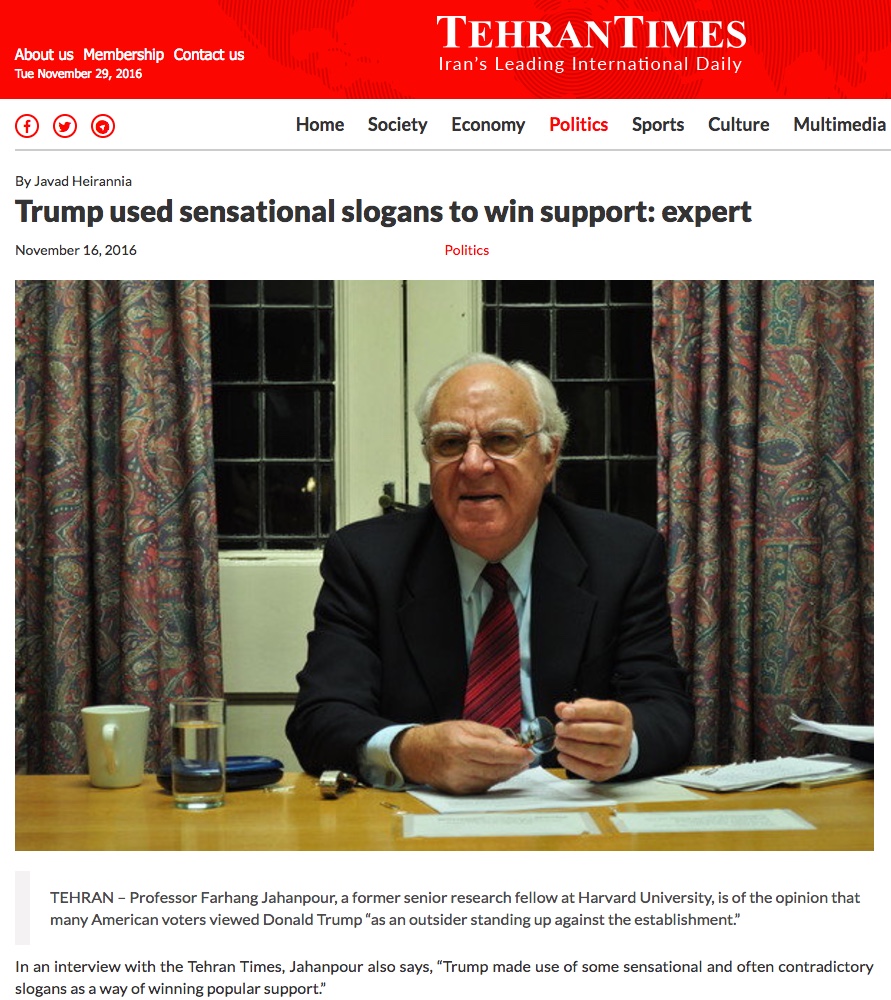

Trump used sensational slogans to win support

By Farhang Jahanpour

TEHRAN – Professor Farhang Jahanpour, a former senior research fellow at Harvard University, is of the opinion that many American voters viewed Donald Trump “as an outsider standing up against the establishment.”

In an interview with the Tehran Times, Jahanpour also says, “Trump made use of some sensational and often contradictory slogans as a way of winning popular support.”

Following is the text of the interview

Peace can be made with Russia

By Jonathan Power

November 22nd 2016

Trotsky, the one-time close comrade of Lenin, reportedly said, “You may not be interested in war but war is interested in you”.

This is how it seems to have been with President Barack Obama when it comes to his policy towards Russia.

Having come to power with President Vladimir Putin open to a closer relationship after the aggressive pushing forward of Nato’s frontier during the time of presidents Bill Clinton and George W. Bush Obama will leave the presidency with a state of hostility between the Russia and the US that most thought had evaporated once the Cold War ended in 1991.

Now, instead of a life time of peace and cooperation ahead of us, as was widely thought, we have Russia engaged in nuclear sabre rattling and the US expanding the frontier of Nato even further right up to Russia’s border and trying to put the heat on over Russia’s involvement in the upheavals in Ukraine, using economic sanctions.

Some observers talk about war between the West and Russia. Although this could not happen as long as Angela Merkel is Chancellor of Germany and France remains French it may be a “damned close-run thing” (as the Duke of Wellington was supposed to have said after victory over Napoleon at the battle of Waterloo).

It is up to President-elect Donald TrumpRead More »

The Trump Presidency 1-5

By Johan Galtung
Writing in Washington

# 1
The 45th President of the USA, Donald Trump, delivered a highly presidential acceptance speech. The words chosen, how he spoke them, his body language, all belied the idea that he could not be presidential. How good a president, remains to be seen.

What matters now in his concrete action coming January. For instance, will he do as he promised, cancel out-sourcing, “trading” of industries to Mexico and “in-sourcing” them back to the USA, to recreate jobs for US workers?

However, the media are still too anti-Trump to realize he is their President, maybe hoping for some reversal. Also too struck by how wrong all the polls have been predicting an easy Hillary victory. They will probably go on with that for a long time.

I do not think there was any objective basis for predicting a Trump victory. Clinton had all criteria in her favor: president’s wife with influence, secretary of state, senator etc. Trump: not even office.

But Clinton’s criteria were elitist and status quo, Trump’s smacked of populism and basic change. The wind was blowing toward populism, which is, actually, what democracy is about, catering to the people.

And vast categories had suffered what the Greeks call a-timia, the loss of status, white-male-workers-Americans. 5-2 in favor of Trump. And the rust belt, the big mid-Western de-industrializing states, Ohio, Milwaukee, Wisconsin. Trump catered to their interests in revival, indeed also in hitting their negations in very unacceptable ways: women, colored, elites, immigrants.

But all of that does not a victory make. There is more to it.

Some idea of a “normal American”, in a “normal America”. Say Spain, that idea brought Franco to power. Answer: we do not know. We need more information. But a revolution it was.

Be that as it may. Much more important: his concrete actions.

(Originally published here)

#2
Trump periphery populism was as unseen by US elites as Brexit periphery populism by UK elites. Read More »

Moralizing military intervention

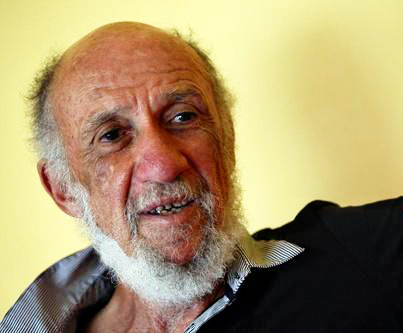
By Richard Falk

I am republishing my review essay that appeared in International Dialogue: A Multilateral Journal of World Affairs 6:2016.

It discusses two excellent studies of humanitarian intervention, a post-colonial trope allowing the United States and West Europeans to feel morally satisfied while projecting military power to distant lands, often with devastating consequences for the people being protected, and sometimes, even being rescued from tyranny and brutal repression.

In some respects, what progressive critics call ‘regime-change’ the champions of such policy like the terminology of ‘humanitarian intervention,’ or even better, ‘Responsibility to Protect’ or R2P.

Donald Trump interestingly portrayed Hillary Clinton accurately as a regime-change advocate, and pledged not to make such mistakes if elected. We will wait, see, and hope that at least this time, he means what he says.

The Middle East has been the testing ground for this ‘new geopolitics’ but its antecedents can be traced back several centuries as the Klose edited collection of essay clearly demonstrates.

Both studies are notable for highlighting the non-humanitarian motivations that accompany such undertakings, which are often hidden from public view, and need to be highlighted to comprehend this latest twist in the conduct of international relations.]

Fabian Klose (ed).
The Emergence of Humanitarian Intervention: Ideas and Practice from the Nineteenth Century to the Present
Cambridge University Press, 2016. 364pp.

Rajan Menon
The Conceit of Humanitarian Intervention
Oxford University Press, 2016. 235pp

Continue to Richard Falk’s article here.

International Women’s boat to Gaza

By Mairead Maguire
Thursday 29th September, 2016 – Wed.,5th October, 2016

Participant on board Zaytoouna-Oliva boat

A few weeks ago, the US Government agreed to give Israel $38 billion dollars, the largest military funding package the U.S. has given any Nation. This $38 billion in military and other type of Aid, will be used to imprison the Palestinians of Gaza, and continue Israel’s military occupation, and imposition of an apartheid state, upon the Palestinian people.

This money will be used in the training fields of Israeli military which are in Gaza, where military experiments are done, using US military weaponry, by the Israeli Occupation Forces.

The U.S. military and Government is complicit in the crimes against the people of Gaza and the Palestinian occupied territory by the use of military hardware given by USA and the training that the Israelis give USA and USA gives to them.

It is also estimated that some 70% of European humanitarian aid to Palestine ends up in Israeli pockets.

Gaza continues to suffer from the continuing Israeli blockade, naval and land, and this 25-mile-long tiny strip, 5 miles wide, with l.9 million people, living in it, is a brutal blockade and Israel controls everything including, all the electricity, the food, etc. Indeed, everything which comes into Gaza comes through Israeli hands. Gaza’s only airport was completely destroyed in 2002 by Israeli jets and ground forces.

Egypt continues to be a part of this blockade as they have blocked Gaza’s southern border and Egypt continues to receive USA military funding. Medical authorities have reported that the time for operations in Gaza now goes up to 2025 as so many are awaiting health care, and the increasing issues around food, water, sewage, electricity, all of these mounting problems have led the U.N. to declare in their latest Report, that by the year 2020 Gaza will be uninhabitable. What hope is there for the Palestinians of Gaza, the vast majority of whom are young people.?

In order to give Hope to the people of Gaza by showing solidarity and support the Women’s Boat to Gaza sailed to Gaza in September, 2016.

Also we sailed in order to challenge this illegal and immoral blockade and occupation of Palestine by Israel, and draw international attention to the fact that under Geneva conventions it is illegal to punish civilians, which is what Israeli government policies continues to do. Read More »

Trump and Clinton: National versus global perspectives

By Richard Falk

November 6, 2016

It is not often that Medea Benjamin, the charismatic founder of Code Pink, offers us her insight into a troublesome American reality that is almost simultaneously confirmed by the New York Times, the virtual bible for secular liberals in the United States.

Yet it happened, most surprisingly, in a positive portrayal of one thin slice of Trump loyalists – veterans of recent foreign wars.

Medea reports on a conversation with such a veteran on a train out West, and was impressed that he felt Clinton much more likely than Trump to get Americans killed in a future distant war disconnected from any reasonable defense of the homeland.

The New York Times in a front-page feature article reached this same plausible conclusion on the basis of a wider scan of relevant evidence.

Here are two disturbing realities Read More »

Imagine a Middle East with no weapons

Here a few comments on Erdogan’s recent attack on the West for supplying arms to the Kurds.

Funny that Turkey’s president should accuse someone else for weaponizing a conflict. At the same time as Turkey does it and is also involved in two wars outside itself – Iraq and Syria – and one inside against the Kurds.

In this short interview I seek to raise the imagination: Since the weaponization of conflicts is a cancer on the world, imagine that a God-like magnetic force that could suck up each and every weapon in the Middle East, what would happen?

They would be forces to sit down and talk!

And one more point I did not get around to say: The world’s cancerous arms industry and criminal arms traders – governmental as well as private – would go out of business and many end up behind bars.

In short, a much better world.

If Obama stayed in power?

By Jonathan Power

November 8th 2016.

An interesting question is what would happen to American foreign policy if President Barack Obama were allowed to have another four year term in office?

It would be a less interventionist presidency than what is about to become. This is not to say that I think the way Obama has handled the war in Afghanistan has been successful. Nor do I believe the attack on Libya was a sensible idea. Nor do I think the way he dealt with Russia and Ukraine in the last four years has been anything but counterproductive.

But I do believe the world would be an even messier place if he had not been president. Syria would have been invaded with ground troops. Iraq would have been replicated.

I think confrontation with China over the ownership of the contested islands in the South China and East China seas would have been more serious than it has been.

There would have been no bringing back Cuba in from the cold. (Cuba was the home of the missile crisis of 1962 when the world came terrifyingly near to a nuclear war.)

Most important, there would have been no nuclear deal with Iran. Iran’s research which could have led to the making of a nuclear bomb (not that I think it had any intention of going that far) would have continued.

At some point Israel would have bombed Iran’s reactors Read More »