Kärnvapen och andra vapen

Av Erni & Ola Friholt

Margot Wallström har utropat en feministisk utrikespolitik för Sverige. Inom den tecknades nyss ett värdlandsavtal med Nato, världens utan jämförelse starkaste militärallians. Avtalet permanentar flera gånger årligen återkommande militärmanövrer i stora delar av vårt lands luftrum, på landytan och i territorialvattnen. Sverige bekostar nödvändiga infrastrukturan-läggningar.

Militärmanövrerna samtrimmar svensk militär med Nato. Den underförstådda motståndaren är Ryssland, ständigt utpekat som aggressivt och hotfullt. Med den förklaringen flyttar Nato ständigt fram sina positioner mot Rysslands gränser. Eftersom Ryssland känner sig hotat utvecklas ett spel som leder till ökad spänning och krigsrisk, vilket i sin tur ger anledning att upprusta båda sidor.

Kapprustningen tar resurser från det civila samhället och skapar oro även där. Närmast ska det torkdrabbade Gotland utrustas med nya anläggningar, vapen och manskap. Kapprustning med ständigt nya vapen har bara ett slut: fattigdom och krig.

I denna situation önskar Sveriges regering förhandla fram ett förbud mot kärnvapen, det vapen som kärnvapenmakternas säkerhetstänkande ytterst vilar på och är det sista de skulle avstå från. Detta erinrar om myten om Sisyfos, mannen som dömts att baxa ett stenblock uppför en sluttning och som varje gång han nått toppen får se blocket rulla ner igen till utgångspunkten.

Den svenska regeringens feministiska Sisyfosarbete bortser ihärdigt ifrån att det är alla de andra vapnen som startar utarmande kapprustning och krigshot. De så kallade konventionella vapnen skördar dagligen och stundligen dödsoffer och skadade. Hur befängt det än kan låta, måste väl illusionen om säkerhet och fred genom de andra vapnen ha lockat till värdlandsavtalet med Nato?

Regeringen väljer att betala och samarbeta med ”de stora grabbarna”, de som i Serbien, Afghanistan, Irak, Libyen, Syrien, Jemen och Somalia med militära konventionella ”insatser” dödat över två miljoner människor på femton år och skadat ännu fler.

Deras svar på konflikter är endast ett: bombningar till underkastelse.

Därför får vi som svar ett evigt s k terrorhot.

Om den feministiska utrikespolitiken vore allvarligt menad, vore den givna politiken nedrustning, samtal och utbyte med den utpekade fienden, allt för avspänning i enlighet med Palmes kommission om gemensam säkerhet, alltså även motsidans säkerhet, och en verklig alliansfrihet.

Nu går färden åt motsatt håll, med kontraproduktiv handelsbojkott och anslutning till Natos våldsdoktrin.

Du lever farligt, Margot!

ERNI & OLA FRIHOLT

Nordic family meets with Big Brother Obama in his nice White House

By Gunnar Westberg

Very pleasant meeting. We all agreed on everything. We follow you, Big Brother, in all your ventures, we are so happy you like us.

Reports and family pictures have appeared in media from a dinner with 350 guests. Nice laudatory speeches, not a disturbing critical word.

There is a final document on everything that was agreed, already beforehand.

I recommend no one to read the paper, you can’t, it is such a soporific (= tending to induce drowsiness or sleep).

No journalist has so far given an overview, they fell asleep too, I guess. The section on Environment and on Energy seems good, but nothing new. The failure of the USA in energy conservation is not allowed to disturb in this Feel good report.

The section on Defence and Security is, however, very depressing. Read More »

TFF PressInfo # 376: North and South Korea: Can be solved if…!

By Johan Galtung

Jeju Peace Forum, Kwangju National University, Seoul; South Korea

Like the Israel-Palestine conflict, the world has gotten tired of it, “what, the two Koreas still unable to sort it out”? Also, like Israel-Palestine, the USA is in it; making the situation complicated.

Never has the situation been so tense after the end of the war in Korea more than 60 years ago. Not only because of the nuclear bomb with missiles in North Korea, and the hawkish pro-nuke reaction in South Korea and Japan, but because of no moves forward to solve the underlying conflict. And where is that conflict? Not between North and South Korea, but between North Korea and USA that after 140+ years of victorious warfare had to accept armistice, not victory, in Korea.

Conflict means incompatible goals. Travel to Pyongyang and find that their goals are peace treaty, normalization of relations, and a nuclear free Korean Peninsula.

And the US goal is the collapse of the present NK regime; failing that, status quo. Given the threat of a major war, even nuclear war, that goal is untenable. Some points.

Why does NK have nuclear capability?

Because NK is threatened by the USA-South Korea alliance in general and their “Team Spirit” in particular to deter conventional, or nuclear attacks; failing that to fight back, and particularly against where the attack might come from: US bases in Okinawa-RyuKyu, and from Japan proper. Militarily trivial.

AND to have a bargaining chip in any denuclearization that of course has to be monitored; given the US cheating in connection with Austrian neutralization in 1955 focused particularly on that one.

AND to show that we are not collapsing, we are capable of making nuclear bombs and the missiles to carry them; far from collapsing.Read More »

TFF PressInfo # 375 Close calls: We were closer to nuclear destruction than we knew (2)

By Gunnar Westberg

The proposition that nuclear weapons can be retained in perpetuity and never used – accidentally or by decision – defies credibility”.

Other serious close calls

In November 1979, a recorded scenario describing a Russian nuclear attack had been entered into the US warning system NORAD. The scenario was perceived as a real full-scale Soviet attack. Nuclear missiles and bombers were readied. After six minutes the mistake became obvious. After this incident new security routines were introduced.

Despite these changed routines, less that one year later the mistake was repeated – this time more persistent and dangerous. Zbigniew Brzezinski, the US national security adviser, was called at three o’clock in the morning by a general on duty. He was informed that 220 Soviet missiles were on their way towards the USA. A moment later a new call came, saying that 2,200 missiles had been launched.

Brzezinski was about to call President Jimmy Carter when the general called for a third time reporting that the alarm had been cancelled.

The mistake was caused by a malfunctioning computer chip. Several similar false alarms have been reported, although they did not reach the national command.

We have no reports from the Soviet Union similar to these computer malfunctions. Maybe the Russians have less trust in their computers, just as Colonel Petrov showed? However, there are many reports on serious accidents in the manufacture and handling of nuclear weapons.

I have received reliable information from senior military officers in the Soviet Union regarding heavy use of alcohol and drugs among the personnel that monitor the warning and control systems, just as in the USA.

The story of the “Norwegian weather rocket” in 1995 is often presented as a particularly dangerous incident. Russians satellites warned of a missile on its way from Norway towards Russia. President Yeltsin was called in the middle of the night; the “nuclear war laptop” was opened; and the president discussed the situation with his staff. The “missile” turned out not to be directed towards Russia.

I see this incident as an indication that when the relations between the nuclear powers are good, then the risk of a misunderstanding is very small. The Russians were not likely to expect an attack at that time.

Indian soldiers fire artillery in northernmost part of Kargil region

Close calls have occurred not only between the two superpowers. India and Pakistan are in a chronic but active conflict regarding Kashmir. At least twice this engagement has threatened to expand into a nuclear war, namely at the Kargil conflict in 1999 and after an attack on the Indian Parliament by Pakistani terrorists in 2001.

Both times, Pakistan readied nuclear weapons for delivery. Pakistan has a doctrine of first use: If Indian military forces transgress over the border to Pakistan, that country intends to use nuclear weapons.

Pakistan does not have a system with a “permissive link”, where a code must be transmitted from the highest authority in order to make a launch of nuclear weapons possible. Military commanders in Pakistan have the technical ability to use nuclear weapons without the approval of the political leaders in the country. India, with much stronger conventional forces, uses the permissive link and has declared a “no first use” principle.

The available extensive reports from both these incidents show that the communication between the political and the military leaders was highly inadequate. Misunderstandings on very important matters occurred to an alarming degree. During both conflicts between India and Pakistan, intervention by US leaders was important in preventing escalation and a nuclear war.Read More »

TFF PressInfo # 374: Close calls: We were closer to nuclear destruction than we knew (1)

By Gunnar Westberg

The proposition that nuclear weapons can be retained in perpetuity and never used – accidentally or by decision – defies credibility”.

This unanimous statement was published by the Canberra Commission in 1996. Among the commission members were internationally known former ministers of defense and of foreign affairs and generals.

The nuclear-weapon states do not intend to abolish their nuclear weapons. They promised to do so when they signed the Nuclear Non-Proliferation Treaty (NPT) of 1970.

Furthermore, the International Court in The Hague concluded in its advisory opinion more than 20 years ago that these states were obliged to negotiate and bring to a conclusion such negotiations on complete nuclear disarmament.

The nuclear-weapon states disregard this obligation. On the contrary, they invest enormous sums in the modernization of these weapons of global destruction.
It is difficult today to raise a strong opinion in the nuclear-weapon states for nuclear disarmament. One reason is that the public sees the risk of a nuclear war between these states as so unlikely that it can be disregarded.

It is then important to remind ourselves that we were for decades, during the Cold War, threatened by extinction by nuclear war. We were not aware at that time how close we were.

In this article I will summarize some of the best-known critical situations. Recently published evidence shows that the danger was considerably greater than we knew at the time.

The risk today of a nuclear omnicide – killing all or almost all humans – is probably smaller than during the Cold War, but the risk is even today real and it may be rising. That is the reason I wish us to remind ourselves again: as long as nuclear weapons exist we are in danger of extermination.

Nuclear weapons must be abolished before they abolish us.

Stanislav Petrov: The man who saved the world

1983 was probably the most dangerous year for mankind ever in history. We were twice close to a nuclear war between the Soviet Union and the USA. But we did not know that.

The situation between the USA and the Soviet Union was very dangerous. In his notorious speech in March 1983, President Reagan spoke of the “Axis of Evil” states in a way that seriously upset the Soviet leaders. The speech ended the period of mutual cooperation, which had prevailed since the Cuba Missile Crisis.

In the Soviet Union many political and military leaders were convinced that the USA would launch a nuclear attack. Read More »

TFF PressInfo # 373: What Obama should do in Hiroshima tomorrow

By Jonathan Power

Lund, Sweden, May 26, 2016

Introduction
By Jan Oberg

President Barack Obama visits Hiroshima on May 27; it’s the first time since the U.S. used nuclear weapons on Hiroshima and Nagasaki in August 1945 that a sitting U.S. president visits Hiroshima

It is known that he will not apologize for the crime that killed and crippled about a quarter of a million innocent people.

Disturbingly, the White House has also announced that he will “not have the time” to meet any victims, the Hibakusha.

According to Time he shakes off the ethical dimension of this unique mass killing by stating that “it is important to recognize that in the midst of war, leaders make all kinds of decisions”(!)

His commitment to peace and a nuclear weapons-free world has been an utter failure, according to TFF Associate Jonathan Power.

And it seems that Obama will not use this unique opportunity to show any moral leadership or this last chance to announce even the smallest step in the direction of what the huge majority of the world’s people want: living in a more peaceful world with fewer and, eventually, no nuclear weapons.

Jonathan Power starts out in Hiroshima

“We were standing in Hiroshima looking at a stone wall. All there was to see was a shadow of a man. Read More »

Marinaleda: A concrete utopia

By Johan Galtung

Marinaleda, Spain

On a periphery road 108 Km east of Sevilla: one white Andalucian village after the other, traditional, poor; and suddenly this super-modern concrete reality, a utopia in many people’s minds!

The basic concept is well known: authorities expropriated land lying fallow in the midst of unemployed starving land labor, and it was transformed into a communal cooperative with very inexpensive housing, kindergarten, schools, clinics. Behind that was the vision, knowledge, skill, will of the mayor for over 30 years, Juan Grillo. With the mind, a reality, and the will to transform that reality.

We are dealing with more than economy and have to look beyond economics to capture what went and goes on. The old distinctions between public and private, and between owning and using, certainly enter. With comments, such as these.

Generally public vs private is seen in terms of state vs capital, the state using plan to advance it goals and capital using the market. That discourse is important and captures a major 20th century reality, the Bolshevik, Soviet experiment as opposed to the Western, Europe-US, ideology and reality, with social democracy in-betweens, both-ands.

As usual, there is a third possibility missing: the commune, the local authority, the municipality. Read More »

What to do about ISIS

By Jonathan Power

May 24th 2016

“ISIS is not an existential threat to the United States”, President Barack Obama told Jeffrey Goldberg of The Atlantic magazine recently.

What becomes clear in this long article, much of it Obama’s own words, is that Obama shies away from the idea that war can make bad things good. The unquenchable wars that he inherited – Iraq and Afghanistan – were set alight by his predecessor, George W. Bush, and no amount of Obama fire engines have been able to douse them with enough water to put them out.

As for the rest of the waterfront of foreign affairs, he argues that after a period of uncertainty he decided that the US should not militarily involve itself in the civil war in Syria. He decided that Ukraine is not a core American interest, although it is a Russian one, and he was convinced that Iran would agree through peaceful negotiation to renounce the dangerous parts of its nuclear program.

As for the toppling of Muammar Gaddafi and the mess that followed he agrees that he made a bad mistake when he put on one side his own philosophy of not intervening militarily in a situation that was not a core US interest.

In the Atlantic article, Obama says believes he has broken with what he calls, derisively, the “ playbook”. “It’s a playbook that comes out of the foreign-policy establishment. The playbook prescribes responses to different events, and these responses tend to be militarized”.Read More »

China’s Silk geopolitics

By Johan Galtung

China is changing world geography, or at least trying to do so.

Not in the sense of land and water like the Netherlands, but in the sense of weaving new infrastructures on land, on water, in the air, and on the web. It is not surprising that a country with some Marxist orientation would focus politics on infrastructure–but as means of transportation-communication, not as means of production.

Nor is it surprising that a country with a Daoist worldview focuses politics on totalities, on holons and dialectics, forces and counter-forces, trying to tilt balances in China’s favor. How this will work depends on the background, and its implications.

Two recent books, Valerie Hansen, Silk Road: A New History (Oxford University Press, 2012) and Peter Frankopan, The Silk Roads: A New History of the World (Knopf, 2015) see them as arteries connecting the world, globalization, before that term became a la mode. Not that loads of goods moved all the way in both directions, parts of the way, maybe further. Europe had much less to offer in return; however:

“Viking traders from–Norway–coarse, suspicious men, by Arab account–were moving down the great rivers of Russia–trading honey, amber and slaves–as early as the ninth century–returning home to be buried with the silks of Byzantium and China beside them”. (Frankopan)

The Silk Roads – so named by the German geographer von Richthofen in 1877 – connected China and Europe (Istanbul) over land from -1200; more precisely from Xi’an to Samarkand by a northern and southern road (Hansen for maps). And the Silk Lanes connected East China and East Africa (Somalia) from +500 till +1500 when Portuguese-Spanish and English naval expansion started a Western takeover by colonization.

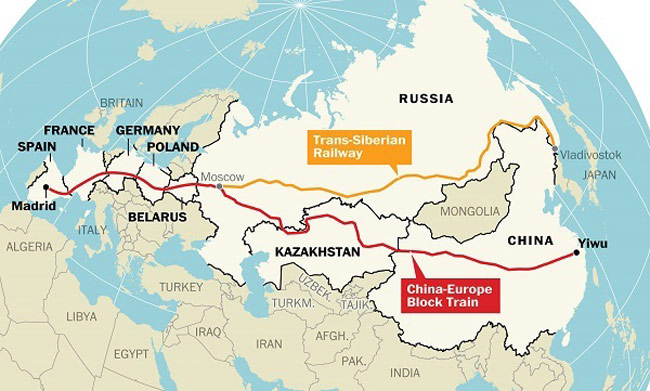
The modern Silk Road East-West, Yiwu/China to Madrid/Spain. Although the transit time for goods or people to transit the route is 21 days, this is 30 days faster than a ship and is 1/10 the cost of shipping freight. See www.bulwarkreview.com

For long periods run by Buddhists in the East and Muslims in the West; Islam using them to expand, from Casablanca to the Philippines. Frankopan sees the high points in the Han dynasty (-207-220, capital Xi’an for West Han), the Tang dynasty (618-902, capital mainly Xi’an) and under Mongolian, Yuan rule–for goods, ideas, faiths, inventions.

Xi’an, 3,000 years old, served as a starting point, both for Silk Roads and for the Silk Lanes, traveling the Yangzi River, or over land, to the East China Sea coast. Till the military uprising against the Tang emperor in 755 (Hansen, Ch. 5, “The Cosmopolitan Terminus on the Silk Road”); but Xi’an is destined always to play major roles.

China is now reviving the past, adding Silk Railroads from East China to Madrid via Kazakhstan-Russia-Belarus-Poland-Germany-France, to Thailand, from East to West Africa–from the Indian Ocean to the Atlantic–from North to South Africa. Silk Flights. And Silk Web.

A silky cocoon is being woven, by worms in China. Too much?

Two features stand out in this approach to geopolitics.Read More »

Obama has failed on nuclear disarmament

By Jonathan Power

During the Cold War barely a week went by without some reportage or debate on nuclear weapons. Not today. Yet most of the nuclear weapons around then are still around.

It would be alright if they were left to quietly rust in their silos. But they are not. When in 2010 President Barack Obama made a deal with Russian President Dimitri Medvedev to cut their respective arsenals of strategic missiles by one-third the Republican-dominated US Congress, as the price for its ratification of the deal, decreed that Obama and future presidents be made to spend a trillion dollars on updating and modernizing America’s massive arsenal.

Now that chicken is coming home to roost – and a few other chickens too.

President Barack Obama’s unexpected legacy is that he has presided over an America that has been at war longer than any previous president. Moreover, of recent presidents, apart from Bill Clinton, he has cut the US nuclear weapon stockpile at the slowest rate.

The Republican’s extreme right clipped Obama’s wings. Of that there is no doubt, making it impossible thus far, to negotiate with Russia any further cuts.

At the same time the counterproductive US/EU confrontation with Russia over Ukraine pushed President Vladimir Putin into the foolish tactic of talking about the possible use of nuclear weapons and deploying intimidating flights over the airspace of the Baltic Sea. When Putin was asked a year ago if Russia was prepared to bring nuclear weapons into play in the confrontation over Crimea, he replied, ”We were ready”.

Yet not all can be pinned on Congress or Putin. Obama’s vision of a nuclear-free world Read More »