Marshallöarna utmanar kärnvapenstaterna

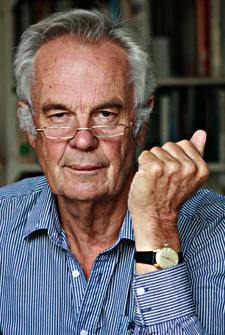
Av Gunnar Westberg

Marshallöarnas utrikesminister Tony de Brum berättade vid den pågående förberedelsekommitténs möte (Prep Com) i FNs-högkvarter i New York, den 28 april till 9 maj 2014 om avtalet mot kärnvapen, NPT, i New York, om sina upplevelser av kärnvapenprov:

Jag har varit vittne till kärnvapenexplosioner och mina minnen från Lipiep-atollen i norra Marshallöarna är starka. Jag bodde där som pojke under de 12 åren som kärnvapenproven pågick. Jag minns det bländande vita ljuset från Bravo-sprängningen på Bikini-atollen år 1954, tusen gånger starkare än den över Hiroshima.

Marshallöarna utsattes för 67 kärnvapenprov mellan 1946 och 1958, motsvarande 1,6 Hiroshima-sprängningar varje dag I tolv år. Följderna finns kvar hos oss som en börda som ingen nation, ingen befolkning, skulle behöva bära.

Marshallöarna förvaltades vid tiden för kärnvapensprängningarna av USA under FN-mandat. Nu är landet självständigt med namnet Republiken Marshallöarna, som omfattar ett stort antal öar med en befolkning av totalt endast 60 000 personer. Landet ar ett avtal med USA som bl a innebär att USA står för försvar och vissa sociala tjänster.

Marshallöarna tar nu strid för att inget land i världen skall utsättas för kärnvapen, inte testsprängningar men framför allt inte kärnvapenkrig. Read More »

TFF PressInfo: GCC Military Command or a More Open Society

By Farhang Jahanpour*

Short e-mail PressInfo version here.

Saudi Military exercises

On 30th April 2014, Saudi Arabia staged its largest-ever military exercises codenamed “Abdullah’s Shield” after the kingdom’s 91-year old ruler and coinciding with the ninth anniversary of his ascension to the throne. The exercises involved 130,000 Saudi troops and showcased some of the latest weapons purchased by the kingdom from the United States and China, including the Chinese CSS-2 intermediate-range ballistic missiles with a range of 2,650 kilometers (1,646 miles) which are capable of carrying nuclear warheads. The Chinese version of these missiles is already equipped with nuclear warheads. This was the first time that these missiles had been seen in public in Saudi Arabia.

Crown Prince Salman presided over the exercises, which were also watched by a number of prominent foreign guests, including King Hamad of Bahrain and more pointedly by Gen. Raheel Sharif, the Pakistani chief of the army Staff. There have been persistent rumors over many decades that in return for Saudi funding of the Pakistani nuclear weapons’ program, Pakistan had committed to provide nuclear warheads for CSS-2 missiles, should Saudi Arabia decide to have them. Earlier in the year when Prince Salman visited Pakistan, he personally invited Gen. Sharif to be his guest at the exercises. Pakistani media stressed the point that Gen. Sharif had gone to Jeddah “on the invitation of Crown Prince Salman bin Abdulaziz al Saud to witness the military exercise…” (1)

With the exception of Bahrain’s ruler, none of the other GCC rulers watched the exercises. The guests included the crown prince of the UAE, the prime minister of Jordan and military commanders from some GCC states, but Qatar pointedly did not send any representatives. This was yet another sign of a growing rift between Saudi Arabia and Qatar.

A unified GCC Command and Monetary Union

At the GCC summit held in Kuwait in December 2013, the Saudis called for a unified GCC military command to have 100,000 forces, half of which would be contributed by the Saudis. (2) However, other GCC members opposed the idea as they saw it as a way of consolidating Saudi domination of other GCC states and affirming Saudi Arabia’s position as the big brother. Many smaller GCC states value their independence, and while they would like to cooperate with other GCC members, they do not wish to be absorbed into a unified military alliance as junior partners. Oman openly expressed its opposition to the proposal and Qatar and Kuwait also followed suit. Read More »

Why the Peace Talks Collapsed—and Should Not be Resumed

By Richard Falk

A week ago Israel suspended participation in the peace talks in response to news that the Palestinian Authority’s Fatah had for a third time concluded a unity agreement with the Hamas leadership of Gaza. Such a move toward intra-Palestinian reconciliation should have been welcomed by Israel as a tentative step in the right direction. Instead it was immediately denounced by Netanyahu as the end of the diplomatic road, contending that Israel will never be part of any political process that includes a terrorist organization pledged to its destruction.

Without Hamas’ participation any diplomatic results of negotiations would likely have been of questionable value, and besides, Hamas deserves inclusion. It has behaved as a political actor since it took part in the 2006 Palestinian legislative elections, and has repeatedly indicated its willingness to reach a long-term normalizing agreement with Israel if and when Israel is ready to withdraw fully to the 1967 borders and respect Palestinian sovereign rights.

The contention that Hamas is pledged to Israel’s destruction is pure hasbara, a cynical means to manipulate the fear factor in Israeli domestic politics, as well as ensuring the persistence of the conflict. This approach has become Israel’s way of choosing expansion over peace, and seemingly ignoring its own citizens’ mandate to secure a stable peace agreement.

Israel had days earlier complained about an initiative taken by the PA to become a party to 15 international treaties. Again, a step that would be viewed as constructive if seeking an end to the conflict was anywhere to be found in Israel’s playbook. Such an initiative should have been interpreted in a positive direction as indicating the Palestinian intention to be a responsible member of the international community. Israel’s contrary lame allegation that by acting independently the PA departed from the agreed roadmap of negotiations prematurely assuming the prerogatives of a state rather than waiting Godot-like for such a status to be granted via the bilateral diplomatic route.

To remove any doubt about the priorities of the Netanyahu-led government, Israel during the nine months set aside for reaching an agreement, authorized no less than 13,851 new housing units in the settlements, added significant amounts of available land for further settlement expansion, and demolished 312 Palestinian homes. Read More »

Homage to International New York Times

By Johan Galtung

On the table are some old clippings mainly from that remarkable paper; in my mind the International Herald Tribune, IHT, from 1857 and a part of my reality for about fifty years. Maybe an addiction? Hard to live without. The recent name change to International New York Times was understandable but too specific geographically, not global. The Honolulu papers, well located, are often more global.

Why homage? Not for the news coverage; usually the news “fit to print”. The news that do not contradict too openly the world views carried by US and Israeli foreign policies, even if this has improved considerably recently. Nor for the editorials, they are usually on the same line and also, sorry, frankly, often boring.

No, the homage is for the articles, essays even, at a very high level in what is after all a newspaper, a paper with news. Those essays often carry discourses that are wide ranging, way back into the past, far into the future. We are not talking about agree-disagree but about broadness, openness, even globally.

Take William Safire 30 September, 1991Read More »

TFF PressInfo: Sverige – inte längre aktör för en bättre värld

Av Jan Öberg
Dr.hc., direktör för TFF
4 maj 2014

Eliten i Sverige är mer lojal mot Nato, USA och EU än mot sitt folk

• Under de senaste 25-30 åren har Sveriges militära, säkerhets- och utrikespolitiska elit vridit Sveriges politik 180 grader.

• Dessa grundläggande förändringar inleddes av den socialdemokratiska regeringen under Göran Persson och utrikesminister Anna Lindh och har genomförts praktiskt taget utan offentlig debatt.

• Omsvängningen till interventionism, militarism och USA/Nato på alla områden har planerats gradvis, i smyg och ohederligt – kort sagt på ett sätt som är ovärdigt en demokrati.

• Denna elit är mer lojal mot Bryssel och Washington än mot svenskarna.

• Om din bild av Sverige är att det är ett progressivt, förnyande och fredsfrämjande land med global inställning som försvarar folkrätten så är den – tråkigt nog – föråldrad.

Hur Sverige har förändrats

Sverige är inte längre neutralt och det är bara formellt alliansfritt; det finns ingen mer närstående bundsförvant än USA/Nato. Landet har upphört att utveckla en egen politik och positionerar istället sig inom ramen för EU och Nato. Landet bidrar inte längre med betydelsefullt nytt tänkande – det sista var Olof Palmes kommission om gemensam säkerhet (1982).Read More »

TFF PressInfo: Sweden – no longer a force for good

Sweden’s elite more loyal with NATO, the US and EU than with its people

By Jan Oberg

May 2, 2014

• Over the last 25-30 years Sweden’s military, security and foreign policy elite has changed Sweden’s policy 180 degrees.

• These fundamental changes were initiated by the Social Democratic government under Goran Persson and foreign minister Anna Lindh and have been carried through virtually without public debate.

• The rapproachment with interventionism, militarism and US/NATO in all fields has been planned, incremental, furtive and dishonest; in short, unworthy of a democracy.

• This elite is more loyal with Brussels and Washington than with the Swedes.

• If your image of Sweden is that it is a progressive, innovative and peace-promoting country with a global mind-set and advocate of international law, it is – sad to say – outdated.

How Sweden has changed

Sweden is no longer neutral Read More »

TFF PressInfo – The West’s hypocrisy in Ukraine

By Jonathan Power

April 29th 2014

When it comes to Ukraine the US and the EU are adopting a holier than thou attitude which, unfortunately, leads them not to worship at the alter of truth.

Take the issue of the fuss made over alleged soldiers wearing Russian uniforms. They are not dressed in the smart fatigues of the unmarked Russian soldiers in Crimea, about which President Vladimir Putin has acknowledged he misled us. What these soldiers, leading the Russian-speaking revolt, are wearing can be bought in any army surplus store. As for the photos Western intelligence has persuaded much of the media to use as evidence, they are hazy and would not be admissible in a court of law.

The Ukranian Security Agency announced that it captured 20 of its Russian counterparts. But then it reduced the number to 10 and then to 3. But the last figure received much less highlighting from Western governments and media than the first.

How all this “Russian interference” compares with the post Cold War expansion by Nato forces up to Russia’s borders, senior Western politicians’ (including the US ambassador) provocative support for a revolutionary movement that included a healthy contingent of neo-fascists who now have seats in the Ukrainian cabinet, and the funding of opposition forces and NGOs, is to be wondered at. (I’ve long been surprised at the tolerance for Western NGOs based in Russia and China. Imagine the reverse.)Read More »

Nonviolent Geopolitics: Law, Politics, and 21st Century Security*

By Richard Falk

In this short essay, my attempt will be to articulate a conception of a world order premised on nonviolent geopolitics, as well as to consider some obstacles to its realization. By focusing on the interplay of “law” and “geopolitics” the intention is to consider the role played both by normative traditions of law and morality and the “geopolitical” orientation that continue to guide dominant political actors on the global stage.

Such an approach challenges the major premise of realism that security, leadership, stability, and influence in the 21st century continue to rest primarily on military power, or what is sometimes described as “hard power” capabilities. [1]

From such a perspective international law plays a marginal role, useful for challenging the behavior of adversaries, but not to be relied upon in calculating the national interest of one’s own country. As such, the principal contribution of international law, aside from its utility in facilitating cooperation in situations where national interests converge, is to provide rhetoric that rationalizes controversial foreign policy initiatives undertaken by one’s own country and to demonize comparable behavior by an enemy state. This discursive role is not to be minimized, but neither should it be confused with exerting norms of restraint in a consistent and fair manner.

My intention is to do three things:

• to show the degree to which the victors in World War II crafted via the UN Charter essentially a world order, which if behaviorally implemented, would have marginalized war, and encoded by indirection a system of nonviolent geopolitics; in other words, the constitutional and institutional foundations already exist, but inert form;

• to provide a critique of the realist paradigm that never relinquished its hold over the imagination of dominant political elites, and an approach has not acknowledged the obsolescence and dangers associated with the war system;

• and, finally, to consider some trends in international life that make it rational to work toward the embodiment of nonviolent geopolitics in practice and belief, as well as in the formalities of international law.Read More »

Peace Economics: Making Money Doesn’t Need to Hurt

By Jelena Mair

Business and Peace are not mutually exclusive. Business does play a crucial role in society. More so, business impacts and depends upon its surrounding. It impacts the
social well-being of people and planet, whether intentionally or unintentionally, both locally and globally through the chosen ways of operation and production.

Equally, does business play a key role in contributing to economic development, peace and stability in the areas where it operates. Business provides jobs and revenue to local markets; sets examples of sustainable business practices and can provide support for various social programs through strategic social investment.

In short, business is an inherent aspect of our society, and therefore, if we are striving for a more peaceful and sustainable world, for-profit private enterprises are the most crucial actors in achieving this goal. Read More »

Time to sanction Israel

By Jonathan Power

US Secretary of State John Kerry’s foray into the politics of peace between Israel and Palestine appears to have run aground despite his tireless and single minded efforts. It is clear that Israel’s Prime Minister Benjamin Netanyahu never believed in it.

Israelis often see their predicament as David against Goliath. In truth it is the reverse. Contrary to popular belief Israel had larger, better equipped and better led forces, during the 1947 war of independence against the joint Arab armies. The Israeli Defence Forces won quick and easy victories against Egypt in 1956 and against Egypt, Jordan and Syria in 1967. All this was done before US aid starting flowing in large amounts. Few doubt it has overwhelming power today, not forgetting its sizeable armoury of nuclear weapons.

Another way to look at the David/Goliath analogy is to look at child deaths as a result of the conflict. The ratio of Palestinian to Israeli children killed is 5.7 to 1.Read More »