Mohammad and the wild, marginal men of the Muslim world.

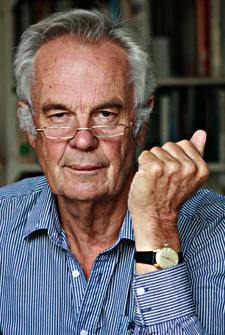
By Jonathan Power

The wild demonstrations that last week burst out in many places in the Middle East, Pakistan, Afghanistan, Sudan and other places will not be the last and neither were they the first to protest Western insults of the prophet Mohammad. Much more serious were the ones that erupted in 1988 following the publication of Salman Rushdie’s novel, “The Satanic Verses”, and seven years ago the protests and threats that followed the publication of satirical cartoons in a Danish paper, mocking Mohammad.Read More »

Embassy protests and Middle East unrest in a context

By Stephen Zunes

It seems bizarre that right-wing pundits would be so desperate to use the recent anti-American protests in the Middle East—in most cases numbering only a few hundred people and (except for a peaceful Hezbollah-organized rally in Lebanon) in no cases numbering more than two or three thousand—as somehow indicative of why the United States should oppose greater democracy in the Middle East. Even more strangely, some media pundits are criticizing Arabs as being “ungrateful” for U.S. support of pro-democracy movements when, in reality, the United States initially opposed the popular movements that deposed Western-backed despots in Tunisia, Egypt, and Yemen, and remains a preeminent backer of dictatorships in the region today.

Meanwhile, Mitt Romney falsely accused President Obama Read More »

The case against war: Ten years later

By Stephen Zunes

Ten years ago, I wrote a series of articles for the Foreign Policy in Focus website in which I put forth a series of arguments against the Bush administration’s push for a U.S. invasion of Iraq prior to the fateful congressional vote authorizing the illegal, unnecessary, and ultimately disastrous war. At the request of the editors of The Nation – the oldest continually published weekly magazine in the United States – I wrote a version entitled “The Case Against War,” which appeared on their website September 12, 2002 and as the cover story of the September 30 issue. It became one of the most widely circulated articles in the magazine’s 147-year old history. Every congressional office received multiple copies.Read More »

The Democratic Convention – Soviet-style and denial

By Johan Galtung
From Charlotte, NC-USA – 5 September 2012 [i]

The Democratic National Convention, DNC, floated into oblivion with no debate – Soviet style, hallelujah, amen – with no mention of overt wars with 5-6 Muslim countries; of covert wars by drones and SEALs-US Navy’s Sea, Air and Land Teams with many others; and the war on terror. Like the Republican National Convention, RNC, squeezing out Ron Paul, who argued for no bases, no wars, no support to Israel.Read More »

Attacking Iran: Disaster for the region and the whole world

By Johan Galtung

The Israeli attack seems imminent. Richard Silverstein circulates a leaked “shock and awe” strategy of Benjamin Netanyahu / Ehud Barak hard zionism to decapitate, paralyze Iran; and Alon Ben‑Meir (an expert on Middle East politics specializing in peace negotiations between Israel and Arab states) says Israel is not bluffing. Israel may prefer an attack with the USA (Romney? Obama after elections?), but may go alone. Some people believe the nuclear bomb story, others believe that the purpose is Israel as a Jewish state from the Nile to the Euphrates, also promoted by Netanyahu’s late father. The two stories do not exclude each other.

Iran is a Shanghai Cooperation Organization-SCO observer. An attack will trigger responses from the Russia‑China core. What Israel may gain in Saudi Sunni support they may lose in more important parts of the world, in diplomatic and economic relations. The SCO is huge.

There is also the real danger of a world war of NATO against SCO, with nuclear powers divided 4‑4; USA‑Israel being indivisible as they came into being in the same way: by taking somebody else’s land.

Iranian devastating responses will come before decapitation. Read More »

Democratic leaders undermine Israeli-Palestinian peace and their own procedures

By Stephen Zunes

In a stunning violation of its own rules, the wishes of the majority of delegates at its national convention, and positions taken by the United Nations and virtually every country in the world, the Democratic Party leadership pushed through an amendment to its platform early during its proceedings on Wednesday, with barely half the delegates present and without allowing for any discussion or debate, stating that Jerusalem “is and will remain the capital of Israel” and should be “undivided.”

The language, as foreign policy analysts noted, is in “in direct opposition to longstanding U.S. policy on Jerusalem” that the status of the city should be determined by talks between the Israelis and Palestinians, both of whom desire Jerusalem as their capital, and that the city should not be unilaterally recognized as the capital of either Israel or Palestine until then. Read More »

U.S. shares responsibility for Rachel Corrie’s death

By Stephen Zunes

On August 28, an Israeli court rejected a civil lawsuit against Israeli occupation forces for the 2003 murder of Rachel Corrie, a 23-year old American peace activist killed in the Gaza Strip, upholding a severely flawed internal Israeli military investigation.

Amnesty International strongly condemned the decision, noting how “the verdict continues the pattern of impunity for Israeli military violations against civilians and human rights defenders in the Occupied Palestinian Territories (OPT). The verdict shields Israeli military personnel from accountability and ignores deep flaws in the Israeli military’s internal investigation of Corrie’s death.”Read More »

Guatemala’s murderous past and this month’s belated justice

By Jonathan Power

Guatemala’s claim to fame, apart from the ruins of the highly sophisticated Mayan civilization which present generations had nothing to do with, is that it is the country with the worst human rights record in the twentieth century among all the countries in the western hemisphere.

I recall once going to interview the then secretary-general of Amnesty International, Thomas Hammarberg, and asking him the country I should visit that had the worst human rights record in the world. He said “Guatemala”. I then asked how many political prisoners did it have. (Amnesty has a well tried and successful system of adopting political prisoners and then showering the authorities with demands they be released.) He replied “There are no political prisoners only political killings”.Read More »

Toward a new geopolitics?

By Richard Falk

During the Cold War the main geopolitical optic relied upon by policymakers and diplomats was associated with a bipolar structure of hard power. There were supposedly two superpowers with overwhelming military capabilities compared to all other sovereign states, and each controlled an alliance of subordinate states that staked their survival on global crisis management and territorial containment skills of either the United States or the Soviet Union.

This framework was an extreme version of the balance of power system that had sustained global order in the West with mixed results during prior centuries. The Cold War nuclear version of the balance of power was frighteningly vulnerable to accident or miscalculation creating a lingering illusion that the current possession of nuclear weaponry on the part of nine sovereign states is a tolerable and stable situation in global affairs.Read More »