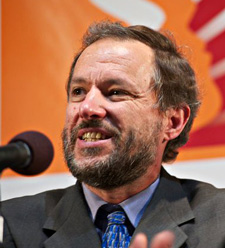
Opening the other eye: Charles Taylor and selective criminal accountability

By Richard Falk

From all that we know Charles Taylor deserves to be held criminally accountable for his role in the atrocities committed in Sierra Leone during the period 1998-2002. Taylor was then President of Liberia, and did his best to encourage violent uprisings against the governments in neighboring countries so as to finance his own bloody schemes and extend his regional influence.

It was in Sierra Leone that ‘blood diamonds,’ later more judiciously called ‘conflict diamonds’ were to be found in such abundance as to enter into the lucrative world trade, with many of these diamonds finding their way onto the shelves of such signature jewelry stores as Cartier, Bulgari, and Harry Winston, and thereby circumventing some rather weak international initiatives designed to prevent this outcome.Read More »

Choosing a president for the World Bank: West centrism prevails over global democracy

By Richard Falk

This post is a revised version of a text that appeared a few days ago in Al Jazeera English, and seeks to use the selection of an American as the new President of the World Bank both to expose the fraudulent claim of a merit-based selection process and to insist indirectly that the future peace and justice of the world requires a more democratic and legitimate structure of global governance that reflects the post-colonial rise of the non-West, a rise that is not reflected in antiquated structures that persist despite changed conditions.

******************************************

The unsurprising announcement that the Board of the World Bank had voted in favor of the American candidate, Jim Yong Kim, presents an opportune moment to reflect upon the soft power structures that shape global public policy in the early 21st Century inside the UN system and beyond.

It is necessary to draw a distinction between Mr. Kim’s substantive qualifications and the procedure by which he was selected. Substantively, although lacking in either financial or diplomatic experience, Dr. Kim is in certain respects an interesting choice because of his lifelong dedication to improving the health of the very poor in the global South, as well as his training in medicine and PhD in anthropology.

He has had extensive relevant experience on the ground, and in working with NGOs (he co-founded the widely admired Partners in Health) and in institutional settings (for some years he directed the HIV/AIDs program for the World Health Organization) and has been president of Dartmouth University for the past three years, although stirring controversy during his brief period of administrative tenure. It may be still wondered whether Dr. Kim understands sufficiently the economic dimensions of World Bank policy to enjoy the respect of the professional staff, and might have been more appropriately chosen to head an enhanced program of the Bank devoted to health and poverty.

Overall, still, the substantive case for the appointment is relatively strong, although the two opposing candidates, both former finance ministers of developing countries, certainly had equally impressive substantive résumés and ethical profiles, and were plausible choices for this position.

The procedural criticisms of the appointment process are far more serious…Read More »

Continuities in U.S. history

By Johan Galtung
From Appomattox, VA – USA

The Civil War ended 147 years ago with General Robert E. Lee of the CSA, Confederate States of America, capitulating to General Ulysses S. Grant of the USA, United States of America. Ended? Not quite. Grant accepted the capitulation of the Army of Northern Virginia; the others capitulated one by one (like Army of Tennessee 26 April, Trans-Mississippi June 2 and finally, November 6, Confederate cruiser Shenandoah surrendered).

The Washington Post (Apr 1, 2012) celebrated the opening of the Appomattox branch of the Museum of the Confederacy the day before, quoting the museum curator: “it is one of the great turning points, if not the great turning point, in American history–when we kind of decided once and for all exactly what it means when we say, ‘liberty and justice for all.’”

Turning point? Not quite. Grant could not accept surrender of the CSA as that would recognize the Confederacy. One rebel at the time. Soldiers within 20 miles of Appomattox, no actor!, were generously given US Army rations as they were starving, and free passage on federal means of transportation on their way home.

We sense a theme: no recognition of collective actors with a cause. Read More »

What do you want, USA? Go up or down?

By Johan Galtung
Washington, DC

One wonders what the US political leaders want. The incumbent lives in this world, playing an ultra-realist game: extra-judicial executions in maybe 70 countries, drone attacks; minimizing US losses, maximizing direct hits at what he sees as the problem, concrete identified individuals, not concrete unidentified conflicts. He has neither the moral nor the intellectual courage to do that.

The challengers, with one exception, are focusing on one issue: down with the welfare state. Ron Paul, the libertarian, adds: down with the warfare state. He has registered Vietnam-Afghanistan-Iraq and the next in line, Iran-Syria, as unwinnable and unaffordable for a bankrupt economy. Young Republicans and others flock to him, but his discourse is too unusual. Warfare, not welfare makes sense. This has to do with the relation to conflict, a three-headed problem: attitude, behavior, contradiction. The USA wants an attitude of love for the USA, military response to evil people who do not and act on that, and contradiction, incompatibility are outside the thinkable. The deep culture of good vs evil and Armageddon for the latter take over.

Well, does it? The reader is invited to look at the scheme below.Read More »

One of the world’s leading peace advocates threatened to punch me in the face

By Stephen Zunes

Gareth Evans, a former attorney-general and foreign minister in Australia, threatened me because I raised the issue of his support for the Suharto dictatorship in Indonesia.

I have rarely ever come face to face – only inches in fact – with such anger. Certainly not at an academic conference. And certainly not from such a prominent figure: chancellor of Australian National University, former attorney-general and foreign minister, former head of the International Crisis Group, and one of the world’s most prominent global thinkers.

Yet here I was with Gareth Evans, cursing at me, ripping my badge off, and threatening to punch me in the face.Read More »

The hypocrite, the fanatic, or Obama?

By Richard Falk
While the headline deals with the Presidential candidates, Falk reflects also on the essence of democracy itself and on whether the US can at all be called a democracy.

The American electorate is facing a presidential election in which there is almost no prospect of a constructive debate. On the Republican side the campaign for the nomination has exhibited the clash of irresponsible and reactionary views, slightly relieved by the libertarian Ron Paul who at least counsel against militarism and the death dance with Israel.

All the Republican presidential hopefuls, except Paul, exhibit a craven distaste for reality when they attack Obama for being insufficiently pro-Israeli, as if 95%+ is insufficient. Such a posture, whether meant seriously or not, expresses contempt for the intelligence and common sense of the American citizenry.Read More »

Get the law and politics right in Iran now!

By Richard Falk

In his important article in the New York Times, March 17, 2012, James Risen summarized the consensus of the intelligence community as concluding that Iran abandoned its program to develop nuclear weapons in 2003, and that no persuasive evidence exists that it has departed from this decision.

It might have been expected that such news based on the best evidence that billions spent to get the most reliable possible assessments of such sensitive security issues would produce a huge sigh of relief in Washington, but on the contrary it has been totally ignored, including by the highest officers in the government. Read More »

Syria – here are some solutionS and roadS to them

By Johan Galtung

We all feel desperate watching the horrible killing, feeling the suffering of the bereaved, the whole people. But, what to do?

Could it be that the UN, and governments in general, have a tendency to make the same mistake, again and again, of putting the cart before the horse? The formula they use is generally:

[11 Get rid of No. 1 as key responsible, using sanctions; then

[2] Cease-fire, appealing to the parties, or intervening, imposing;

[3] Negotiation among all legitimate parties; and from that

[4] A political solution as a compromise between the positions.

It looks so logical. There is a key responsible, President Assad, ordering the killing; get rid of him by all means. Then the cease-fire, the fire ceasing; then negotiation, and then the solution emerges. Logical, yes; but maybe not very wise.Read More »

Afghanistan: The war turns pathological – Leave!

By Richard Falk

The latest occupation crime in Afghanistan is a shooting spree on March 11 by a lone American soldier in the village of Balandi in the Panjwai District of Kandahar Province of Afghanistan. 16 Afghan civilians, including women and children, were shot in their homes in the middle of the night without any pretense of combat activity in the area.

Such an atrocity is one more expression of a pathological reaction by one soldier to an incomprehensible military reality that seems to be driving crazy American military personnel on the ground in Afghanistan. The main criminal here is not the shooter, but the political leader who insists on continuing a mission in face of the evidence that it is turning its own citizens into pathological killers.Read More »

Koran burning in Afghanistan: Mistake, crime, and metaphor

By Richard Falk

On February 20, 2012 several American soldiers, five having been identified as responsible at this point, took some Islamic writings including several copies of the Koran to a landfill on Bagram Air Base in Afghanistan where they were burned. As soon as Afghan workers on the scene realized that Korans were being burned, they recognized what was happening as an act of desecration, and launched an immediate protest. The protest spread rapidly throughout the country, and turned violent, producing at least 30 Afghan deaths, as well as five dead American soldiers that also produced many non-lethal casualties.Read More »