TFF PressInfo # 390 – Ten articles on the new Cold War and a reflection

By Jan Oberg

Lund, October 26, 2016

Over the last four month, ten articles about the new Cold War have been published on the TFF Associates blog. And on our social media you’ll find hundreds of brilliant, informative posts written by others.

While this new Cold War is certainly different from the first Cold war that ended in 1989, we are not in doubt that there is a new such tragic war and that the risk of military confrontation between Russia and NATO countries in Europe has increased.

We also happen to think it could have been avoided.

This Cold War has to do with, among many other things, NATO’s counterproductive expansion since 1994, the way Yugoslavia broke down and was broken up, with Ukraine and now Syria as well as – perhaps surprisingly to some – the rapidly diminishing political power and legitimacy of the West in the emerging world order.

A reflection on how security politics and media contribute to the closing of the open society

The increasing symbiosis between the political and the leading mainstream media of the Western world implies that, grosso modo, Russia is blamed for having caused this new situation. While Russia is certainly not innocent and it usually does take two to conflict this blame is rather a sign of diminishing capacity (knowledge) and will (economic and intellectual independence and courage) to ask critical questions that now characterise the corporate media.

Defence and security political news coverage, journalistic processing, editing and commentaries have sunk to an intellectual level that is considerably lower than during the first Cold War. The entire field is given low priority by editors. Domestic issues, sports, entertainment, lifestyle etc. have made it to the top.

Out of sync with the globalising world, most media do with 1-2 pages about global affairs out of, say, 40-50 pages and they base this material on the same handful of Western news bureaus.

The double checking of a variety of sources, versatility and multi-perspective coverage are things of the past and we see more uniformity and more subjectivity in the news media coverage than ever.

Add to this that both Russia and NATO countries engage in media management, or propaganda (tax payers footing the bills) which squeezes out comprehensive knowledge and unbiased analyses as well as critical angles on one’s own policies and actions.Read More »
Trump visits Putin

By Jonathan Power

October 25th 2016

I have a fantasy. Donald Trump wins. He goes to Moscow on his first trip as president and gives President Vladimir Putin a bear hug and they go hunting in the forest, Soviet style.

When they emerge they have shot a couple of bears and have had a good lunch laid out for them by acolytes at which they have discussed the matters of the world.

They give a press conference. They have decided to re-start negotiations on major nuclear arms reductions and both say they unilaterally are immediately ridding themselves of a 1000 missiles each.

They have found a way to implement autonomy for eastern Ukraine, as done in Scotland, which Trump with his Scottish golf courses knows well. Ukraine can work towards both a trade agreement with the EU and the Russian-backed Eurasian Economic Union. Russia was always happy about such an arrangement, but many Ukrainians weren’t and only wanted an EU arrangement. This was the trigger for the uprising in Kiev and Western support for the powerful revolutionary movements that had a fascist pedigree.

Dealing with Syria is both simpler and more difficult – difficult because of the intensity of the fighting and the multi-nation interests and easier because neither Russia nor the NATO powers want to see a clash over a relatively small part of the global population – Syria’s population is 9 million, about the same as one of America’s eastern states.

In the forest they agreed to stop using Russian warplanes backing President Bashar al-Assad, the US to stop aiding anti-Assad guerrillas and both to concentrate on defeating ISIS. In return the US would invite Russia to share its airbase in Qatar. The civil war opponents would be left alone to fight. UN mediation would continue.

Trump has a point in wanting rapprochement with Russia.

At the moment Read More »

U.S. nuclear weapons – two very different world views

By Jan Oberg

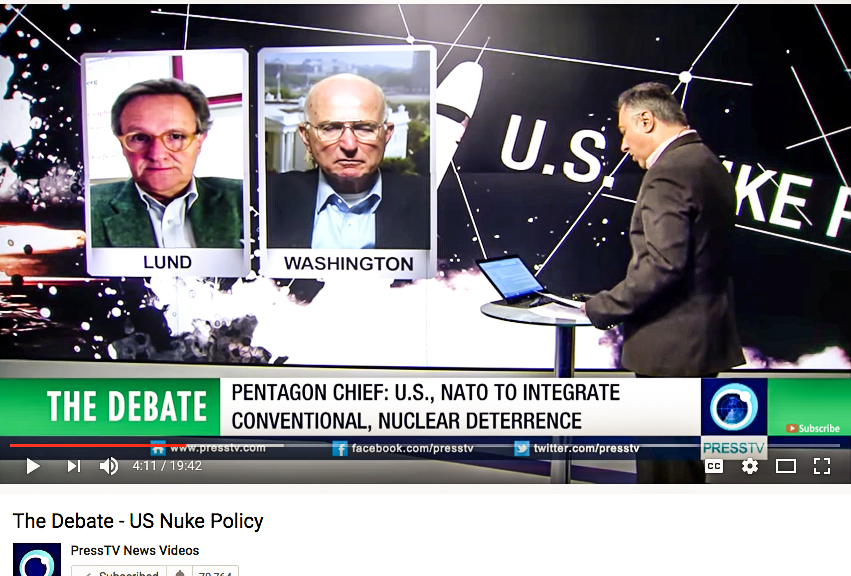
Last night I had the opportunity to discuss nuclear weapons with an experienced, high-ranking security analyst who has been both a military, a scholar, an assistant secretary of defence, presidential adviser, a corporate man and now a think tank member, Lawrence J. Korb.

We were discussing the issues touched upon in this and this article.

I would assume that the debate – facilitated by Iran’s PressTV in an excellent manner – is illustrative of the degree to which the world can be seen from different perspectives and how different we can perceive words such as law, legality, ethics, security, deterrence and peace.

I assume also that the debate illustrates the difference between a systems-embedded interpretation of the world and an independent or free perception, including what can and must be changed and what doesn’t have to change to make the world a better place.

Enjoy!

TFF PressInfo # 389: Ukraine as the border of NATO expansion

And why Russia doesn’t have to be a threat to the West

By Jan Oberg

TFF Series ”The New Cold War” # 7

If the Ukraine conflict is the centerpiece of the new 2nd Cold War, it is essential to ask: What really happened? What did NATO countries do to cause it? What did Russia do to cause it?
And – if you live in the West, in particular: Did we really have to end in this situation given Russia’s significant weakness over 25 years?
This article argues that the superior West could have played its cards differently and it’s time for self-critical soul-searching and just a little living yourself into the shoes of the other.
If peace rather than war is your true aim.

There was a beginning and a framework

The Ukraine conflict has a 25-years history. Instead of dissolving NATO, the alliance was expanded. Relieved from there being a Soviet Union and a Warsaw Pact, the alliance went as fast it could to do all it wanted. Remember, a series of WW III scenarios has been written in which that war would start with some uncontrollable event in Yugoslavia. Now it could be chopped up – freely and without risk. Serbia was bombed and Kosovo carved out without a UN mandate whatsoever (1999).

How did they think about that in the Kremlin at the time, one must wonder?

Clinton literally did not give a damn about all the promises made to Soviet leader Gorbachev by US leaders such as Bush, James Baker and German leaders including Hans-Dietrich Genscher. (Yes, they were not written down but confirmed by those involved and present).

He began the expansion of NATO in 1994 – in Georgia (see what I refer to elsewhere in this series). All around a Russia on its knees Americans were placed in the offices of prime ministers, defence and foreign ministers – I saw it myself in former Yugoslavia – and met CIA people in Croatia disguised as humanitarian workers. And had a long conversation with the representative of the US in Tblisi in 1994. Historical moment!

The bad Christians, the Orthodox, were the Serbs and Russians and Greeks – all should be antagonized and the good guys in Yugoslavia were those who had been on the fascist side in WWII – the leaderships in Croatia, Muslims in Bosnia and the Kosovo Albanians. The Serb minority that had lived 400 years as a minority in the Croatian republic were, in the common Western discourse, invaders masterminded by strongman Slobodan Milosevic – whom Clinton without hesitation called the new ’Hitler of Europe’.

Ukraine was – and remains – what its name says: the border areas (like Krajina in Croatia). This is where NATO can establish itself as little as Chruschev could get away with deploying nukes in Cuba – considerably further away from the US, but anyhow.

Imagine – with a little bit of empathy (not necessarily sympathy) how Washington would react if today Putin’s Russia was 12 times stronger militarily than the alliance-free US (NATO dissolved 25 years ago) and tried with his alliance of 27 other members to make Canada or Mexico the 29th member. Perhaps most people in the US and Europe would have some sympathy for the negative reaction of Washington. Rand remember, Trump wants to build a wall to Mexico…

The main reason, it is stated again and again, in the Western press, NATO and other political circles is: Ukraine and Crimea. The lie about Putin’s aggression on Ukraine is told so many times that it is becoming the truth. Just see these two recent articles by Newsweek as two of hundreds of articles.

Here’s the chosen story in politics and media alike

The narrative is simplified beyond recognition and goes like this:

Putin (there is always just one top guy in Western eyes and it is one leader at the top like Milosevic, Mohamed Farah Aideed, Saddam Hussein, Moammar Khaddafi, al-Assad) is a bad guy and you know that because out of the blue his suddenly annexed Crimea. By that he changes the borders of Europe and then he gets his disguised soldiers into Eastern Ukraine – a Ukraine that we, in contrast to Bush Senior, care very very much about today.

We care so much about it that Read More »

The Future of Europe: The capacity to integrate, for dialogue and to generate

By Maired Maguire

“War is illegal and immoral, it has to end and it can be ended.’

Speech at the international meeting “Thirst For Peace”, Assisi September 18-20, 2016. Promoted by Community of Sant Egidio and Diocese of Assisi and Franciso Families.

Dear Friends,

I am happy to be here at this International Meeting and I would like to thank our hosts, for their invitation to attend. I have always been inspired by the lives of St. Francis and St. Clare, whom I believe are Icons of Christian Gospel Peace and Nonviolence.

Francis the man of action, steeped in empathy and love for all, and Clare a woman of prayer, whose love of God led her into the depth of mysticism and peace.

Francis and Clare lived in a time of violence and war, yet they choose to live the nonkilling/nonviolence of Jesus. Francis as a youth fighting in his local military, knew well how to wield a sword, yet he choose to follow the command of Jesus to Peter, when he told him to put up his sword and healed the Soldier’s ear.

He left the military to live in poverty and service, and together with Clare, and his followers refused to take up arms. Francis and Clare, in the midst of much feudal violence, choose to follow the Christian nonviolence manifesto ‘the Sermon on the Mount’.

For many people in Europe and the world, challenged by growing violence and injustice, the lives of these two great 13th century Saints gives us hope and inspiration.

Pope Francis, following in the steps of St. Francis, gives us all hope as he challenges us to work for the abolition of the death penalty, ending poverty, the arms race, nuclear weapons, and environmental destruction, etc.,

However, I believe we need a clear renunciation of the ‘just war’ theory (a phoney piece of morality in the words of the late Fr. John L. McKenzie) and I add my voice to those appealing to Pope Francis for an Encyclical on Peace and Nonviolence, calling Christians to rejection militarism and war and to follow a Peace theology in keeping with the teachings of the Nonviolent Jesus.

This would give great Spiritual leadership not only to Europe but to Humanity.

I believe Europe todayRead More »

More US hostility towards China?

By Jonathan Power

September 20th 2016

The two American presidential candidates give the impression of being rather hostile towards China. This is counterproductive.

“The US should not adopt confrontation as a strategy of choice. In China, the US would encounter an adversary skilled over the centuries in using prolonged conflict as a strategy and whose doctrine emphasizes the psychological exhaustion of the opponent. In an actual conflict both sides possess the capabilities and ingenuity to inflict catastrophic damage on each other. By the time any such hypothetical conflagration drew to a close, all participants would be left exhausted and debilitated. They would then be obliged to face anew the very task that confronts them today: the construction of an international order in which both counties are significant components”.

Henry Kissinger who wrote this four years’ ago, was the architect, along with his boss, President Richard Nixon, of the US’s rapprochement with China which led to Communist China taking up its seat on the Security Council and to full diplomatic recognition.

But these days China has begun to feel the old Soviet paranoia that it is being not only contained but encircled. The US of President Barack Obama has been giving it a hard time. The dispute over the ownership of the islands in the East and South China Seas is profoundly threatening for most members of China’s governing elite. Indeed they are right to feel partially encircled.

China has no friends to the east and to the south, except North Korea. To the west it has Read More »

The Global Right and Left and Immanuel Wallerstein

By Johan Galtung

Immanuel Wallerstein is unique. Nobody else has presented such a coherent theory of what he calls the modern world-system, from “the long 16th century” up till today; essentially capitalist. There are ups and downs during those four centuries. He is very much at home in the economic Kondratiev cycles–A for up, B for down, but not that much down–and in the political-military hegemonic cycles of the would-be hegemons in the same period.

Read Immanuel Wallerstein and become wiser.

He warns against the Global Right “Lampedusa tactic” of “changing things so that they remain the same”. And insists on Liberty, Equality and Fraternity for the Global Left–but sees the French Revolution more as normalizing change than as people’s sovereignty. Like faith in the middle classes: they are actually helping the Global Right, when in minority they are enlarged by the majority working classes, when in majority they neglect the working class minority left behind.

Right now Wallerstein sees capitalism in crisis with no remedy – of which I am not so sure – and the US hegemony also in a crisis with no remedy – a view I share – as the fall of an empire with local elites killing for them; now they have to do most of the killing themselves.

The Global Right, in power for a long time, is now faltering. Time for the Global Left?

Or, does Zizek’s brilliant formula “the left never misses a chance to miss a chance” apply?

Wallerstein offers six Global Left proposals:Read More »

9/11 Anniversary: What could have been!

Fifteen years ago on 9/11, Al Qaeda terrorists changed the course of history, and the consequences of what happened on that day are still very much with us, and are arguably even growing more complex and more dangerous.

On 11 September 2001, 19 young Arab militants affiliated to Al Qaeda who had received rudimentary flying instruction in the United States hijacked and flew two passenger aircraft at the twin towers of the World Trade Center in New York, one at the Pentagon in Washington and another aircraft was allegedly also flying towards the White House or the Capitol but it was brought down before it reached its target.

Nearly 3,000 innocent people were killed as the result of those terrorist outrages. In response, America launched the “War on Terror” that has killed upward of a million people, destroyed many Middle Eastern countries, ruined the lives of tens of millions, killed nearly 7,000 US troops and injured another 50,000, and has cost the United States a staggering six trillion dollars.

This was the first time in US history that the American mainland had been attacked after the British troops had set fire to the White House in 1814 during the war between the United States and England. Even during the Second World War the continental United States did not receive any direct attacks, and the closest that the Japanese got was to attack the US naval base at Pearl Harbour in Hawaii, on December 7, 1941.

Of course, during the past few decades there have been numerous terrorist attacks on the US and other targets, the most notable being the attack carried out by Timothy McVeigh on the Alfred P. Murrah Federal Building in Oklahoma City, which claimed 168 lives and left over 800 people injured. McVeigh too had religious motivations for his attacks.

He was a religious fanatic and a follower of David Koresh, and he bombed the federal building on the anniversary of the destruction of the Branch Davidian camp in Waco by federal forces, as the result of which Koresh, 54 other adults and 21 children were burnt alive

One can think of the massacre of close to a million Tutsis and Hutus in Burundi and Rwanda. A Human Rights Watch analysis estimated that 77% of the Tutsi population of Rwanda was slaughtered in the Rwandan Genocide of 1994.

Apart from the initial slaughter of hundreds of Palestinians and the ethnic cleansing of nearly 70% of the Palestinian population in 1948, we had the slaughter of as many as 3,500 Palestinian refugees at the Sabra and Shatila Camps in Lebanon by the Christian Phalangists between the 15 and 16 September 1982, under the supervision of the invading Israeli forces led by Ariel Sharon.

However, the 9/11 attacks have assumed a significance far greater than all other terrorist acts in the world.

Most Americans believe Read More »