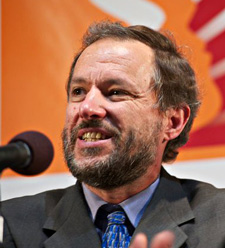
Democrats share the blame for tragedy of Iraq War

By Stephen Zunes

The Democrats who voted to support the war and rationalized that vote by making false claims about Iraq’s WMD programs – a minority of Democrats, but much over-represented in Democratic leadership councils – were responsible for allowing the Bush administration to get away with lying about Iraq’s alleged threat.

Here on the tenth anniversary of the Iraq War, it is important to remember that it was not just those in the Bush White House who were responsible for the tragedy, but leading members of Congress as well, some of whom are now in senior positions in the Obama administration.

Continue reading at truthout

Remembering those responsible on the 10th anniversary of the Iraq War

By Stephen Zunes

This March 19 marks the 10th anniversary of the start of the U.S. invasion of Iraq.

The U.S. war and occupation has resulted in the deaths of up to half a million Iraqis, the vast majority of whom are civilians, leaving over 600,000 orphans.

More than 1.3 million Iraqis have been internally displaced and nearly twice that many have fled into exile.

Almost 4,500 Americans were killed and thousands more have received serious physical and emotional injuries which will plague them for the rest of their lives.Read More »

The Iraq War – 10 years later

By Richard Falk

After a decade of combat, casualties, massive displacement, persisting violence, enhanced sectarian tension and violence between Shi’ias and Sunnis, periodic suicide bombings, and autocratic governance, a negative assessment of the Iraq War as a strategic move by the United States, United Kingdom, and a few of their secondary allies, including Japan, seems near universal.

Not only the regionally destabilizing outcome, including the blowback effect of perversely adding weight to Iran’s overall diplomatic influence, but the reputational costs in the Middle East associated with an imprudent, destructive, and failed military intervention make the Iraq War the worst American foreign policy disaster since its defeat in Vietnam in the 1970s, and undertaken with an even less persuasive legal, moral, and political rationale.

Most geopolitical accounting assessments do not bother to consider the damage to the United Nations and international law arising from an aggressive use of force in flagrant violation of the UN Charter, Read More »

Hugo Chavez: A maker of history

By Johan Galtung

That his life and his deeds had black dots is part of the story; but that should not block seeing the greatness of a maker of history.

First, in his own society, Venezuela, he lifted the bottom people up from misery, into economic wellness, political participation, cultural pride (of their often African, or Indian, blood), social dignity; much beyond Gini coefficients to measure increasing equality. Even the rich human rights language is too bland to reflect all that.

Second, he did the same for Latin America; he helped lift the bottom countries up, also under the name of the iconic Simón Bolívar: Cuba and Nicaragua, Ecuador and Bolivia, Brazil to mention some.

Of course the two policies are related. Colombia with its immense record of violence 1948-2013, is a pariah country and can only be lifted up by lifting its bottom up, attacking flagrant inequality. Chávez and his fellow leaders Castro and Ortega, Correa and Moráles, Lula, are on line. The leadership of the continent, with Kirchner from Argentina, and the Salvador Allende icon from Chile! A formidable team; well beyond the European leaders trying to manage their crises.Read More »

Iraq and the betrayal of a people – Impunity forever?

By Hans von Sponeck

Iraq’s recent history includes two far reaching events, on the 2 August 1990 Iraq’s invasion into Kuwait and on 19 March 2003 the US/UK invasion into Iraq. Whether political leaders will draw lessons from these events will be, at best, questionable. Iraqis continue to be wronged. Danger to life and turmoil remain a cruel part of Iraq’s reality in early 2013. The collective suffering of a nation is visibly all pervasive. It can not be hidden.

The Iraqi puzzle of life confirms an endless number of tragedies
Ethnic tension and sectarianism have become a major element in Iraqi politics since the US/UK invasion of 2003, a polarization of inter-group relations  Iraqis had not known before. This explains much of the existing hideous crime including murder, kidnapping, property destruction and, most noteworthy, the deteriorating relationships between Baghdad and the three northern Kurdish governorates.

Since the years of war, sanctions and occupation, Iraq’s once state-of-the-art medical system has all but collapsed. Malnutrition and diseases, almost forgotten in Iraq, such as respiratory infections; measles; typhoid fever and tuberculosis have re-emerged on a large scale. The planned destruction of water and sanitation facilities, especially in the 1991 war, and recurrent drug shortages, throughout the period of sanctions and after the 2003 invasion, promoted significantly ill-being, morbidity and mortality in the country (WHO). Read More »

Crying wolf over Iran’s nuclear program

By Farhang Jahanpour

Crying wolf – the evidence

After producing his comic diagram during his speech at the United Nations General Assembly last September, drawing a red line in order to stop Iran’s alleged imminent nuclear bomb, the Israeli Prime Minister Benjamin Netanyahu called for immediate action against Iran before it was too late.

However, as the result of President Barack Obama’s insistence that he wanted to resolve the dispute by peaceful means, the war fever subsided to some extent. However, on the eve of the meeting between Iran and the P5+1 in Almaty, Kazakhstan, and the forthcoming visit of President Obama to Israel, Netanyahu has once again started to press the panic button about Iran’s nuclear intentions.

Referring to Iran’s announcement that she was installing new centrifuges for enriching uranium, and undaunted by his earlier false predictions, Netanyahu once again claimed that the new centrifuges could cut by a third the time needed to create a bomb.1)

However, when Israel’s intense campaign to start a war with Iran stalled, Israeli officials said that their original assessment about the deadline for dealing with Iran had been false. As Jacques E. C. Hymans points out in his recent article in Foreign Affairs, Israeli intelligence officials have now downgraded their assessment of Iran’s ability to build a nuclear bomb.2) Now, they say: “Iran won’t be able to build a nuclear weapon before 2015 or 2016, pushing back by several years previous assessments of Iran’s nuclear ambitions.”3)Read More »

Cambodia leaves the darkness behind

By Jonathan Power

Dateline: Phnom Penh, Cambodia, March 5th 2013

Cambodia has lain for too long under the black umbrella of its past. But Cambodia is waking up, has looked the evil one in its eye and, re-born, found its strength.

Cambodia has been to hell and back – 2 million of its people killed out of population of 8 million, with 500,000 of them executed, the consequence of a fanatical communist movement, the Khmer Rouge, led by Pol Pot and a group of henchmen now being tried in the UN War Crimes Court. (Pol Pot himself is dead.)

The Khmer Rouge violently took power in 1975 and fell in 1979. They wanted a classless society. They abolished money, property and religious practices. Family relationships were criticised and people were forbidden from even showing the slightest affection. The work day in the fields was 12 hours long without pause. Torture and the bullet were the instant punishment for deviance. Anybody educated was singled out for death.Read More »

What’s The Problem With Iran?

TFF PressInfo 1-2013

On Tuesday February 26, in Kazakhstan, a new round of negotiations are due between Iran and the Five Permanent UN Security Council members + Germany. We’d like to bring the following expert statement to your attention.

Contacts for interviews as well as analytical sources below the statement.

Summary

The problem is not nuclear weapons, essentially. It’s strategic interests such as control of oil and gas and that requires a change of Iran’s ‘obstinate’ and ‘defiant’ regime.


The present US/NATO/EU policy is based on escalating threats without an exit strategy. This increases the risk of war, whether intended or not. If that is not the deliberate purpose, an entirely new Western policy vis-a-vis Iran must be developed.

The Transnational Foundation in Sweden – an independent think tank with 27 years of experience – provides you with the diagnosis, the prognosis and the proposals for improved relations built on trust.
 (See below.)Read More »

Room for optimism in Iran and the P5-plus-1 talks

By Farhang Jahanpour*

Iran and the P5-plus-1, which includes the United States, will meet again on 26 February in Kazakhstan. This is the first time that the two sides will meet in an atmosphere of continuing mutual suspicion since the third round of talks held in Moscow on 18-19 June 2012 ended in stalemate.

Iran believes that the West, particularly the United States, is using the talks as a pretext to increase the sanctions until Tehran bends to its will; whereas Washington holds that Iran is prolonging the talks in order to continue its uranium enrichment with the aim of producing a nuclear weapon. The fact of the matter is that neither side is sincere in their remarks and both sides are engaged in a cat and mouse game trying to use the talks for domestic purposes and for pursuing other goals, rather than finding a mutually acceptable solution to Iran’s nuclear program.Read More »
