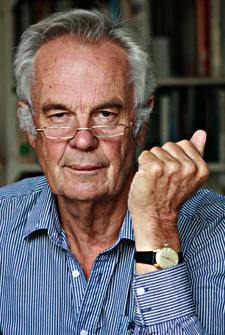
TFF PressInfo: Wow, Hillary Clinton as moral philosopher

By Jan Oberg, TFF director

Jan Oberg

Lund, Sweden July 31, 2014

Responsibility for wars and killing

A number of Western/NATO politicians – Hillary Clinton foremost among them – and media people have recently introduced a new ethical principle in international affairs:

When A delivers weapons to B, A is responsible for what B does with these weapons. The former Secretary of State and perhaps future U.S. President presents this new ethical principle here on CNN.

This makes a lot of sense to me. Look at it this way:

Here is a young confused boy who has little to look forward to – and less to lose – because his country is falling apart in nasty civil war. He’s been told by some commander, or by his President, that he must hate the enemy; he gets paid for killing off as many as he can. And so he does.

He believes also in what he’s been promised: Fame as a hero upon return – that is, if he returns – and a comfortable life.

So he kills people, Read More »

Three elections, three reactions: Ukraine, Egypt and Syria

By Farhang Jahanpour

On Friday 27 June, Ukraine’s new president Petro Poroshenko signed a trade and economic pact with the European Union. It was the same deal that his predecessor, Viktor Yanukovych, was prepared to sign in November 2013 provided that he could also maintain economic links with Russia, but he eventually backed out from signing it due to US and EU insistence that he had to choose between the two.

That event led to violent street demonstrations that forced Yanukovych to flee, pushing his troubled country towards upheaval and a virtual civil war.

On Thursday 26 June, President Obama requested $500 million from Congress to train and arm what the White House called “appropriately vetted” members of the Syrian opposition to fight against President Bashar Assad.

This is despite the fact that the insurgents fighting in Syria have morphed into Al-Qaeda-affiliated Jabhat al-Nusra and even into ISIS, the Islamic State in Syria and Sham or greater Syria that has overrun parts of both Syria and Iraq and has been even disowned by Al-Qaeda for being too violent!

A week earlier, during a tour of the Middle East, US Secretary of State John Kerry met with the new Egyptian President, the former Army Chief, General Abdel Fattah el-Sisi, pledging American help and support for his government. Officials accompanying Kerry on the trip told reporters that Washington had quietly restored all but about 78 million dollars of the 650 million dollars of US aid to Egypt earlier this month.

Kerry told reporters in Cairo after meeting Sisi that he was “absolutely confident” that all of the aid would soon be restored. (1) Washington has provided Cairo with an average of about 1.3 million dollars in military aid annually over the past three decades as part of the Camp David Accord signed by the late President Muhammad Anwar Sadat and the late Israeli Prime Minister Menachem Begin at Camp David under President Jimmy Carter.

As it happens, there have been elections in all the three countries in June, and it is useful to study the circumstances surrounding those elections and the West’s reactions to those elections.Read More »

Israel-Palestine: Beyond the liberal imaginary

By Richard Falk

Prefatory Note:
What follows is a letter to the NY Times responding to their editorial of June 6, 2014, which was not accepted for publication. I publish it here as a post because I believe it identifies some of the continuing ways in which public opinion on the relationship between Israel and Palestine continues to be distorted on Israel’s behalf in American media sources that have the undeserved reputation of being objective and trustworthy. The New York Times has long ranked high on this list, if not at its top!

This letter is particularly concerned with the misleading characterizations of Hamas, and the failure to pass judgment on the Netanyahu leadership as ‘extremist.’

*****************

To the Editor, New York Time

Re “Israeli-Palestinian Collision Course” (editorial, June 6, text reproduced below):

You are correct that this is an opportune time to take account of Israel-Palestine peace prospects in light of failed direct negotiations and subsequent developments. It is misleading, however, to equate Israel’s accelerated expansion of settlements with the formation of the Fatah-Hamas unity government. Israeli action continues a pattern of flagrant violation of the 4th Geneva Convention while the Palestinian action is a constructive move that could finally make diplomacy on behalf of all Palestinians legitimate and effective.Read More »

Do Russia and China threaten the West?

By Jonathan Power

In recent months the scare-mongers have been at it again – Russia’s foray into Ukraine and China’s behaviour in the South China Sea have set their alarm bells ringing. But why?

Big power politics is not back. Indeed in the round it is rather subdued. Take the Russian-EU-US fracas over Ukraine at the moment. Does this compare with the Cold War when the West prepared itself for a Russian invasion of Europe, nuclear missiles were targeted on each other, and when the Soviet Union along with the US stirred up proxy civil wars in Central America and Africa?

Do the US and NATO fear such threats as these today? Of course not. Critics of President Barack Obama and denigrators of President Vladimir Putin badly need a sense of perspective.Read More »

TFF PressInfo: Democracy’s crisis – 10 points

By Jan Oberg

Democracy is a core feature of Western society, normally understood as representative parliament – i.e. in free elections citizens vote for people to represent their interests for a parliament consisting of parties of which some form the government and some the opposition.

It’s not always included in the definitions that democracy requires a reasonable level of knowledge and information, freely available. For instance, one often hears that India is the world’s biggest democracy but 26% of the people are still illiterate (287 million people).

So the ”world’s largest democracy” also has the world’s largest population who can’t read and write. In comparison, China illiterate citizens make up about 3% and is regularly called a dictatorship.

Also, in a society where the persons running for office are – or have to be – extremely wealthy to pay for their campaign and where large corporations make multi-million dollar contributions to certain candidates (presumably not out of altruism), falls outside a reasonable definition of democracy – even though they may also not be dictatorships; there are many stations in-between the two.

Are young people giving up parliamentary democracy?

When I was in my high-school years – a few decades ago – and wanted to contribute to changing society for the better, the most natural thing to do – and the finest – was to join a political party. Not so today. My students in peace studies around the world often ask me at the end of a course and it is time to say goodbye whether I can help them somehow in making their career. Their career dreams may be to work for the UN, for human rights, the environment or starting their own NGO with a peace profile or set up their own consultancy firm for a better world.

Significantly, over all these years, only one single student asked me what I thought about contributing to peace and development by becoming a politician.

As is well-known, people today engage in social issues mainly through civil society and the use of social media as their primary tool. This is good from most perspectives and holds fascinating prospects for de facto global citizenship and action, but it does something to the old type of representative democracy.

When we talk about global crisis, people think much more of the environment, identity issues or warfare than of democracy being in crisis. I think it is in fundamental crisis for the the following reasons.Read More »

TFF PressInfo – Why Obama’s speech should make us think

By Jan Oberg

Lund, Sweden – May 29, 2014

In a speech by the President of the United States of America – read by millions in all corners of our world in minutes – rest assured that every single word has been weighed with utmost care.

With this in mind, Obama’s speech can be analysed as both offending to the rest of us and – exceptionally – weak.

It caused no enthusiasm among the future army officers he spoke to and no enthusiasm among leading Western media.

I will argue that

• Intellectually and morally the speech doesn’t have the basics – full of contradictions and imbued with unbearable self-praise.

• While there is a recognition of ”mistakes” such as ”our” war in Iraq and a potential step-back from interventionism, there is neither an adequate analysis of the past nor of what the future may need in terms of leadership.

• Little had I anticipated that my analysis in the TFF PressInfo on ”Psycho politics in the age of imperial decline” just a few days ago would be confirmed so quickly and so strongly. Read More »

A word in the American president’s ear

By Jonathan Power

Who makes foreign policy in the US government? Ultimately the president. That goes without saying. But who has his ear? Sometimes the eminence grise becomes well known – a star like Henry Kissinger who crafted policies that put the flesh – and blood – on Richard Nixon’s foreign policy. Others become an intimate but out-of-the-limelight counsellor, like Brent Scowcroft with George Bush senior. Others like Barack Obama’s two secretaries of state, Hillary Clinton and John Kerry, are strong voices in the Administration but are not in the White House’s self-effacing inner circle. Obama makes the foreign policy himself, although in his early days, unaccountably, he allowed the military to make his policy in Afghanistan.

Perhaps the most perfect of relationships was between President Jimmy Carter and Zbigniew Brzezinski, his national Security Advisor. It was an unusual union between a southern “born again” Christian and a sophisticated academic who had made his name in the hard knocks school of real politik.

Such was Read More »

TFF PressInfo: Psyko-politik i tiden för imperiets nedgång

Av Jan Öberg

Lund , Sverige – 23 maj 2014

Tiden för rationell politik, om begreppet någonsin funnits, är över .

”Realpolitik” har blivit en blandning av marknadsförda ord, propaganda och ledare som gör uttalanden som gränsar till absurd teater. Tunnare och tunnare länkar till Realiteten.

Detta är vad som händer när man förnekar nedgången.

Alla imperier går ner. Det amerikanska imperiet är på nedgång. Makrohistoriker (se t.ex. British Arnold Toynbee’s 12–volymarbete 1934-1961) berättar att det finns många skäl till att imperier faller:

• militarism med konstant krigföring;

• överutvidgning – försöka kontrollera mer än vad du kan hantera;

• förlust av legitimitet i andras ögon;

• strukturella ekonomiska kriser;

• moraliskt förfall;

• förlust av intellektuell och teknisk innovation;

• andra maktstrukturer ökar i styrka över tid och göra saker på nya, kreativa sätt .

Efter 1945 ansågs USA vara starkt på en rad olika maktdimensioner: militär, ekonomi, politik, legitimitet, kultur, innovation. Idag är de bara nummer ett på den militära dimensionen. När alla andra indikationer går ner, blir militären en stor börda som bara accelererar nedgången.

USA är på tillbakagång och i förnekelse. Så är även de flesta av dess allierade och sympatisörer .

Deras utrikes politiska beslutsfattare verkar tro att allt är bra och de kan ändå leda och forma världen enligt deras intresse och världsbild. Det är fortfarande i grunden en missionär .

Här är några delar av vad den består av:Read More »

TFF PressInfo: Psycho politics in the age of imperial decline

By Jan Oberg

Lund, Sweden – May 23, 2014

The time of rational politics, if it ever existed, is over.

”Realpolitik” has become a mixture of marketing soundbites, propaganda and leaders making statement that borders on the Theatre of the Absurd. Thinner and thinner links to Real-ity.

This is what happens when decline in being denied.

All empires go down. The U.S. empire is in decline. Macro historians (see e.g. British Arnold Toynbee’s 12-volume work 1934-61) tell that there are many reasons when empires fall:

• militarism with constant warfare;

• overextension – trying to control more than you can manage;

• loss of legitimacy in the eyes of others;

• structural economic crisis;

• moral decay;
• loss of intellectual and technological innovation and

• simply other powers gaining strength over time and doing things in new, creative ways.

After 1945 the U.S. was considered strong on many power dimensions: military, economics, politics, legitimacy, culture, innovation. Today, it is only clearly Number One on the military dimension. When all the other indicators go down, the military becomes a huge burden and only accelerates the decline.

The U.S. is in decline and denial. So are most of its allies and sympathizers.

Its foreign policy-makers seem to assume that everything is fine and they can still lead and shape the world according to their interest and worldview. It remains fundamentally a missionary.

Here is some elements of what it consists of:Read More »

The mouse that roared

By Gunnar Westberg

The Mouse that roared was a much acclaimed movie comedy from 1955 in which a small European Duchy tried in vain to get the attention of the USA for a trade conflict. To get the attention of the mighty superpower the Duchy finally declared war on the USA. And to its surprise, won!

The story to be told below is less funny.

The Minister of Foreign Affairs for the Marshall Islands, Mr. Tony de Brum, spoke at the recent conference on the treaty against nuclear weapons, NPT, in New York. He remembered his experience of nuclear weapon tests in his childhood:

“I have witnessed nuclear weapon explosions and my memories from the Lipiep atoll in Northern Marshall Islands are strong. I lived there as a boy during the 12 years of nuclear testing. I remember the blinding white light from the Bravo test on the Bikini atoll in 1954, a thousand times stronger than that over Hiroshima.

The Marshall Islands was used for 67 nuclear tests between 1946 and 1958, with an explosive yield corresponding to 1.6 Hiroshima bombs every day for twelve years. The consequences are still with us as a burden which no nation, no population, should be forced to bear.” Read More »