Vietnam and the US versus China over oil in the sea

By Jonathan Power

May 20th 2014.

Who makes the law of the sea as China and Vietnam clash over China moving an oil rig close to an island only 25 miles from the mainland of Vietnam?

One would hope that China which has ratified the Law of the Sea Treaty which has, among its other virtues, an arbitrating court for such disputes, would seek international, but disinterested arbitration. It refuses to.

Has this got something to do with the fact that the US has not ratified the Treaty? The Chinese don’t say so explicitly, but if the world’s one and only superpower refuses to sign up why should China pay the Treaty due regard? Is that what China is thinking? It is not a very good reason, but conceivably an understandable one.Read More »

TAP+TPP = “All But China” = TAP+TIPP?

By Johan Galtung

Washington is working hard to reconquer slipping world hegemony; in the Anglo-American tradition assuming that No. 2–this year maybe No. 1 economically–is an enemy, instead of deepening cooperation.

In addition to military confrontation, NATO (North Atlantic Treaty Organization)-AMPO (Japan-US Security Treaty) against SCO (Shanghai Cooperation Organization) over Crimea-Ukraine, economic exclusion; isolating China like they try to isolate Russia over Ukraine. Together in SCO, with new ties being spun daily in the budding Eurasia and giga gas deals in the making, “isolation” of the most populous and largest countries in the world seems out of touch with reality.

Bordering on the Asian sub-continent and the Islamic world most of them might actually lean toward China-Russia, or prefer being open to “isolators” and “isolated” alike.Read More »

Citizens versus subjects in a democratic society: The American case

By Richard Falk

“Have we agreed to so many wars that we can’t

Escape from silence?…”

Robert Bly, “Call and Answer”

In my understanding silence is passivity as a way of being. Silence can be much more than the avoidance of speech and utterance, and is most poignantly expressed through evasions of body, heart, and soul. Despite the frustrations and defeats of the period, America was different during the years of the Vietnam War and the civil rights movement.

It was then that alienated gun-wielders assassinated those among us who were sounding the clearest calls for justice and sending messages of hope. In a perverse reaction, Washington’s custodians of our insecurity went to work, and the sad result is this deafening silence!

I have long felt that most American ‘citizens’ increasingly behave as ‘subjects,’ blithely acting as if a love of country is exhibited more by obedience than conscience.

In my view the opportunity to be a citizen is a precious reality, a byproduct of past struggles. Genuine citizenship remains possible in the United States, but has become marginal, and is not much in evidence these days. I am identifying the citizen as an ethically sensitive and responsible member of a political community, most significantly of a sovereign state. In contrast, the subject conceives of upright standing in a political community by the willingness to go along with the group and to obey the directives of government and those exercising formal authority.

The moral substance at the core of genuine citizenship only exists if the political structure allows opposition without imposing a severe punishment. If citizenship is possible, then it automatically gives rise to responsibility to act accordingly, that is, by honoring the imperatives of conscience. Read More »

TFF PressInfo: GCC Military Command or a More Open Society

By Farhang Jahanpour*

Short e-mail PressInfo version here.

Saudi Military exercises

On 30th April 2014, Saudi Arabia staged its largest-ever military exercises codenamed “Abdullah’s Shield” after the kingdom’s 91-year old ruler and coinciding with the ninth anniversary of his ascension to the throne. The exercises involved 130,000 Saudi troops and showcased some of the latest weapons purchased by the kingdom from the United States and China, including the Chinese CSS-2 intermediate-range ballistic missiles with a range of 2,650 kilometers (1,646 miles) which are capable of carrying nuclear warheads. The Chinese version of these missiles is already equipped with nuclear warheads. This was the first time that these missiles had been seen in public in Saudi Arabia.

Crown Prince Salman presided over the exercises, which were also watched by a number of prominent foreign guests, including King Hamad of Bahrain and more pointedly by Gen. Raheel Sharif, the Pakistani chief of the army Staff. There have been persistent rumors over many decades that in return for Saudi funding of the Pakistani nuclear weapons’ program, Pakistan had committed to provide nuclear warheads for CSS-2 missiles, should Saudi Arabia decide to have them. Earlier in the year when Prince Salman visited Pakistan, he personally invited Gen. Sharif to be his guest at the exercises. Pakistani media stressed the point that Gen. Sharif had gone to Jeddah “on the invitation of Crown Prince Salman bin Abdulaziz al Saud to witness the military exercise…” (1)

With the exception of Bahrain’s ruler, none of the other GCC rulers watched the exercises. The guests included the crown prince of the UAE, the prime minister of Jordan and military commanders from some GCC states, but Qatar pointedly did not send any representatives. This was yet another sign of a growing rift between Saudi Arabia and Qatar.

A unified GCC Command and Monetary Union

At the GCC summit held in Kuwait in December 2013, the Saudis called for a unified GCC military command to have 100,000 forces, half of which would be contributed by the Saudis. (2) However, other GCC members opposed the idea as they saw it as a way of consolidating Saudi domination of other GCC states and affirming Saudi Arabia’s position as the big brother. Many smaller GCC states value their independence, and while they would like to cooperate with other GCC members, they do not wish to be absorbed into a unified military alliance as junior partners. Oman openly expressed its opposition to the proposal and Qatar and Kuwait also followed suit. Read More »

Homage to International New York Times

By Johan Galtung

On the table are some old clippings mainly from that remarkable paper; in my mind the International Herald Tribune, IHT, from 1857 and a part of my reality for about fifty years. Maybe an addiction? Hard to live without. The recent name change to International New York Times was understandable but too specific geographically, not global. The Honolulu papers, well located, are often more global.

Why homage? Not for the news coverage; usually the news “fit to print”. The news that do not contradict too openly the world views carried by US and Israeli foreign policies, even if this has improved considerably recently. Nor for the editorials, they are usually on the same line and also, sorry, frankly, often boring.

No, the homage is for the articles, essays even, at a very high level in what is after all a newspaper, a paper with news. Those essays often carry discourses that are wide ranging, way back into the past, far into the future. We are not talking about agree-disagree but about broadness, openness, even globally.

Take William Safire 30 September, 1991Read More »

TFF PressInfo: Sweden – no longer a force for good

Sweden’s elite more loyal with NATO, the US and EU than with its people

By Jan Oberg

May 2, 2014

• Over the last 25-30 years Sweden’s military, security and foreign policy elite has changed Sweden’s policy 180 degrees.

• These fundamental changes were initiated by the Social Democratic government under Goran Persson and foreign minister Anna Lindh and have been carried through virtually without public debate.

• The rapproachment with interventionism, militarism and US/NATO in all fields has been planned, incremental, furtive and dishonest; in short, unworthy of a democracy.

• This elite is more loyal with Brussels and Washington than with the Swedes.

• If your image of Sweden is that it is a progressive, innovative and peace-promoting country with a global mind-set and advocate of international law, it is – sad to say – outdated.

How Sweden has changed

Sweden is no longer neutral Read More »

TFF PressInfo – The West’s hypocrisy in Ukraine

By Jonathan Power

April 29th 2014

When it comes to Ukraine the US and the EU are adopting a holier than thou attitude which, unfortunately, leads them not to worship at the alter of truth.

Take the issue of the fuss made over alleged soldiers wearing Russian uniforms. They are not dressed in the smart fatigues of the unmarked Russian soldiers in Crimea, about which President Vladimir Putin has acknowledged he misled us. What these soldiers, leading the Russian-speaking revolt, are wearing can be bought in any army surplus store. As for the photos Western intelligence has persuaded much of the media to use as evidence, they are hazy and would not be admissible in a court of law.

The Ukranian Security Agency announced that it captured 20 of its Russian counterparts. But then it reduced the number to 10 and then to 3. But the last figure received much less highlighting from Western governments and media than the first.

How all this “Russian interference” compares with the post Cold War expansion by Nato forces up to Russia’s borders, senior Western politicians’ (including the US ambassador) provocative support for a revolutionary movement that included a healthy contingent of neo-fascists who now have seats in the Ukrainian cabinet, and the funding of opposition forces and NGOs, is to be wondered at. (I’ve long been surprised at the tolerance for Western NGOs based in Russia and China. Imagine the reverse.)Read More »

Nonviolent Geopolitics: Law, Politics, and 21st Century Security*

By Richard Falk

In this short essay, my attempt will be to articulate a conception of a world order premised on nonviolent geopolitics, as well as to consider some obstacles to its realization. By focusing on the interplay of “law” and “geopolitics” the intention is to consider the role played both by normative traditions of law and morality and the “geopolitical” orientation that continue to guide dominant political actors on the global stage.

Such an approach challenges the major premise of realism that security, leadership, stability, and influence in the 21st century continue to rest primarily on military power, or what is sometimes described as “hard power” capabilities. [1]

From such a perspective international law plays a marginal role, useful for challenging the behavior of adversaries, but not to be relied upon in calculating the national interest of one’s own country. As such, the principal contribution of international law, aside from its utility in facilitating cooperation in situations where national interests converge, is to provide rhetoric that rationalizes controversial foreign policy initiatives undertaken by one’s own country and to demonize comparable behavior by an enemy state. This discursive role is not to be minimized, but neither should it be confused with exerting norms of restraint in a consistent and fair manner.

My intention is to do three things:

• to show the degree to which the victors in World War II crafted via the UN Charter essentially a world order, which if behaviorally implemented, would have marginalized war, and encoded by indirection a system of nonviolent geopolitics; in other words, the constitutional and institutional foundations already exist, but inert form;

• to provide a critique of the realist paradigm that never relinquished its hold over the imagination of dominant political elites, and an approach has not acknowledged the obsolescence and dangers associated with the war system;

• and, finally, to consider some trends in international life that make it rational to work toward the embodiment of nonviolent geopolitics in practice and belief, as well as in the formalities of international law.Read More »

Time to sanction Israel

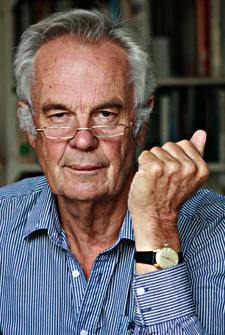
By Jonathan Power

US Secretary of State John Kerry’s foray into the politics of peace between Israel and Palestine appears to have run aground despite his tireless and single minded efforts. It is clear that Israel’s Prime Minister Benjamin Netanyahu never believed in it.

Israelis often see their predicament as David against Goliath. In truth it is the reverse. Contrary to popular belief Israel had larger, better equipped and better led forces, during the 1947 war of independence against the joint Arab armies. The Israeli Defence Forces won quick and easy victories against Egypt in 1956 and against Egypt, Jordan and Syria in 1967. All this was done before US aid starting flowing in large amounts. Few doubt it has overwhelming power today, not forgetting its sizeable armoury of nuclear weapons.

Another way to look at the David/Goliath analogy is to look at child deaths as a result of the conflict. The ratio of Palestinian to Israeli children killed is 5.7 to 1.Read More »

The New World Order?

By Richard Falk

There is no more reliable guardian of entrenched conventional wisdom than The Economist. And so when its cover proclaims ‘the new world order,’ and removes any ambiguity from its intentions, by its portrayal of Putin as a shirtless tank commander with menacing features.

No such iconography accompanied the last notable invocation of the phrase ‘new world order’ by George H. W. Bush in mobilizing support for a forcible response to the Iraqi invasion and annexation of Kuwait in 1990, the dirty work of Saddam Hussein. Read More »