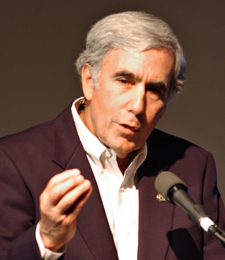
The US cliff, swamp, quagmire: Two major proposals

By Johan Galtung

There is more than the fiscal cliff to meet the naked eye.

Wise people – Borosage, Krugman, Stiglitz – some of them economists, see neither the fiscal deficit nor the US debt but the lack of growth as the key problem. They point to Clinton years and how, through growth, the Debt/GDP ratio went from a half to a third. This is important, but then there is a fourth consideration: some Americans are suffering out there. “16 percent” comes up very often, of people and families below the poverty line, not knowing for sure where the food comes from the next day, not having medical insurance. Macroeconomics is blind to human basic needs, yet there may even be solutions hidden in it.

But after the Clinton years came somebody else; increasing expenditure with enormously costly wars making conflicts even worse, and in addition lowering the revenue by reducing taxes on the super-rich. That a fiscal deficit would rear its ugly head, fed by such policies year after year, was a foretold conclusion. Democracy protects the president with a golden parachute, similar to that enjoyed by the CEO of a bankrupt company. But rightly so: he was elected, even re-elected. US voters, you asked for it and you got it!Read More »
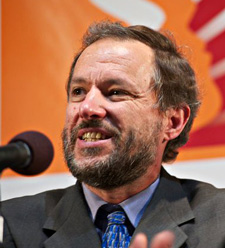
The case against Kerry

By Stephen Zunes

President Obama’s selection of John Kerry as the next secretary of state sends the wrong signal to America’s allies and adversaries alike. Kerry’s record in the United States Senate, where he currently chairs the Foreign Relations Committee, has included spurious attacks on the International Court of Justice, unqualified defense of Israeli occupation policies and human rights violations, and support for the U.S. invasion and occupation of Iraq, thereby raising serious questions about his commitment to international law and treaty obligations.

Furthermore, his false claims about Iraqi “weapons of mass destruction” and his repeated denials of well-documented human rights abuses by allied governments raise serious questions about his credibility.Read More »

Responding to the unspeakable killings at Newtown, Connecticut

By Richard Falk

Once again, perhaps in the most anguishing manner ever, the deadly shooting of 20 children (and 8 adults) between the ages of 5 and 10 at the Newton, Connecticut Sandy Hook Elementary School, has left America in a stunned posture of tragic bemusement. Why should such incidents be happening here, especially in such a peaceful and affluent town?

The shock is accompanied by spontaneous outpourings of grief, bewilderment, empathy, communal esprit, and a sense of national tragedy. Such an unavoidably dark mood is officially confirmed by the well-crafted emotional message of the president, Barack Obama.

The template of response has become a national liturgy in light of the dismal pattern of public response: media sensationalism of a totalizing kind, at once enveloping, sentimental, and tasteless (endless interviewing of surviving children and teachers, and even family members of victims), but dutifully avoiding deeper questions relating to guns, violence, and cultural stimulants and conditioning. What are called ‘difficult issues’ in the media reduce to what some refer to as ‘reasonable gun control’ (that is, a ban on assault weapons, large magazine clips, and somewhat stiffer gun registration rules) and to improved procedures for identifying those suffering the kind of mental disorders that could erupt in violent sociopathic behavior. Read More »

Cultivating peace, preventing violence

By Johan Galtung

… was the title of the Symposium at Virginia Tech in Blacksburg, Virginia-USA 17-19 Nov 2012. An example of the blossoming wave of peace studies all over the US; inter-disciplinary and international. Most papers were given by very promising students on most aspects of peace studies. It is inconceivable that this will not have a major impact on US foreign policy in a generation or so, particularly with the demographic shift from the WASP (White Anglo-Saxon Protestant) males voting Romney to the negations of all of that, including Blacks, Latins and women voting Obama. And with that shift the idea of a Chosen People with a Promised Land and a Covenant with the Almighty making them exceptional and indispensable, above the law of ordinary states, will slowly die.Read More »

Obama’s victory and Romney’s defeat

By Richard Falk

Around the world even more than in the United States there is an audible sigh of relief the day after Obama won a clear mandate for a second term as president. Deconstructed it mainly meant that many more were relieved that Romney lost, rather than excited that Obama won. Yet there were some, with whom I partly agree, whose gaze carries beyond the narrow victory in popular vote (as distinct from the decisive victory in the electoral college vote), to appreciate a positive fundamental change in American demographics.

The white majority coalition that Reagan fashioned so skillfully in the 1980s, achieving incredibly regressive societal results, seems to be losing out to the rising proportion of the electorate that is African-American and Latino, reinforced by the political outlook of youth and the liberal outlook of many women when it comes to reproductive rights. Perhaps, as indicative of a changing social climate were the successful referenda on state ballots in Maine, Maryland, and Washington to legalize same sex marriage and separate initiatives calling for legalizing the medical use of marijuana. Only a decade ago putting such measures on the ballot in several battleground states was understood as a brilliant tactical move by Karl Rove to mobilize the Republican base that was passionately dedicated to defeating such liberalizing initiatives, widely regarded by conservatives as signs of societal degeneracy.

What makes the Obama victory surprising is that his four years in the White House had definitely demobilized his base that had been so ardent in 2008, and seemed only lukewarm in 2012. Read More »

A change in Washington ? (1)

By Johan Galtung

From Washington, DC on Election Night

One of them won, of course, even if the real winners as usual were the non-voters, for whatever reason: men more than women. About 23:15 Obama passed the magic 50 percent mark, not of popular votes but of electoral colleges, with 302-206, well above 270; it turned into a landslide. Net result: status quo, no change.

The media did their best to make the presidential election look important, being the pinnacle, the altar on which democracy is built. Some democracy. Bad enough with a Supreme Court washing the process in six billion dollars as one more freedom of expression like talking words; any kind of words, libelous, often neither true nor relevant. Stupid TV spots. But many issues were somehow articulated, there were real disagreements, there was some kind of rhetorical left-right.Read More »

Obama, Romney, and the foreign policy debate

By Stephen Zunes

Perhaps the most disturbing aspect of the third and final presidential debate of the 2012 campaign was the similarity between the two candidates on many basic foreign policy issues. Part of the reason is that, as he did in the first two debates, GOP candidate Mitt Romney reversed himself on a number of extreme right-wing positions he had taken earlier in a desperate effort to depict himself as a moderate. At the same time, Obama’s hawkish stances served as yet another reminder of just how far to the right Obama has evolved since running as an anti-war candidate just four years ago.

Indeed, Romney’s perceived need to lie about Obama’s record and his reluctance to provide much in the way of specific policy alternatives is indicative of how little difference there actually is between the two when it comes to the U.S. role in the world.

Both candidates agree on American exceptionalism, as exemplified by Obama’s insistence that “America remains the one indispensable nation.” Read More »

Comparing presidential elections: 2008 versus 2012

By Richard Falk

In 2008, Barack Obama rekindled faith in the America electoral process for many, and revived the deeper promise of American democracy, bringing to the foreground of the national political experience a brilliant and compassionate African American candidate. When Obama actually won the presidency, it was one of the exciting political moments in my lifetime, and rather reassuring as a sequel to the dark years of George W. Bush’s presidency.

Of course, many Americans didn’t share such positive feelings, and an important embittered minority believed that the election of a liberal-minded black man was the lowest point ever reached in national politics, challenging this segment of society that now was deeply alienated from the prevailing political current to mobilize their forces so as to win back control of the country on behalf of white Christian Americans, and also a time to indulge such absurd scenarios as an imminent Muslim takeover of the society. Such polarization, gave rise to an Islamophobic surge that revived the mood of fear and paranoia that followed upon the 9/11 attacks and Read More »

Obama is a great success

By Jonathan Power

Bar Martin Luther King, Barack Obama is the finest political orator in America’s living memory. His supporters are dumbstruck that in his debate with his challenger for the November 6th vote for the presidency his performance was so weak. He didn’t even mention Mitt Romney’s absurd statement that he has written off 47% of Americans because they depend on some sort of government handouts.

Hopefully Obama can recover this lost ground in the next two debates, one on domestic policy, the other on foreign affairs.Read More »

Reflections on the Cuban Missile Crisis at fifty

By David Krieger

Fifty years ago this month, the world teetered on the precipice of a nuclear war between the US and Soviet Union during the 13-day Cuban Missile Crisis. We were fortunate to have survived that crisis, thanks largely to the restraint shown by President Kennedy and Premier Khrushchev.

Now, fifty years later, there is no immediate crisis such as that in 1962 over Soviet nuclear-armed missiles being placed in Cuba. There are, however, still some 19,000 nuclear weapons in the arsenals of nine nuclear-armed nations: the US, Russia, UK, France, China, Israel, India, Pakistan and North Korea. Approximately 95 percent of these weapons are in the arsenals of the US and Russia. Some 2,000 of them are kept in a state of high alert, ready to be immediately launched upon an order to do so at any moment of any day or night. Read More »