TFF PressInfo # 394: The State of the World Right Now: A Macro View

By Johan Galtung

“View” meaning not only a glimpse from above, but a position taken on the world on which the US electorate is now dumping Donald Trump.

That world is today basically multi-polar, maybe with 8 poles: 1) Anglo-America, 2) Latin America-Caribbean, 3) African Unity, 4) Islam-OIC from Casablanca to Mindanao, 5) European Union, 6) Russia more region than state, 7) SAARC from Nepal to Sri Lanka, 8. ASEAN, Australia-New Zealand. [See list of abbreviations with links to the mentioned organisations under the article]

And thre is the multi-regional Shanghai Cooperation Organization, SCO, with China and Russia, Islamic countries, India and Pakistan.

There is a waning state reality, smaller states being increasingly absorbed into regions.

There is a waxing region reality with the above eight; adding West Asian, Central Asian and Northeast Asian regions, maybe eleven.

There is a global reality based on IGOs, inter-governmental organizations, with the United Nations on top; TNCs, the transnational corporations, with the US-based on top so far; and INGOs, international non-governmental organizations, with religions on top.

Now, insert into all of that something concrete from William Blum’s Anti-Empire Report #146 and his Rogue State.

From WWII, the USA has:Read More »

Trump’s beefed up economics

By Jonathan Power

Donald Trump is changing the right wing’s economic spots. He is doing what Franklin Roosevelt did at the time of the Great Depression by increasing government spending – although it was the rearmament brought on by entering World War 2 that was an even more important factor in lifting America out of the doldrums.

He is following what Hitler did so successfully before World War 2 when he rebuilt Germany’s economic strength with autobahns and industrial subsidies (not rearmament in the beginning, as is often said). He is walking in the footsteps of President Richard Nixon who when he changed course with a new economic policy said, “We are all Keynesians now”.

John Maynard Keynes was the greatest economist who ever lived.

For reasons that were shameful, politicians have not listened to his advice as often as they should. The Germans, with their urge to austerity, have gone the other way, carrying (or pushing) nearly every European state with them, apart from Poland and Sweden which did not follow the herd and now have the best economic growth record of the last few years.

But Obama has certainly been Keynesian. Read More »

Frightening: Flynn’s “Field Of Flight”

By Farhang Jahanpour

I have just spent a couple of miserable hours reading General Michael Flynn’s and Michael Ledeen’s book, The Field Of Flight. He will be President Trump’s national security adviser. And, frankly, I don’t know where to begin.

As someone who is opposed to the regime of the mullahs and would like to see the end of that regime through peaceful and democratic means, I truly cannot understand the reason for what one can call the irrational hostility and the depth of hatred of people like Flynn and Michael Ledeen towards Iran. Of course they are entitled to their feelings of hatred and hostility towards Iran and Muslims as a whole, but they are not entitled to their facts.

It is really amazing to see how without any concern for the facts Flynn jumps from one subject to another,Read More »

Trump’s National Security Adviser Facilitated the Murder of Civilians in Afghanistan

By Gareth Porter

After retired Lt. Gen. Michael J. Flynn spoke at the Republican National Convention, The Washington Post captured the prevailing media view of Flynn in the headline: “He was one of the most respected intel officers of his generation. Now he’s leading ‘Lock her up’ chants.”

Now that President-elect Donald Trump has chosen Flynn as his national security adviser, media coverage has given prominence to the more serious issue of Flynn’s denunciation of Islam as a “cancer” and other manifestations of his embrace of Islamophobia. But the mainstream media view of Flynn’s military record ignores his pivotal role in devising a targeting scheme that was the basis for an indiscriminate Joint Special Operations Command (JSOC) campaign of killing and incarcerating Afghans suspected of being in the Taliban insurgency. The corporate media, which have never examined that dark chapter in the history of the Afghanistan war critically, have long treated the campaign as one of the few success stories of the war.

Continued here.

Bringing In the Future: An Essay on Time

By Johan Galtung

International Sociological Association Prize
New School for Social Research, New York NY, 15 Nov 2016

The West, and Western sciences in particular, have a peculiar way of conceptualizing time; derived from two millennia Christianity.

Thus, in the civilizations of Hinduism, Buddhism, China and Japan, to mention some, time flows from eternity to eternity. In the West (and Islam is similar), there is a Beginning (Creation for the religious, Big Bang for the secular), and an Ending, the End Time (Armageddon for the religious, entropy, death, etc. for others).

In others, time flows from past into a possibly different future; in the West, the future is continuous with the past. In the natural sciences, “laws” from the past are automatically valid for the future; reality being as stable as the planetary system, the galaxy; astronomy being the model. The Creation has been finished, once and for all.

In the social sciences, the future is largely off limits, taboo; predictions are often discarded as “wild speculations”. Extension of built-in trends into the future is permitted, but not forecasting with qualitative jumps. The underlying assumption is stable equilibrium, things have found their place and that’s it. Thus, no forecasting of (early) modernity during the Middle Ages, let alone working for it.

That is in theory, but the practice is different. People design their individual careers – life trajectories – and have always done so. For collective life there is politics, designing future societies.

But the social sciences are not supposed to be in it. They approach past and present with Read More »

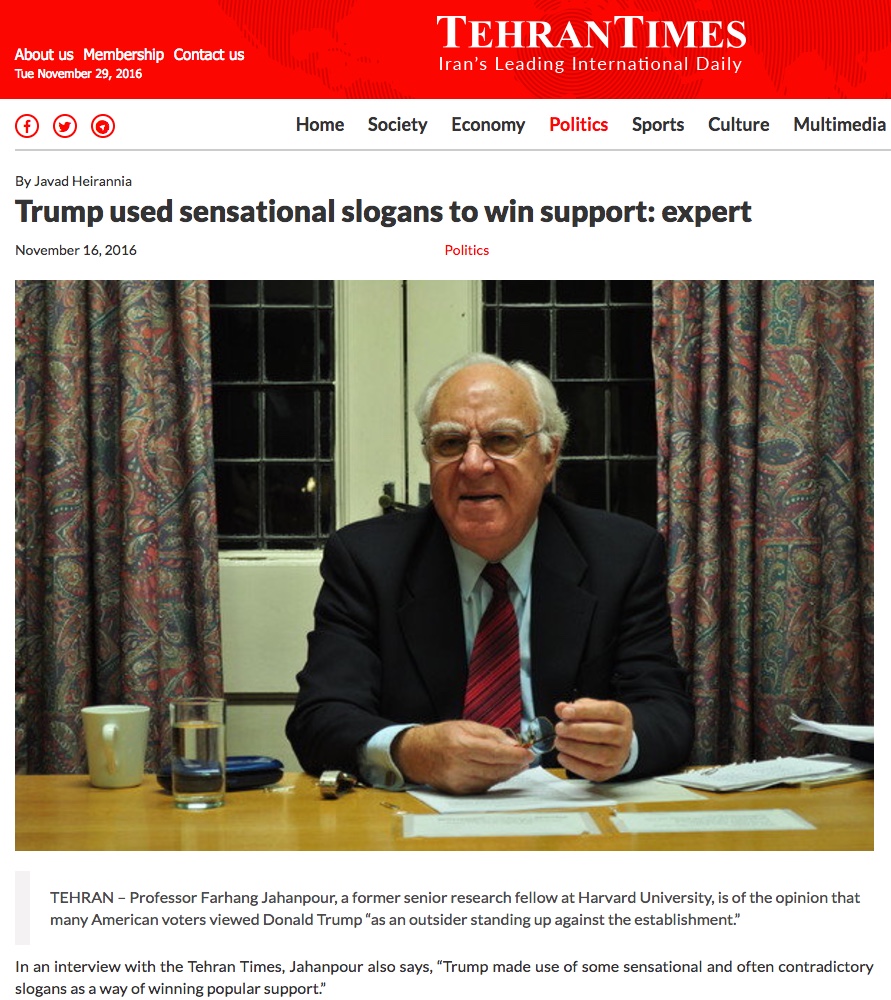
Trump used sensational slogans to win support

By Farhang Jahanpour

TEHRAN – Professor Farhang Jahanpour, a former senior research fellow at Harvard University, is of the opinion that many American voters viewed Donald Trump “as an outsider standing up against the establishment.”

In an interview with the Tehran Times, Jahanpour also says, “Trump made use of some sensational and often contradictory slogans as a way of winning popular support.”

Following is the text of the interview

The Trump Presidency 1-5

By Johan Galtung
Writing in Washington

# 1
The 45th President of the USA, Donald Trump, delivered a highly presidential acceptance speech. The words chosen, how he spoke them, his body language, all belied the idea that he could not be presidential. How good a president, remains to be seen.

What matters now in his concrete action coming January. For instance, will he do as he promised, cancel out-sourcing, “trading” of industries to Mexico and “in-sourcing” them back to the USA, to recreate jobs for US workers?

However, the media are still too anti-Trump to realize he is their President, maybe hoping for some reversal. Also too struck by how wrong all the polls have been predicting an easy Hillary victory. They will probably go on with that for a long time.

I do not think there was any objective basis for predicting a Trump victory. Clinton had all criteria in her favor: president’s wife with influence, secretary of state, senator etc. Trump: not even office.

But Clinton’s criteria were elitist and status quo, Trump’s smacked of populism and basic change. The wind was blowing toward populism, which is, actually, what democracy is about, catering to the people.

And vast categories had suffered what the Greeks call a-timia, the loss of status, white-male-workers-Americans. 5-2 in favor of Trump. And the rust belt, the big mid-Western de-industrializing states, Ohio, Milwaukee, Wisconsin. Trump catered to their interests in revival, indeed also in hitting their negations in very unacceptable ways: women, colored, elites, immigrants.

But all of that does not a victory make. There is more to it.

Some idea of a “normal American”, in a “normal America”. Say Spain, that idea brought Franco to power. Answer: we do not know. We need more information. But a revolution it was.

Be that as it may. Much more important: his concrete actions.

(Originally published here)

#2
Trump periphery populism was as unseen by US elites as Brexit periphery populism by UK elites. Read More »

Trump and Clinton: National versus global perspectives

By Richard Falk

November 6, 2016

It is not often that Medea Benjamin, the charismatic founder of Code Pink, offers us her insight into a troublesome American reality that is almost simultaneously confirmed by the New York Times, the virtual bible for secular liberals in the United States.

Yet it happened, most surprisingly, in a positive portrayal of one thin slice of Trump loyalists – veterans of recent foreign wars.

Medea reports on a conversation with such a veteran on a train out West, and was impressed that he felt Clinton much more likely than Trump to get Americans killed in a future distant war disconnected from any reasonable defense of the homeland.

The New York Times in a front-page feature article reached this same plausible conclusion on the basis of a wider scan of relevant evidence.

Here are two disturbing realities Read More »

If Obama stayed in power?

By Jonathan Power

November 8th 2016.

An interesting question is what would happen to American foreign policy if President Barack Obama were allowed to have another four year term in office?

It would be a less interventionist presidency than what is about to become. This is not to say that I think the way Obama has handled the war in Afghanistan has been successful. Nor do I believe the attack on Libya was a sensible idea. Nor do I think the way he dealt with Russia and Ukraine in the last four years has been anything but counterproductive.

But I do believe the world would be an even messier place if he had not been president. Syria would have been invaded with ground troops. Iraq would have been replicated.

I think confrontation with China over the ownership of the contested islands in the South China and East China seas would have been more serious than it has been.

There would have been no bringing back Cuba in from the cold. (Cuba was the home of the missile crisis of 1962 when the world came terrifyingly near to a nuclear war.)

Most important, there would have been no nuclear deal with Iran. Iran’s research which could have led to the making of a nuclear bomb (not that I think it had any intention of going that far) would have continued.

At some point Israel would have bombed Iran’s reactors Read More »

“Humanity Knows No Borders”

By Hans Graf Sponeck

Freiburg, 1 October 2016

1. The global sky is full of dark clouds. There is reason, there must be reason, for concern. Humanity has to take time out to reflect. To-day is a good occasion to do so, especially since we have among us Haifa al Mansour and Solmaz Panahi who, together with her mother, has joined us on behalf of Jafar Panahi, her father.

The Kant Foundation is honouring two artists from the Middle East, one from Saudi Arabia, the other from Iran. They have taken Immanuel Kant’s demand of yesteryear seriously and have shown the courage to use their minds with all the consequences that this has entailed. They have been swimming against the currents, they have built bridges and they have climbed mountains that try to separate people.

2. The community of nations has created an impressive body of law which is as densely woven as the most magnificent carpets one can find in the Middle East. Life in all its facets is well protected by such law – or so it seems! The UN Charter remains the supreme road map for human life with peace. It echoes what many thinkers and humanists throughout centuries have proclaimed. Can there be any disagreement that the usefulness of a map lies in its use?

3. Emotions? Feelings? – important as they are, must be in harmony with reason! The irrational rejection of Europe by Britain would not have happened if feelings and reason had been in balance! How much more evidence do we need to accept that humanity knows no borders?

4. Let me pause here for a moment and interject… Read More »