How ought we treat each other?

By Johan Galtung

Upon receiving the Gandhi-King-Ikeda Community Builder Prize

Atlanta, 31 Mar 2016

Dear President, dear Dean of Morehouse College, Ladies and Gentlemen,

I am deeply honored by the prize from a college in Georgia, in the US South, that has been and is a beacon in the struggle from dominion to dignity in race relations. The civil rights movement is an American Revolution, like the feminist movement it inspired–aiming at parity and dignity for all. To refuse sharing the spoils of exploiting Reds and Blacks and poor Whites with London was far from a revolution.

This college shaped Dr Martin Luther King Jr. I had the honor of meeting him twice here in Atlanta in 1960–working on desegregation without violence in Charlottesville, VA–and in 1964 in Oslo when he received the Nobel Peace Prize. This College made him use Gandhi’s clinging to truth through nonviolent struggle, satyagraha, lifting 20 million Blacks into dignity. There is a backlash: Blacks are again shot at, and used as slave labor in prisons. The struggle continues.

Building communities. There are at least two of them, the community of people, and the community of states. I will deal with both and share with you in this speech the basic ideas of TRANSCEND mediation – an NGO of more than 500 invited members, comfortable with our mantra, “Peace by Peaceful Means”. Transcend means going beyond.

Let us approach answering the question through some words on how we ought not treat each other.

It is all in our thought habits, the deep culture of our thinking. In the West we think in simple dichotomies, like positive/negative, good/bad, even evil. Either one or the other, not in-between, neither-nor, both-and. And we very easily fall into the trap of seeing ourselves as only good, and someone else as only bad, steered by God or Satan. The road to narcissism, self-love and paranoia, seeing threats everywhere, is short. Victory! not solution.

AND Narcissism + Paranoia = Psychosis, the psychiatric diagnosis.

To escape from this thought habit use ancient Chinese habits. Yin/Yang. They also think positive/negative, good/bad; but add more levels, like the positive and negative in the positive and negative, the good and bad in the good and bad. That opens for identifying the negative in Self and the positive in Other; for positive-peaceful, not negative-violent relations. Not either-or; but both-and, neither-nor.

The TRANSCEND formula: focus on the positive, good in everybody including yourself; but keep the negative, bad in the back of the mind to improve it and as possible danger, to Self and-or Other.

Then create projects linking good with good; first as vision, then reality.Read More »

TFF PressInfo # 369 – A Sunni-Salafist-Zionist Coalition Changing Middle East?

By Jan Oberg

Please try Google “Gulf states want nuclear weapons against Iran – Israel “ and only one Western mainstream media will appear, an excellent article by The Telegraph’s Raf Sanchez in Jerusalem.

The only other media carrying the story is Russia Today and Vigilant Citizen and MintPress News also carries the story and offers a wider background

What is this about?A new coalition?

So the usual Western media filter, meaning it must be interesting. And it is a quite sensational story: Saudi Arabia and Israel are up to a nuclear mischief against a country that has just been prevented from acquiring nuclear weapons by means of a huge legally binding document, UN Security Council endorsement and extremely tight monitoring mechanism. What’s it about?

It’s about Israel’s defence minister Moshe Ya’alon saying in public at the recent Munich conference that Arab states are “not willing to sit quietly with Iran on the brink of a nuclear bomb”.

He thinks that Iran was liable to break the agreement as their economic situation improves with the lifting of international sanctions. Ya’alon is quoted as saying that “I speak about the Gulf states and North African states too…For them, Iran and the Muslim Brotherhood are the enemy. Iran is the bad guy for us and for the Sunni regimes. They are not shaking hands [with Israelis] in public, but we meet in closed rooms.”

So not only Jordan’s monarchy and Egypt’s dictatorship but also Gulf and North African states: A coalition lead by Saudi Arabia and Israel – Israel as the only nuclear weapons power in the region and Saudi Arabia as the most likely next nuclear weapons state.

For much too long the world’s attention has been on Iran’s imagined nuclear weapons, not on the dozens or hundreds real nukes that Israel possesses as a non-member of which is the Non-Proliferation Treaty (NPT).

One can say that Israel and Saudi Arabia lost the political battle against the nuclear deal with Iran concluded with the five permanent UNSC members and Germany last year – and now will do their utmost to use Iran’s non-nuclear weapons status as a pretext for others going nuclear against, predominantly, Iran.

Propaganda hysteria dominates in an age where knowledge plays a diminishing role

The problem for them, however, is that Iran will be difficult to sell as a real threat – but we live of course in Read More »

TFF PressInfo # 368: Reflections after Brussels

Lund, Sweden, March 29, 2016

Recommended reading…

The general post-Brussels mainstream media discourse has shown the same profile as virtually all others since September 11, 2001:

• Emphasis on who did it, the circumstances where it happened and how the crime was carried out;

• The fate of the victims, the mourning of the nearest relations and the memorial;

• Much larger coverage than more devastating attacks outside the West.

• Absence of relevant and intellectually challenging questions related to the big WHY – Why do some people hate us so intensely, willing to die for it?

• And absence of discussions about possible historical causes and action-reaction perspective – the only reason offered is that they are evil people/Muslims and evil acts must be met with force – Francois Hollande who never misses an opportunity to puff himself up talks about all of Europe being hit – 35 people killed out of 508 million to be precise.

• The underlying, tacit ‘narrative’ of course is that we Europeans are simply innocent victims – more important, that is, than the roughly 1 million Iraqis who died thanks to the European participation in 13 years of sanctions and an illegal war and occupation led by the US. And, as is well-known, victim psychology often legitimates disproportionate responses – to be seen.

• Finally, the complete loss of perceptive proportions in a war that has resulted so far in 350.000 dead Syrians, 4,6 million Syrian refugees and 6,6 million Syrian internally displaced and destruction of yet another Middle Eastern country and its culture – among other things thanks to arms trade to all fractions and thousands upon thousands of bombing sorties – the far majority of which orchestrated by the US/NATO/EU countries over the last 5 years.

We believe there are different perspectives that deserve our attention – based on complex analyses, a moral standpoint and an intense desire to help stop this – for all self-defeating – vicious spiral.

We invite you to browse these and share them in your circles:Read More »

Reflections on the Brussels attack

By Richard Falk

Prefatory Note
A much abbreviated version of this post was published in Al Jazeera English on March 24, 2016. Although the essential analysis is the same, the reasoning here is greatly elaborated. The themes addressed and the policies proposed are advanced in a tentative spirit. Debate and reflection are urgently needed with respect to the political violence that is being unleashed in various forms in the West and non-West.

This latest terrorist outrage for which ISIS claimed responsibility exhibits the new face of 21st century warfare for which there are no front lines, no path to military victory, and acute civilian vulnerability. As such, it represents a radical challenge to our traditional understanding of warfare, and unless responses are shaped by these realities, it could drive Western democracies step by step into an enthused political embrace and revived actuality of fascist politics.

Already the virulence of the fascist virus dormant in every body politic in the West has disclosed its potency in the surprisingly robust Trump/Cruz run to become the Republican candidate in the next American presidential election.

Perhaps, the most important dimension of this 21st century pattern of warfare, especially as it is playing out in the Middle East, is the will and capacity of violent extremists to extend the battlefield to those perceived to be their enemies, and to rely on acutely alienated Europeans and North Americans to undertake the suicidal bloody tasks.

The British Independent struck the right note in its commentary, Read More »

A pope, a patriarch, a spiritual revolution

By Johan Galtung

The first editorial here at Transcend of March 3 2008, “50 Years of Fidel Castro” celebrated a political revolution that changed the world, and spelt the end of US-Western imperialism. This editorial celebrates a spiritual revolution that may also change the world, spelling the end of Western materialism, and spread from there.

We are talking about processes, not events, and of structures and cultures more than of actors.

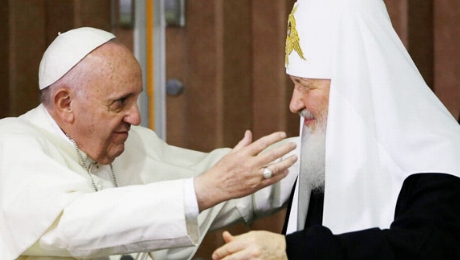
Again, Cuba played a major role, as meeting place between two major parts of Christianity, Catholic and Orthodox. In the Great Schism of 1054 they had excommunicated each other; and the Roman empire had split Catholic/Orthodox in 395. Fidel’s Catholic brother and successor Raúl was a condition for this historic meeting for peace; so was the meeting between Putin–an Orthodox Christian–and Francis in June 2015. However, not many pairs of brothers rival the two Castros in shaping history.

They met, Pope Francis of the Catholic Church and Patriarch Kirill of Moscow and all Russia – after earlier meetings between popes and the patriarch of Constantinople – with a Joint Declaration on 12 Feb 2016 in 30 articles. There were 17 quotes from the Bible; showing that they are “brothers in the Christian faith”, “pained by the loss of unity”, “divided by wounds caused by old and recent conflicts”. Not from the Bible are the many references to “the Most Holy Mother of God, Virgin Mary, and the saints we venerate”. Problematic for Protestants.

The bulk of the Joint Declaration is about the fate of Christians in the Middle East, meaning mainly Orthodox; like “the Metropolitans of Aleppo, Paul and John Ibrahim, who were taken in April 2013, to make every effort to ensure their prompt liberation”. However, together they “invite our Churches in Ukraine to work towards social harmony”.

They also jointly argue strongly against abortion and euthanasia, and in favor of “respect for the dignity of the individual called into being according to the Creator’s plan”. Do not destroy God’s creation.Read More »

Is Islam violent?

By Jonathan Power

Is Islam violent? ISIS in Syria and Iraq. In Pakistan, there is Lashkar-e-Taiba and the attempted murderer of the schoolgirl, Malala Yousafzai. Immigrant Moroccan men roughly pushing women and fondling them in the crowd in Cologne. Murderous bombs in Paris. Ayan Hirsi Ali, a Somali female author who was raised a Muslim, writes, “Violence is inherent in Islam- it’s a destructive, nihilistic cult of death. It legitimates murder.”

The late Harvard professor, Samuel Huntington, argued that in the later years of the last century and the early years of this an uncannily high percentage of the world’s violent conflicts took place between Muslims and non-Muslims: Turks versus Greeks, Russians versus Chechens, Bosnian Muslims and Albanians versus Serbs, Armenians versus Azeris, Uighurs versus Han Chinese, Indian Hindus versus Muslims, and Arabs versus Jews.

Yet most Muslims don’t commit acts of violence. If Islam is intrinsically violent then roughly a billion believers either do not understand their own religion, or are too cowardly or unfaithful to follow its precepts. That is my sarcasm but, indeed, this is what the violent Islamists say.

Westerners have a tendency to create myths about the teachings of Mohammed in the Koran. An outrageous one is the claim that an adulterous woman should be stoned. But the only teaching in any world major religion advocating stoning can be found in the Jewish Old Testament. (Paradoxically, the Jews haven’t practiced this for millennia but Saudi Arabia does today.)

Scholars like Huntington have given the impression that Islam is a much more violent religion than Christianity.

But another point of view is Professor John Owen’s. He writes in his book, Confronting Political Islam: “A broad view of the history of the Middle East suggests that Islam is much like other religions. It is marked by times and places of conquest and brutality, but also by times and places of peace……Christendom has had its sustained spasms of violence, both to outsiders with the Crusades and fellow believers, as in the Counter Reformation and the Inquisition”. And we should add in as in World War 1 and 2.

We shouldn’t forget that Mohammad Khatami, a former president of Iran, repeatedly condemned the 9/11 attacks and declared that suicide bombers wouldn’t go to heaven.

However, the fact is that Mohammed behaved in a very different way than Jesus. He was more in line with the sometimes violent and warlike Old Testament Jewish leaders. In 630 AD Mohammed himself led his troops to conquer Mecca. By the time of his death two years later most of the Arabs of the western part of Arabia were Muslims by conquest.

Within 20 years of Mohammed’s death the Muslims had conquered large parts of the Roman Empire and had absorbed the almighty Persian. Within a 100 years Mohammed’s followers had established an empire greater than Rome at its zenith. By the thirteenth and fourteenth centuries Islam had spread as far east as India, Indonesia and parts of China. In Africa it was introduced on the back of the slave trade.

In total contrast the Christians submitted themselves to the lions rather than fight and not until the Emperor Constantine converted to Christianity some 300 years after Jesus’ death did Christianity take on the role of running a state with all its well-embedded military traditions.Read More »

TFF PressInfo # 365: Denmark to attack in Syria – too

By Jan Oberg

Something is rotten in the State of Denmark and the world will increasingly see it. It’s an unpleasant combination of Islamophobia, militarism and a peculiar ethical and intellectual self-destructive obedience to US/NATO all wrapped up in a pseudo-humanitarian flag.

It’s important that intellectuals criticise the policies of their native country and not only and politically correctly criticise that of others. In the case of Danish foreign and security policy it is fairly easy to do so provided you are supported neither by that country’s state nor its corporations.

Denmark to be aggressor in Syria – too

On March 4, 2016 a large majority of Danish political parties agreed to send F16s and special forces to Syria. The decision is likely to soon be confirmed by the Danish parliament.

The most important decision any government can take is the one to go to war. But that sort of thing is now routine in H.C. Andersen’s anything but idyllic rogue state. When the Danish MPs decided that Denmark should bomb in Libya an MP told me that they did so on the basis of 1,5 A4 pages memo drafted by the Ministry of Foreign Affairs.

So here Denmark is off again, this time to Syria. It’s the 6th time – Serbia in 1999, Afghanistan 10/7 2001, Iraq occupation power 2003-2007 – under non-convicted war criminal prime minister Anders Fogh Rasmussen who was rewarded by an academic title in the U.S. and then kicked upwards to the post of NATO’s S-G and in which capacity he took responsibility (without any later regret later for that or Iraq) for the pulverisation of Libya way beyond the UN mandate; then a second time in 2014-15 in Iraq bombing against ISIS/Daesh. And now Syria.

All these wars have been exemplary political and moral fiascos – if not deliberate killing missions for strategic and naked power reasons.

In none of these conflicts has Denmark that boasts an active foreign policy taken any constructive initiatives of the type that is needed – mediation, consultation, negotiations, large-scale humanitarian aid, violence-prevention, reconciliation or presented any innovative thoughts, peace plans or similar.

In no case has it argued for a large international peace-keeping presence, e.g. UN and/or regional organisations with predominantly civilian elements. And in no case has it dared criticise U.S. foreign policy in even the mildest of words.

Denmark’s humanitarianism flies F16

Prime minister Løkke Rasmussen’s argument for aggression on Syria now Read More »

TFF PressInfo # 363: Can we give meaning to the destruction of Syria?

By Jan Oberg

Five years ago

In 2011 when it all began, an educated conflict analyst or otherwise conflict competent person would have said about the conflict in Syria that it was a very complex thing, caused by history, environment, traumas, external factors, the economic situation, etc. And that al-Assad and his government was certainly an important reason but far from the only one.

The conflict expert would have warned against at last four ways of thinking:

a) any interpretation that put all the good people on one side and all the bad people on the other – because there are no conflicts in the world with only two such parties;

b) any idea that the conflict could be solved by siding with the presumed good ones and going against the bad one(s);

c) every attempt to ‘weaponise’ the conflict and increase the level of violence, the duration of the conflict and the human suffering;

d) any and every idea that foreigners would know better than the Syrians themselves – government, opposition and citizens in civil society – what should be a solution.


Finally – the professional conflict and peace worker would have maintained that you can’t make peace by asking one person – not even brilliant ones like Kofi Annan or Staffan di Mistura – with a small team around him and some shuttle diplomacy to succeed with facilitation, consultations, brainstorming, proposal-making, mediation and, finally, some kind of negotiations leading to a peace agreement in what is undoubtedly one of the most complex and ‘hard’ conflicts on earth.

Peace-making requires a completely different approach to not just be a pawn in the wider war game – a game that according to Al-Jazeera today encompasses some 900 military groups – add to that government forces and all the political and civil groups that don’t carry weapons: 1500?

Five years later – at least 250.000 dead people, 3 million refugees and 6,5 million internally displaced people, cities, economy, cultural heritage destroyed – anyone can see that no one listened to such simple conflict rules of thumb.

Conflict and peace illiteracy

The self-appointed and completely un-educated, peace-makers of the international community – presidents, prime and foreign ministers of the US, NATO, Russia, etc. – did about everything else.

It seems to not even occur to them or to the media that Read More »

Ukraine, a frozen conflict

By Jonathan Power

It’s two years since a mass of demonstrators brought down the centrist government of President Viktor Yanukovych.

We don’t hear much about Ukraine these days, mainly because the foreign journalists, not having too much to do – and often being freelance and therefore only paid by the number of lines they get printed – have gone home or to other hot spots.

Most of the news these days comes out of the Washington-based IMF that repeatedly warns that the economy of Ukraine teeters on the brink and that corruption remains so deep and widespread that it is difficult, to say the least, to get good economic decisions made. Often the government appears to be checkmated by an unsympathetic parliament where the representatives of the oligarchs, who prefer the status quo, wield their power.

To compound the problems – which will surely continue even if Russia, the EU and the US find a common political and military solution – fighting in the east has now resumed. Fortunately, the main truce, agreed at Minsk a year ago by the heads of government of Russia, Ukraine, France and Germany, is maintained and these short flare-ups tend to happen every couple of months.

Winding the clock back to two years ago, the demonstrators in the Maidan,Read More »