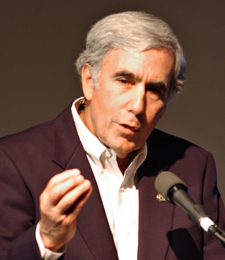
Nonviolent Geopolitics: Law, Politics, and 21st Century Security*

By Richard Falk

In this short essay, my attempt will be to articulate a conception of a world order premised on nonviolent geopolitics, as well as to consider some obstacles to its realization. By focusing on the interplay of “law” and “geopolitics” the intention is to consider the role played both by normative traditions of law and morality and the “geopolitical” orientation that continue to guide dominant political actors on the global stage.

Such an approach challenges the major premise of realism that security, leadership, stability, and influence in the 21st century continue to rest primarily on military power, or what is sometimes described as “hard power” capabilities. [1]

From such a perspective international law plays a marginal role, useful for challenging the behavior of adversaries, but not to be relied upon in calculating the national interest of one’s own country. As such, the principal contribution of international law, aside from its utility in facilitating cooperation in situations where national interests converge, is to provide rhetoric that rationalizes controversial foreign policy initiatives undertaken by one’s own country and to demonize comparable behavior by an enemy state. This discursive role is not to be minimized, but neither should it be confused with exerting norms of restraint in a consistent and fair manner.

My intention is to do three things:

• to show the degree to which the victors in World War II crafted via the UN Charter essentially a world order, which if behaviorally implemented, would have marginalized war, and encoded by indirection a system of nonviolent geopolitics; in other words, the constitutional and institutional foundations already exist, but inert form;

• to provide a critique of the realist paradigm that never relinquished its hold over the imagination of dominant political elites, and an approach has not acknowledged the obsolescence and dangers associated with the war system;

• and, finally, to consider some trends in international life that make it rational to work toward the embodiment of nonviolent geopolitics in practice and belief, as well as in the formalities of international law.Read More »


Peace Economics: Making Money Doesn’t Need to Hurt

By Jelena Mair

Business and Peace are not mutually exclusive. Business does play a crucial role in society. More so, business impacts and depends upon its surrounding. It impacts the
social well-being of people and planet, whether intentionally or unintentionally, both locally and globally through the chosen ways of operation and production.

Equally, does business play a key role in contributing to economic development, peace and stability in the areas where it operates. Business provides jobs and revenue to local markets; sets examples of sustainable business practices and can provide support for various social programs through strategic social investment.

In short, business is an inherent aspect of our society, and therefore, if we are striving for a more peaceful and sustainable world, for-profit private enterprises are the most crucial actors in achieving this goal. Read More »

Time to sanction Israel

By Jonathan Power

US Secretary of State John Kerry’s foray into the politics of peace between Israel and Palestine appears to have run aground despite his tireless and single minded efforts. It is clear that Israel’s Prime Minister Benjamin Netanyahu never believed in it.

Israelis often see their predicament as David against Goliath. In truth it is the reverse. Contrary to popular belief Israel had larger, better equipped and better led forces, during the 1947 war of independence against the joint Arab armies. The Israeli Defence Forces won quick and easy victories against Egypt in 1956 and against Egypt, Jordan and Syria in 1967. All this was done before US aid starting flowing in large amounts. Few doubt it has overwhelming power today, not forgetting its sizeable armoury of nuclear weapons.

Another way to look at the David/Goliath analogy is to look at child deaths as a result of the conflict. The ratio of Palestinian to Israeli children killed is 5.7 to 1.Read More »

The New World Order?

By Richard Falk

There is no more reliable guardian of entrenched conventional wisdom than The Economist. And so when its cover proclaims ‘the new world order,’ and removes any ambiguity from its intentions, by its portrayal of Putin as a shirtless tank commander with menacing features.

No such iconography accompanied the last notable invocation of the phrase ‘new world order’ by George H. W. Bush in mobilizing support for a forcible response to the Iraqi invasion and annexation of Kuwait in 1990, the dirty work of Saddam Hussein. Read More »

The obsolescence of ideology: Debating Syria and Ukraine

By Richard Falk

I have been struck by the unhelpfulness of ideology to my own efforts to think through the complexities of recommended or preferred policy in relation to Syria, and more recently, the Ukraine. There is no obvious posture to be struck by referencing a ‘left’ or ‘right’ identity. A convincing policy proposal depends on sensitivity to context and the particulars of the conflict.

To insist that the left/right distinction obscures more than it reveals is not the end of the story. To contend that ideology is unhelpful as a guide for action is not the same as saying that it is irrelevant to the public debate. In the American context, to be on the left generally implies an anti-interventionist stance, while being on the right is usually associated with being pro-interventionist. Yet, these first approximations can be misleading, even ideologically. Liberals, who are deliberately and consigned to the left by the mainstream media, often favor intervention if the rationale for military force is primarily humanitarian.

Likewise, the neocon right is often opposed to intervention if it is not persuasively justified on the basis of strategic interests, which could include promoting ideological affinities. The neocon leitmotif is global leadership via military strength, force projection, friends and enemies, and the assertion and enforcement of red lines. When Obama failed to bomb Syria in 2013 after earlier declaring that the use of chemical weapons by the Assad regime was for him a red line this supposedly undermined the credibility of American power.

My point is that ideology remains a helpful predictor of how people line up with respect to controversial uses of force, although relying on ideology is a lazy way to think if the purpose is to decide on the best course of action to take, which requires a sensitivity to the concrete realities of a particular situation. Such an analysis depends on context, and may include acknowledging the difficulties of intervention, and the moral unacceptability of nonintervention. Read More »

Far from good enough, Mr. Putin !

By Johan Galtung

History matters, not only law; like how Crimea and Abkhazia-South Ossetia–basically Russian-Orthodox–became Ukrainian-Georgian. Two Soviet dictators, Khrushchev and Stalin, attached to Ukraine and Georgia, so decided, by dictate. The local people were not asked, nor were Hawaiians when the USA annexed their Kingdom in 1898–by dictate.

The first referendum in Crimea was held last Sunday, 16 March 2014: an overwhelming No to Ukraine and Yes to the Russian federation.

Khrushchev’s 1954 transfer of Crimea was within the Soviet Union, and under Red Army control. But the Soviet Union collapsed and the Red Army became the Russian army; the conditions were no longer valid. George W. Bush wanted Ukraine and Georgia to become NATO members, moving the Russian minorities two steps away from Russia. Nothing similar applies to the other Russian minorities in the former Soviet republics. They are people living on somebody else’s land, not people living on their own land.

What happened to Crimea was a correction of what had become a basic mistake. Although Russia moving into eastern Ukraine could be–as the West says–invasion-occupation-annexation. But highly unlikely.

Unless civil war breaks out between Ukraine West and East and the Russian minority in the East–Donetsk–is in danger. Russia will not stand by watching, just as NATO would not if something similar happened close to the Polish border in Lvov.

This simply must not happen; nevertheless it is getting close.Read More »

TFF PressInfo: Crimea – The referendum, the mote and the beam

By Jan Oberg

Lund, Sweden March 16, 2014

Of course it is illegal and of course it will be rigged, that referendum in Crimea today. And of course it is a ploy and comes only in the wake of Russia’s (read Putin’s) unprovoked aggression, used as a pretext to build a new Greater Russia.

That is, if you browse the mainstream Western media the last week and on this Sunday morning.

Referendum means referring an issue back to the people. It is – or should be – an important instrument in democracies. And it’s a much better instrument than war and other violence to settle complex conflicts.

Generally, citizens-decided conflict-resolution is likely to last longer and help healing wounds of the past than any type of solution imposed by outside actors.

In Switzerland citizens go and vote on all kinds of issues on many a Sunday throughout the year. Sweden has used it to decide about nuclear energy, Denmark about EU membership and – in 1920 – to solve the conflicts in Schleswig-Holstein and define the future border between Germany and Denmark. Referendums, binding as well as non-binding, are an accepted instrument in many countries.

Why did the West not use referendums?

The West likes to pride itself of its type of democracy whenever and wherever it can. But it doesn’t use the referendum instrument that often. Read More »

Why do I persist?

By Richard Falk

I have been asked recently why do I persist in working hard for the things that I believe in, knowing that I will die in the next several years, and am almost certain not to be around for the catastrophic future that seems to cast its dark shadow across the road ahead, and can only be removed by a major transnational movement of the peoples of the world.

Similarly, why do I accept the defamation and related unpleasantness that accompanies my efforts to be a truthful witness of the sufferings endured by the Palestinian people in the course of their struggle for freedom and in violation of their fundamental rights? Some friends pointedly suggest ‘why don’t you just sit back, enjoy the pleasures of an easy life, and if still restless and alert enough, devote yourself to the narcissisms of producing a memoir?’

Or at least, why not at least indulge the self-exploratory pleasures of proving to myself that I am a decent poet or that I can still improve my chess or that, appearances to the contrary, I am still not too old to learn Turkish? At worst, I could continue to write barbed comments on the passing scene from the relative safety and comfort of the blogosphere, and to relieve the monotony of a virtual life, take occasional cruises to exotic destinations seeking out ‘ships of fools.’

Several prominent philosophers have attempted to answer such generic questions in a book recently published with the alluring title of Death and the Afterlife (Oxford University Press, 2013). It contains three lectures given by Samuel Scheffler, two at the Berkeley campus of the University of California and the third at the University of Utah, as well as a series of generally laudatory commentaries by four other distinguished philosophers and a response at the end by Scheffler.

The core argument developed by Scheffler is that human beings care more about the collective survival of humanity than they do about either their own personal immortality or even about the survival of those that they love and befriend, that is, those who are closest to us in our present life.

This rather novel line of inquiry investigates the implications of a thought experiment that supposes the extinction of the human species either due to ‘a doomsday scenario’ in which life on the planet is brought to an end or ‘an infertility scenario’ in which all women stop having the capacity to bear children. Read More »

Pakistan – What Now?

By Johan Galtung


Islamabad, Ministry of Foreign Affairs, 28 Feb 2014

Your Excellencies,

The basic point is that Pakistan will not get that commodity called “peace” in Kashmir, Afghanistan and Central Asia by pursuing the ends and means of Washington and some local elites only. For peace to blossom the goals of other parties also have to be considered; and they are many. The logic of the political games pursued today presupposes some kind of victory or domination of “our side”: neither feasible nor desirable for peace. Hence, the need for some visions for peace politics is Kashmir, Afghanistan and Central Asia for tomorrow or the day after, with the hope that they can be useful when you have come to the end of the road with current policies. Nothing of this is easy; and without visions even impossible.

The fairly detailed, non-dogmatic vision appended (below) was my acceptance speech of the 2011 Abdul Ghaffar Khan International Peace-Builder Award by the Pakistan-American Muslim Association.

However, why do present policies so often seem to be non-starters?

The British empire drew three lines with disastrous effects for Pakistan: the Durand line in 1893, a 1,600-mile wound defining the border with Afghanistan, dividing the Pashtun nation – the biggest nation in the world without a state – into two parts; the McMahon line of 1914 defining the border with China in ways unacceptable to the Chinese; and the Mountbatten line of 1947 leading to the catastrophic violence of the partition. These lines have to be negated, liberating Pakistan from that past. Read More »

TFF PressInfo: Institute a course for all on what confront humanity in the 21st century

Open Letter to College and University Presidents Re: Global Security 101

By David Krieger

You are in a unique position of leadership to influence today’s youth to achieve a better tomorrow for America and the world. I am writing to enlist your help in educating young people to understand the survival challenges that face humanity in the 21st century.
Education is driven by values. Young people must learn to live with reverence for life, as did Albert Schweitzer, and to support equitable and nonviolent solutions to social problems, as did Gandhi and Martin Luther King, Jr. Young people must be imbued with compassion, commitment and courage. They must learn to use their imaginations to find creative and cooperative solutions to the great issues of our time. And they must find joy in the process and take time to celebrate the miracle of living on the only planet we know of in the universe that supports life. Continue here…