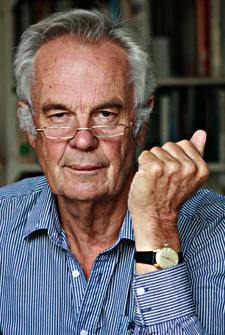
The future after oil: Six proposals

By Johan Galtung

Keynote Speech – Doha, Qatar – 2 April 2013

Peak Oil: Challenges and Opportunities in the GCC-Gulf Cooperation Council Countries

Distinguished Participants!

The organizers deserve high praise for setting this key, almost existential for some, issue on the agenda for an international conference. Oil and gas being limited there obviously is a peak–in the North Sea some years ago for Denmark, the UK and Norway. But this conference is not only about whether the peak is behind us, right now, in the future, and in that case when; but about and then what. Diagnosis, prognosis, therapy.

However, the peak may be more due to demand than to supply; more due to the problems caused by converting the energy stored in fossil fuels than to the extraction becoming too expensive to pay off. To the contrary, the more expensive the higher the profits as percentage of the costs, and given the oil-gas addiction the richest in a very inegalitarian world can always pay. In a better world energy for daily needs should be as freely available to everybody as walking on a street, or as health and education in a decent welfare state (they still exist). We risk fossil energy for the few only, not a peak.

On the demand side, all over, more or less, there is a turn to the alternative: the many green energy conversions. “The Surgeon General has decided that smoking is bad for you” has a follow up: “fossil fuels are bad for us“. We are not there, but it also took much time for high numbers to give up smoking. A massive shock, and compelling evidence of a causal connection, is needed. The increase in natural disasters and the erratic climate may soon provide that.

The world sees other peaks. Peak US Empire – not USA – with China coming up, Peak West with Rest coming up, headed by BRICS, Peak inter-state wars with inter-nation violence coming up. It’s a very dynamic world.

China burns coal-oil-gas, but is also a massive pioneer in green energies with photovoltaic and solar cells and electric cars, produced in ever greener ways. In the USA highly effective coal-oil-gas lobbies prevent the greening and promotes ecologically bad extraction. Politicians are bought by banks, banks invest in that extraction.

The world is moving East, the East is moving green. And so are millions. Read More »

Envisioning a world without nuclear weapons

By Richard Falk

Book Review

ZERO: THE CASE FOR NUCLEAR WEAPONS ABOLITION
By David Krieger (published in 2013 by the Nuclear Age Peace Foundation); $14.95

I have known David Krieger for the past twenty-five years, and he has never wavered, even for a day, from his lifelong journey dedicated to ridding the world of nuclear weapons and the threat of nuclear war. If I were given to categorization, I would label such an extraordinary engagement with a cause as an instance of ‘benign fanaticism.’

Unfortunately, from the perspective of the human future, it is a rather rare condition, posing the puzzle as to why Krieger should be so intensely inclined, given his seemingly untraumatized background. He traces his own obsession back to his mother’s principled refusal to install a bomb shelter in the backyard of their Los Angeles home when he was 12 years old. He comments in the Preface to ZERO that even at the time he “hadn’t expected” her to take such a stand, which he experienced as “a powerful lesson in compassion,” was especially moved by her unwillingness “to buy into saving herself at the expense of humanity.” (xiv).

Nine years later after Krieger graduated from college his mother was again an instrumental force, giving him as a graduation present a trip to Japan to witness first-hand “what two nuclear weapons had done to the cities of Hiroshima and Nagasaki.” (xiv) The rest is, as they say, ‘history.’ Or as Krieger puts it in characteristic understatement, “[t]hose visits changed my life.” (xiv)Read More »

Nepal – Six years of “transition”

By Johan Galtung

From Kathmandu, Nepal

Three huge revolts in Asia in the last decades came to an end: the anti-Confucian cultural revolution in China 1967-76, the anti Phnom Penh Khmer Rouge revolution in Cambodia 1975-79, and the anti-feudal monarchy anti-caste maoist People’s War in Nepal that lasted 10 years from 13 February 1996, followed by 18 days of effective nonviolence in the streets of Kathmandu in 6-24 April 2006. The King abdicated.

Transcend mediated in May 2003, and identified, through dialogues with the parties, eleven deep faultline conflicts as roots of violence…Continue here

http://s7.addthis.com/js/250/addthis_widget.js#pubid=ra-4e9ecaf669e1e638

Iran and the Cuban nuclear missile crisis

By Jonathan Power

It’s always better to talk than be super-tough. But Iran’s supreme leader, Ayotollah Ali Khamenei, last week firmly rejected the US attempt to resume negotiations over its suspected nuclear bomb making.

This is nothing short of disastrous. The Ayotallah must know that now Barack Obama has been re-elected not only has he got much more room to compromise but he has effectively seen off the attempt of Benjamin Netanyahu, the Israeli prime minister, to persuade the US to attack Iran.

The Ayotallah probably thinks by going eyeball to eyeball with the US he is going to win more than even Obama is prepared to give. This is nonsense and the attitude of both sides reminds me of the negotiating tactics of President John Kennedy and Soviet Premier, Nikita Khrushchev, during the Cuban missile crisis in 1963 which nearly brought the superpowers to a nuclear war.Read More »

An indispensable book on Palestine/Israel

By Richard Falk

Fast Times in Palestine: A Love Affair with a Homeless Homeland
By Pamela Olson (Berkeley, CA: Seal Press)

I realize that without knowing it, I have long waited for this book, although I could not have imagined its lyric magic in advance of reading. It is a triumph of what I would call ‘intelligent innocence,’ the great benefits of a clear mind, an open and warm heart, and a trustworthy moral compass that draws sharp lines between good and evil while remaining ever sensitive to the contradictory vagaries of lives and geographic destinies.

Pamela Olson exhibits an endearing combination of humility and overall emotional composure that makes her engaged witnessing of the Palestinian ordeal so valuable for me as I believe and hope it will be for others.

Early on, she acknowledges her lack of background with refreshing honesty: “Green and wide-eyed, I wandered into the Holy Land, an empty vessel.” But don’t be fooled. Olson, who had recently graduated from Stanford, almost immediately dives deeply into the daily experience of Palestine and Palestinians, with luminous insight and a sensibility honed on an anvil of tenderness, truthfulness, and a readiness for adventure and romance. Read More »

On Syria: What to do in 2013

By Richard Falk

I took part last week in an illuminating conference on Syria sponsored by the new Center of Middle East Studies that is part of the Josef Korbel School of International Studies at the University of Denver. This Center has been recently established, and operates under the excellent leadership of Nader Hashemi and Danny Postel, who previously together edited the best collection of readings on the Green Revolution in Iran published under the title The People Reloaded.

The conference brought together a mixture of Syrian specialists, Syrian activists, and several of us with a more general concern about conflict in the region, as well as with human rights and as participants in the heated debates of recent years about the virtues and vices of ‘humanitarian intervention’, what is now being called ‘Responsibility to Protect’ of ‘R2P’ in UN circles and among liberals.

I came to the gathering with a rather strong disposition to present myself as a confirmed R2P skeptic, regarding it as a cynical geopolitical euphemism for what Noam Chomsky labeled as ‘military humanism’ in the context of the controversial NATO Kosovo War of 1999. Ever since the Vietnam War I have viewed all Western claims to use force in the post-colonial non-West with suspicion. Read More »

Against world revolution – constructively!

By Johan Galtung

From Alicante, Spain

“Unemployment in Spain Tops 6.1M” – Unemployment rate is 26.6 percent; for those under the age of 25, 56.5 percent; all growing, all EU records. “Bank of Spain inspectors pen damning report about wrongdoing in Spanish banks: look the other way” was the reaction, while the government spends billions of Euros to bail out those banks. (El País, early January 2013).

And this: “300 Madrid health chiefs resign over privatization”; “Locksmiths in Pamplona refuse taking part in evictions involving families with young children”; “Theater chief sells carrots at 13 Euro as entrance ticket” – value-added tax down from 21 to 4 percent for food; “Mothers strip for erotic calendar to drum up funds for canceled school buses”.

A country rapidly de-developing, into low Third World levels, even in health. A country not only saving banks rather than people but also letting the banks get away with crimes. A country reacting with mini-revolutions, nonviolence, civil disobedience against such glaring injustices. A country where the class war is over for the time being; capitalism won and more particularly the bankers and their servants, the politicians, and even more particularly the finance-speculation capital.

And this in a Spain close to 40 years into democracy after 40 years of Franco dictatorship. Constitution + democracy + elections + human rights (also to property) + parliament vs finance capitalism. Weak vs strong.

What is Spain, and EU heading for? What will be fund further down this road?Read More »

Stopping Iran building a nuclear bomb

By Jonathan Power

There has never been a full-scale war between two nuclear-armed states. If Iran does cross the nuclear threshold the same deterrence will apply. No one rational would want to provoke their own incineration. Kenneth Waltz, the distinguished theorist on the conduct of war, has written in “Foreign Affairs” that with Israel possessing over 200 nuclear weapons Iran having a bomb would bring stability.

I don’t think I want to go as far as Waltz does with that last point. The launch of nuclear weapons can always be done by accident or by the action of rogue members of the launch team in a silo. It has nearly happened in the US a number of times.

My question is why doesn’t President Barack Obama put a lot more effort into pressuring Israel to make peace with the Palestinians. This, more than anything, would work to defuse the whole bad situation.

Or, going further, why doesn’t Obama, as Hans Blix, the former head of the International Atomic Energy Agency, explains to me, push through a Middle East Nuclear-Free Zone? This is necessary not just because of Iran but because if Iran goes nuclear so perhaps will Saudi Arabia, Turkey and Egypt. But the US torpedoed the latest attempt.Read More »

Structural violence, peace and the handicapped

By Johan Galtung

From Frankfurt am Main, Caritas

How do social structures and handicaps–mental or physical, spiritual or material–relate to each other?

Answer: about the same way as social structures relate to other marginalized, even stigmatized, groups: women and non-whites, younger and older, workers, the physically and mentally ill, the handicapped, and other “deviants”. And at the world level the colonized and the imperialized, the less and the least developed countries, the pariahs.

What do they have in common? That somebody is on top of them in a hierarchy. They are different, hierarchies make them unequal, and hierarchies are strong and tend to be reborn. Those on top exclude those lower down as “deviant” from “normal”, included, society. They may even exploit them economically, use force militarily, decide over them politically, imprint their way of thinking on them culturally. Four types of power, four ways of exercising structural violence in hierarchies. Not strangely, we have had amazing revolts against such hierarchies in the last centuries under the banner of the human right to be different, yet equal. From the American revolution leaving clergy and aristocracy behind and the French beheading them via working class struggle for decent livelihood, colonies for freedom, countries to shake off capitalist or communist imperial yokes to poor countries for their share, women for parity, younger people to be taken seriously.

And age: it carries stigma as in white/gray hair, care when walking. 15 years beyond retirement age, I should be in Ruhestand, quietude, on a side-track, Abstellgleis; materially well but spiritually limited to hobbies like children to playing, excluded from the challenges of real work, for individual and social development, for new syntheses. Next stop: the cemetery. So I refused to retire, to become re-tired, tired again and again for lack of challenge; like exploring how concepts close to me may explain the hindrances, Behinderung, for handicapped.Read More »