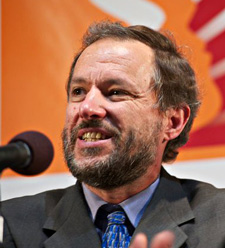
Israel-USA vs Iran: Talk Peace!

By Johan Galtung

The state system at its worst: trading insults and threats, sanctions, readiness to use extreme violence, forward deployment of US troops in Israel as hostages to guarantee US involvement, disregard for common people and the effects of warfare in the Middle East and the world. The options are harder sanctions, or war. The far better option, sitting down, with mediators, talking and searching for solutions, is absent. Polarization, escalation, the material of which wars are made fill the media. What a shame.Read More »


The Menace of Present & Future Drone Warfare

By Richard Falk

After the atomic bombs were dropped on Hiroshima and Nagasaki, and the colossal scale of devastation disclosed, there was a momentary embrace of sanity and rationality by world leaders and cultural commentators. There was a realization that living with such weaponry was at best a precarious journey into the future, and far more likely, an appointment with unprecedented human catastrophe if not apocalypse.

What to learn from the ongoing existence of nuclear weaponry

This dark mood of foreboding did produce some gestures toward nuclear disarmament tabled initially by the U.S. Government, but in a form that reasonably struck others at the time, especially the Soviet Union, as a bad bargain — the U.S. was proposing getting rid of the weapons for the present, but retaining the materials, the technology, and the experience needed to win handily any nuclear rearmament race. Read More »

Turkey’s Foreign Policy: Zero Problems with Neighbors Revisited

By Richard Falk

Pundits in Europe and North America in recent months have delighted in citing with a literary smirk ‘zero problems with neighbors,’ which has been the centerpiece of Ahmet Davutoglu’s foreign policy agenda since he became Foreign Minister on May 1, 2009. Mr. Davutoglu had previously served as Chief Advisor to both the Prime Minister and Foreign Minister ever since the AKP came to power in 2002, and was known in those years as the ‘architect’ behind the scenes.

Critics of the zero problems approach point to the heightened Turkish tensions with Syria and Iraq, the persisting inability of Ankara to overcome the hostile fallout from Mavi Marmara incident with Israel, and even the revived salience of the long unresolved dispute with the Armenian diaspora sparked by a new French law that makes the denial of genocide associated with the 1915 massacres a crime and has led to a dramatic worsening of Turkish-French relations.

Troubles to be sure, but should these be interpreted as ‘failures,’ and more precisely as ‘Turkish failures’? Read More »

Om King hade levt idag

– och om likheterna mellan stater och människor i fängelse

Av Martin Smedjeback
Tal på Helsingborgs stadsbibliotek på King-dagen 17 januari 2011

21 år gammal åkte jag till USA för att jobba som au pair. Väl på plats flyttade jag in hos en rik familj i New Jersey för att under ett år ta hand om deras barn. I denna familj med två vuxna och tre barn hade de fyra bilar och sju TV-apparater. De hade ett materiellt överflöd men brist på kärlek. Elaka ord om varandra utdelades ofta i familjen, väldigt sällan ömhetsbetygelser.

“Vi måste snabbt börja gå från ett tingorienterat samhälle till ett personorienterat samhälle” sa Martin Luther King i ett tal. ”När maskiner och datorer, vinstmotiv och äganderättigheter, anses vara viktigare än människor då kan vi inte övervinna de tre enorma problemen: rasism, materialism och militarism.” Read More »

Unarmed resistance is Syria’s best hope

By Stephen Zunes

The Syrian pro-democracy struggle has been both an enormous tragedy and a powerful inspiration. Indeed, as someone who has studied mass nonviolent civil insurrections in dozens of countries in recent decades, I know of no people who have demonstrated such courage and tenacity in the face of such savage repression as have the people of Syria these past 10 months.Read More »

Nuclear-free Middle East: Desirable, necessary and impossible

By Richard Falk

Finally, there is some argumentation in the West supportive of a nuclear free zone for the Middle East. Such thinking is still treated as politically marginal, and hardly audible above the beat of the war drums. It also tends to be defensively and pragmatically phrased as in the NY Times article by Shibley Telhami and Steven Kull (January 15, 2012) with full disclosure title, “Preventing a Nuclear Iran, Peacefully.”Read More »

2012 Peace Proposal: Human Security and Sustainability: Sharing reverence for the dignity of life

By Daisaku Ikeda
President of Soka Gakkai International (SGI)

Every year Dr. Ikeda publishes his thoughts on what must be done to secure a better future for us all. He is a true contributor to the TFF pro-peace orientation that emphasizes how important it is to “imagine a better world”.
We are proud to have had this wise, visionary leader of what is probably the world’s largest peace movement, as TFF Associate over many years.
Much more about him here
.

The economist Amartya Sen, a renowned advocate of the methods and approaches of human security, has emphasized “the dangers of sudden deprivation.” Such unanticipated threats can take the form of natural disaster and conflict, and can also arise from economic crises and rapid environmental degradation brought about by climate change. It is crucial that we respond vigorously to such threats, which can grievously undermine people’s lives, livelihoods and dignity.Read More »

Stop warmongering in the Middle East

By Richard Falk

A critique of western policies vis-à-vis Iran and two pro-peace proposals

The public discussion in the West addressing Iran’s nuclear program has mainly relied on threat diplomacy, articulated most clearly by Israeli officials, but enjoying the strong direct and indirect backing of Washington and leading Gulf states. Israel has also engaged in covert warfare against Iran in recent years, somewhat supported by the United States, that has inflicted violent deaths on civilians in Iran.

Many members of the UN Security Council support escalating sanctions against Iran, and have not blinked when Tel Aviv and Washington talk menacingly about leaving all options on the table, which is ‘diplospeak’ for their readiness to launch a military attack. Read More »

Waging War against Iran is a Criminal Act, in Violation of International Law

By Francis A. Boyle

Article 2 (3) of the United Nations Charter requires the pacific settlement of the international dispute between the United States and Iran. To the same effect is article 33 and the entirety of Chapter VI of the United Nations Charter that mandate and set up numerous procedures for the pacific settlement of the international dispute between the United States and Iran. And of course Article 2(4) of the U.N. Charter prohibits both the threat and use of force by the United States against Iran.Read More »