Review of “The Need for a New Economic System”

Review of John Avery’s book by Dorothy Guyot

A Scientist Presses for Action on Many Fronts: A review of the book

The Need for a New Economic System
By John Scales Avery
Selected Works Volume 1, 291 pages
Irene Publishing
Sparsnäs, Sweden 2015

The Need for a New Economic System by John Scales Avery is an important book for everyone concerned over the future of humanity. The urgent voice of the book stems from Dr. Avery’s seeing the discontinuity between the loving care that people bestow on their children and their failure to reduce the harm to their children from a destructive economic system, climate change, resource depletion, and war.

This book of advocacy demonstrates the need for solutions to problems created under the present economic system. Political-economic analyses of the causes of the problems and of solutions are outside of the scope of the book. Scattered through the book are a few general policy suggestions. At the center is Avery’s assessment sector by sector of the critical problems that must be solved to avert disasters.

The book first demonstrates the impossibility of sustaining growth economies on our finite planet. The central three chapters analyze the damage from climate change and war. Globalization, population growth, and the food crisis are the last problems Avery analyzes.

He builds toward his conclusions by sketching the nineteenth century cooperative movement and Gandhian economics. The concluding chapter revisits the problems to advocate change.

The premise of the book is that when people face up to the extent and nature of world problems, people can act creatively and effectively.

John Avery is thinker and writer. Read More »

John Avery’s CV

John Scales Avery

John Scales Avery received a B.Sc. in theoretical physics from MIT and an M.Sc. from the University of Chicago. He later studied theoretical chemistry at the University of London, and was awarded a Ph.D. there in 1965.

He is now Lektor Emeritus, Associate Professor, at the Department of Chemistry, University of Copenhagen.

Fellowships, memberships in societies
Since 1990 he has been the Contact Person in Denmark for Pugwash Conferences on Science and World Affairs. Member of the Danish Peace Commission of 1998. Technical Advisor, World Health Organization, Regional Office for Europe (1988- 1997). Chairman of the Danish Peace Academy, April 2004-.

You’ll find a lot about this eminent scholar at Wikipedia. Avery is also a leading peace researcher and activist – “Since 1990, Avery has been the Contact Person for Denmark the Pugwash Conferences on Science and World Affairs. In 1995, Avery was part of a group that shared in the Nobel Peace Prize for their work in the 1990s in organizing the Pugwash Conferences on Science and World Affairs.

In 1998, Avery was elected to the Danish Peace Commission. During the years 1988-97, Avery was the Technical Advisor at the World Health Organization, Regional Office for Europe. In 2004, Avery became the Chairman of the Danish Peace Academy.

In his usual humble and plain style John tells the story of his life – his personal life, his scholarly life and his peace life – here.

Publications
Dr. Avery seems to have ben writing day and night throughout his life – here is his amazing list of books, chapters and articles on world affairs.

In early 2016, Irene Publishing – run by TFF Associates Jørgen Johansen and Majken Jul Sørensen – published Avery’s Collected Essays as well as The Need For A New Economic System.

John joined TFF as TFF Associate in March 2016.

TFF PressInfo # 370: If Obama visits Hiroshima (Part 1)

By Richard Falk

There are mounting hopes that Barack Obama will use the occasion of the Group of 7 meeting in Japan next month to visit Hiroshima, and become the first American president to do so.

It is remarkable that it required a wait of over 60 years until John Kerry became the first high American official to make such a visit, which he termed ‘gut-wrenching,’ while at the same time purposely refraining from offering any kind of apology to the Japanese people for one of the worse acts of state terror against a defenseless population in all of human history.

Let’s hope that Obama goes, and displays more remorse than Kerry who at least deserves some credit for paving the way.

The contrast between the many pilgrimages of homage by Western leaders, including those of Germany, to Auschwitz and other notorious death camps, and the absence of comparable pilgrimages to Hiroshima and Nagasaki underscores the difference between winning and losing a major war. This contrast cannot be properly accounted for by insisting on a hierarchy of evils that the Holocaust dominates.

The United States, in particular, has a more generalized aversion to revisiting its darker hours, although recent events have illuminated some of the shadows cast by the racist legacies of slavery.

The decimation of native Americans has yet to be properly addressed at official levels, and recent reports of soaring suicide rates suggests that the native American narrative continues to unfold tragically.

The New York Times in an unsigned editorial on April 12 urged President Obama to make this symbolic visit to Hiroshima, and in their words “to make it count” by doing more than making a ritual appearance. Recalling accurately that Obama “won the Nobel Peace Prize in 2009 largely because of his nuclear agenda” the editorial persuasively criticized Obama for failing to follow through on his Prague vision of working toward a world free of nuclear weapons.

A visit to Hiroshima is, in effect, a second chance, perhaps a last chance, to satisfy the expectation created early in his presidency.

When it came to specifics as to what Obama might do the Times offered a typical arms control set of recommendations of what it called “small but doable advances”: canceling the new air-launched, nuclear-armed cruise missile and ensuring greater compliance with the prohibition on nuclear testing by its endorsement coupled with a recommendation that future compliance be monitored by the UN Security Council.

The Times leaves readers with the widely shared false impression that such measures can be considered incremental steps that will lead the world over time to a nuclear-free world. Such a view is unconvincing, and diversionary.

In opposition, I believe these moves serve to stabilize the nuclear status quo have a negative effect on disarmament prospects. By making existing realities somewhat less prone to accidents and irresponsibly provocative weapons innovations, the posture of living with nuclear weapons gains credibility and the arguments for nuclear disarmament are weakened even to the extent of being irrelevant.

I believe that it is a dangerous fallacy to suppose that arms control measures, even if beneficial in themselves, can be thought of as moving the world closer to nuclear disarmament.

Instead, what such measures do, and have been doing for decades, is to reinforce nuclear complacency by making nuclear disarmament either seem unnecessary or utopian, and to some extent even undesirably destabilizing. In other words, contrary to conventional wisdom, moving down the arms control path is a sure way to make certain that disarmament will never occur!

As mentioned, many arms control moves are inherently worthwhile. It is only natural to favor initiatives that cancel the development of provocative weapons systems, disallow weapons testing, and cut costs. Without such measures there would occur a dangerous erosion of the de facto taboo that has prevented (so far) any use of nuclear weaponry since 1945.

At the same time it is vital to understand that the taboo and the arms control regime of managing the nuclear weapons environment does not lead to the realization of disarmament and the vision of a world without nuclear weapons.

Let me put it this way, if arms control is affirmed for its own sake or as the best way to put the world on a path of incremental steps that will lead over time to disarmament, then such an approach is nurturing the false consciousness that has unfortunately prevailed in public discourse ever since the Nonproliferation Treaty came into force in 1970.

The point can be express in more folksy language: we have been acting for decades as if the horse of disarmament is being pulled by the cart of arms control. In fact, it is the horse of disarmament that should be pulling the cart of arms control, which would make arms control measures welcome as place holders while the primary quest for nuclear disarmament was being toward implementation.

There is no reason to delay putting the horse in front of the cart, and Obama’s failure to do so at Prague was the central flaw of his otherwise justly applauded speech.

Where Obama went off the tracks in my view was when he consigned nuclear disarmament to the remote future, and proposed in the interim reliance on the deterrent capability of the nuclear weapons arsenal and this alleged forward momentum of incremental arms control steps.

What is worse, Obama uncritically endorsed the nonproliferation treaty regime, lamenting only that it is being weakened by breakout countries, especially North Korea, and this partly explains why he felt it necessary back in 2009 to consider nuclear disarmament as a practical alternative to a continued reliance on nonproliferation, although posited disarmament more as a goal beyond reach and not as a serious present political option.

He expressed this futuristic outlook in these words: “I am not naïve. This goal will not be reached quickly – perhaps not in my lifetime.” He never clarifies why such a goal is not attainable within the term of his presidency, or at least its explicit pursuit.

In this regard, and with respect to Obama’s legacy, the visit to Hiroshima provides an overdue opportunity to disentangle nuclear disarmament from arms control.

Part 2

Danmark skal heller ikke bombe i Syrien – 6 artikler

Af Jan Øberg

Posted on 18 April, 2016 on Jan Oberg’s blog

Den 19. april 2016 havde Folketinget 2. behandling af forslaget om også at bombe og indsætte specialstyrker i Syrien.

Jeg mener at sagen er fundamentalt vigtig for Danmark, danskerne og vor fremtidige rolle og ‘image’ ude i verden.

Desuden finder jeg at beslutningsgrundlaget, mediedækningen og den offentlige debat giver anledning til den største bekymring.

At gå i krig er den vigtigste beslutning en regering kan tage og en befolkning bakke op om. Men det er som om dette at deltage i krig stort set rager både ministre, folketingsmedlemmer, journalister og befolkning en forårsblomst.

Med en vis fortvivlelse skrev jeg derfor 6 artikler med forskellige temaer og producerede en video, der også foreslår hvad vi kunne gøre i stedet.

Jeg ville have disse ting sagt og spredt inden beslutningen blev taget.

Herunder findes de én for én som jeg har skrevet dem med en lille kommentar til publiceringsprocessen, som også i et vist omfang vidner – for mig i hvert fald – om mærkelige prioriteringer hvad angår tidspunkt og længde.

Alt andet lige bliver redaktionerne ikke oversvømmet af kvalificerede, kritiske og konstruktive artikler af denne type – men det er dog kun meget korte ting, man kan få ind. Om overhovedet…

1. Dansk krigsdeltagelse i Syrien vil være landsskadelig

Politiken 16. april 2016. Problemfri publicering.

Den 19. april skal folketinget have 2. behandling af forslaget om at Danmark skal deltage i krigen over Syrien og endog have specialstyrker på landjorden.

Det vil i så fald være sjette krigsdeltagelse siden 1999 – Serbien, Afghanistan, Irak 2003-2007, Libyen, Irak igen.

Der synes desværre at være flertal for krigspolitikken uanset det faktum at samtlige krige har været fiaskoer på deres egne præmisser og ud fra et fredsskabende synspunkt.

Politikere og andre mennesker, der støtter det krigsførende Danmark gang på gang, må vel efterhånden kunne blive stillet til ansvar for deres holdning til massedrab på uskyldige. Kan det være rigtigt at dette er så uproblematisk som den ringe offentlige debat tyder på at det er så let at beordre mord på andre mennesker?

Internationale rapporter gør gældende at den vestlige verden kan have dræbt op til 4 millioner muslimer siden 1990.Read More »

Realpolitik versus Realistic Politics

By Johan Galtung

School of Conflict Analysis and Resolution – Arlington, VA, USA – April 11, 2016

Classical Realpolitik is the priority in US foreign relations. Let force decide issues, if possible by threat, if necessary by fighting to the end.

The two traditional nominees for the US Presidency, Cruz and Clinton, both advocate open violence; Cruz by “carpet bombing” and by patrolling Muslim neighborhoods making use of force credible, Clinton by standing by her past record of bombing Muslim countries.

Trump, distancing himself from both Clinton belligerence and Cruz patrolling, deepens underlying conflicts in a most unfortunate way by stirring up prejudice and discrimination against Muslims and Mexicans. He wants a fence, built by Mexico, forcing them out.

Sanders is so focused on US domestic inequality that he remains vague on foreign policy. However, he might steer US discourse as well as foreign policy by arguing more positive policies; examples below.

Net conclusion: the two official candidates, Clinton and Cruz, are more similar than they are to their intra-party rivals. Paul Krugman (INYT 5/6 Mar 2016) throws the official Republican (former) candidate Rubio “con artist” for Donald Trump back at Ryan-Cruz-Rubio. And Thomas Friedman, “Only Trump can trump Trump” (INYT 10 Mar 2016), says that should Trump become the nominee and elected, he has a lot of space to maneuver towards the center, away from his extreme positions. “He will have no problem playing the moderate unifier”.

Nevertheless, Trump may already have helped gravediggers dig his grave.

Both Clinton and Cruz have credibility problems. Democrats may find Clinton’s turn toward the left incredible and prefer Sanders as more genuine; Republicans may find Cruz’ Tea Party extremism incredible and prefer Trump. With Sanders-Trump unavailable, high abstention?

However, in the US delegatocracy, very cleverly crafted to protect the USA against democracy, alternatives may still appear/be drafted.

US Realpolitik has led to more than 20 million killed in 37 countries after WWII, while the US relative economic, military – not cultural – position in the world declines. This should lead to a search for something realistic, solving problems rather than adding new problems to the old; solidifying the US position.

What does it take to make US foreign policy more realistic? New ways of thought more than political decisions and economic allocations.

Identify the positive, good in the other big world actors, Russia-India-China-Islam-EU-Africa-Latin America, learn from positives, and link their good to the US good, for cooperation and harmony.

To promote peace, cooperation must be equitable – mutual and equal benefit – and harmony must be based on empathy – deep understanding of others. Know the shadows of history, Read More »

How ought we treat each other?

By Johan Galtung

Upon receiving the Gandhi-King-Ikeda Community Builder Prize

Atlanta, 31 Mar 2016

Dear President, dear Dean of Morehouse College, Ladies and Gentlemen,

I am deeply honored by the prize from a college in Georgia, in the US South, that has been and is a beacon in the struggle from dominion to dignity in race relations. The civil rights movement is an American Revolution, like the feminist movement it inspired–aiming at parity and dignity for all. To refuse sharing the spoils of exploiting Reds and Blacks and poor Whites with London was far from a revolution.

This college shaped Dr Martin Luther King Jr. I had the honor of meeting him twice here in Atlanta in 1960–working on desegregation without violence in Charlottesville, VA–and in 1964 in Oslo when he received the Nobel Peace Prize. This College made him use Gandhi’s clinging to truth through nonviolent struggle, satyagraha, lifting 20 million Blacks into dignity. There is a backlash: Blacks are again shot at, and used as slave labor in prisons. The struggle continues.

Building communities. There are at least two of them, the community of people, and the community of states. I will deal with both and share with you in this speech the basic ideas of TRANSCEND mediation – an NGO of more than 500 invited members, comfortable with our mantra, “Peace by Peaceful Means”. Transcend means going beyond.

Let us approach answering the question through some words on how we ought not treat each other.

It is all in our thought habits, the deep culture of our thinking. In the West we think in simple dichotomies, like positive/negative, good/bad, even evil. Either one or the other, not in-between, neither-nor, both-and. And we very easily fall into the trap of seeing ourselves as only good, and someone else as only bad, steered by God or Satan. The road to narcissism, self-love and paranoia, seeing threats everywhere, is short. Victory! not solution.

AND Narcissism + Paranoia = Psychosis, the psychiatric diagnosis.

To escape from this thought habit use ancient Chinese habits. Yin/Yang. They also think positive/negative, good/bad; but add more levels, like the positive and negative in the positive and negative, the good and bad in the good and bad. That opens for identifying the negative in Self and the positive in Other; for positive-peaceful, not negative-violent relations. Not either-or; but both-and, neither-nor.

The TRANSCEND formula: focus on the positive, good in everybody including yourself; but keep the negative, bad in the back of the mind to improve it and as possible danger, to Self and-or Other.

Then create projects linking good with good; first as vision, then reality.Read More »

TFF PressInfo # 369 – A Sunni-Salafist-Zionist Coalition Changing Middle East?

By Jan Oberg

Please try Google “Gulf states want nuclear weapons against Iran – Israel “ and only one Western mainstream media will appear, an excellent article by The Telegraph’s Raf Sanchez in Jerusalem.

The only other media carrying the story is Russia Today and Vigilant Citizen and MintPress News also carries the story and offers a wider background

What is this about?A new coalition?

So the usual Western media filter, meaning it must be interesting. And it is a quite sensational story: Saudi Arabia and Israel are up to a nuclear mischief against a country that has just been prevented from acquiring nuclear weapons by means of a huge legally binding document, UN Security Council endorsement and extremely tight monitoring mechanism. What’s it about?

It’s about Israel’s defence minister Moshe Ya’alon saying in public at the recent Munich conference that Arab states are “not willing to sit quietly with Iran on the brink of a nuclear bomb”.

He thinks that Iran was liable to break the agreement as their economic situation improves with the lifting of international sanctions. Ya’alon is quoted as saying that “I speak about the Gulf states and North African states too…For them, Iran and the Muslim Brotherhood are the enemy. Iran is the bad guy for us and for the Sunni regimes. They are not shaking hands [with Israelis] in public, but we meet in closed rooms.”

So not only Jordan’s monarchy and Egypt’s dictatorship but also Gulf and North African states: A coalition lead by Saudi Arabia and Israel – Israel as the only nuclear weapons power in the region and Saudi Arabia as the most likely next nuclear weapons state.

For much too long the world’s attention has been on Iran’s imagined nuclear weapons, not on the dozens or hundreds real nukes that Israel possesses as a non-member of which is the Non-Proliferation Treaty (NPT).

One can say that Israel and Saudi Arabia lost the political battle against the nuclear deal with Iran concluded with the five permanent UNSC members and Germany last year – and now will do their utmost to use Iran’s non-nuclear weapons status as a pretext for others going nuclear against, predominantly, Iran.

Propaganda hysteria dominates in an age where knowledge plays a diminishing role

The problem for them, however, is that Iran will be difficult to sell as a real threat – but we live of course in Read More »

Reflections on the Brussels attack

By Richard Falk

Prefatory Note
A much abbreviated version of this post was published in Al Jazeera English on March 24, 2016. Although the essential analysis is the same, the reasoning here is greatly elaborated. The themes addressed and the policies proposed are advanced in a tentative spirit. Debate and reflection are urgently needed with respect to the political violence that is being unleashed in various forms in the West and non-West.

This latest terrorist outrage for which ISIS claimed responsibility exhibits the new face of 21st century warfare for which there are no front lines, no path to military victory, and acute civilian vulnerability. As such, it represents a radical challenge to our traditional understanding of warfare, and unless responses are shaped by these realities, it could drive Western democracies step by step into an enthused political embrace and revived actuality of fascist politics.

Already the virulence of the fascist virus dormant in every body politic in the West has disclosed its potency in the surprisingly robust Trump/Cruz run to become the Republican candidate in the next American presidential election.

Perhaps, the most important dimension of this 21st century pattern of warfare, especially as it is playing out in the Middle East, is the will and capacity of violent extremists to extend the battlefield to those perceived to be their enemies, and to rely on acutely alienated Europeans and North Americans to undertake the suicidal bloody tasks.

The British Independent struck the right note in its commentary, Read More »

Two ways of looking at the race for the American presidency

By Richard Falk

#1: as an incredibly dumbing down of the political process, turning the presidential campaigns for the nomination as heavily financed shadow shows, hiding special interests and money management, all about selling the candidate by boast and bluster;

#2: as pre-revolutionary ferment, mobilizing the young, and confronting the established order, finally, with non-establishment choices between the radical right of Trump & Cruz and the moderate social democratic left of Sanders.

This tedious struggle for political prominence and historical name recognition is being played out against a backdrop of the three pillars of America’s global role: the Pentagon, Wall Street, and Israel.

No candidate has managed to shake the pillars, although this time around Sanders has at least launched a genuine attack on the Wall Street pillar, and Trump has gestured toward what might be a mild push against the Israel pillar. This alone makes Sanders and Trump the first outsiders to compete seriously for a run at the White House.

Of course, since Sanders has done so much better than expected, Clinton makes some noises as if she is also taking on Wall Street, but as her unreleased transcripts of her gilt talks at Goldman-Sachs no doubt confirm, no one think she means it, and she doesn’t. This is her way of harmlessly sparring with the man from Vermont until she locks up the machine-driven nomination.

When we look at the candidates from a Hollywood central casting point of view, we have to wonder who is running the show, especially on the Republican side.

Senator Ted Cruz appears to be a credible reincarnation of Tomás de Torquemada, Read More »

A pope, a patriarch, a spiritual revolution

By Johan Galtung

The first editorial here at Transcend of March 3 2008, “50 Years of Fidel Castro” celebrated a political revolution that changed the world, and spelt the end of US-Western imperialism. This editorial celebrates a spiritual revolution that may also change the world, spelling the end of Western materialism, and spread from there.

We are talking about processes, not events, and of structures and cultures more than of actors.

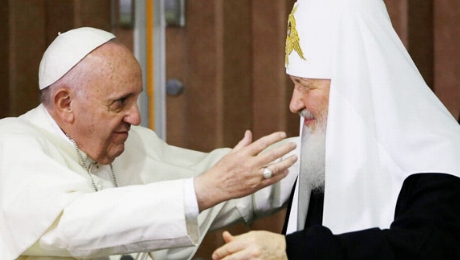
Again, Cuba played a major role, as meeting place between two major parts of Christianity, Catholic and Orthodox. In the Great Schism of 1054 they had excommunicated each other; and the Roman empire had split Catholic/Orthodox in 395. Fidel’s Catholic brother and successor Raúl was a condition for this historic meeting for peace; so was the meeting between Putin–an Orthodox Christian–and Francis in June 2015. However, not many pairs of brothers rival the two Castros in shaping history.

They met, Pope Francis of the Catholic Church and Patriarch Kirill of Moscow and all Russia – after earlier meetings between popes and the patriarch of Constantinople – with a Joint Declaration on 12 Feb 2016 in 30 articles. There were 17 quotes from the Bible; showing that they are “brothers in the Christian faith”, “pained by the loss of unity”, “divided by wounds caused by old and recent conflicts”. Not from the Bible are the many references to “the Most Holy Mother of God, Virgin Mary, and the saints we venerate”. Problematic for Protestants.

The bulk of the Joint Declaration is about the fate of Christians in the Middle East, meaning mainly Orthodox; like “the Metropolitans of Aleppo, Paul and John Ibrahim, who were taken in April 2013, to make every effort to ensure their prompt liberation”. However, together they “invite our Churches in Ukraine to work towards social harmony”.

They also jointly argue strongly against abortion and euthanasia, and in favor of “respect for the dignity of the individual called into being according to the Creator’s plan”. Do not destroy God’s creation.Read More »