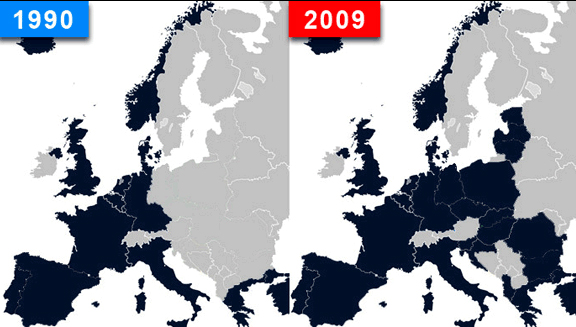
Make Russia a friend again

By Jonathan Power

August 26th 2014.

In his magisterial book “Europe”, Norman Davies writes, “Europe is a relatively modern idea. It gradually replaced the earlier concept of ‘Christendom’ in a complex intellectual process lasting from the fourteenth to the eighteenth centuries.”

Jean Monnet, the founder of the European Union, said, “Europe has never existed. One has to genuinely create Europe”.

“For more than 500 years”, continues Davies, “the cardinal problem in defining Europe has centred on the inclusion or exclusion of Russia. Throughout modern history the Orthodox, autocratic, economically backward but expanding Russia has been a bad fit.”

Nevertheless, Empress Catherine the Great announced in 1767 in St Petersburg that “Russia is a European state”. Dostoevsky, at the poet Pushkin’s funeral, eulogised Europe. “Peoples of Europe don’t know how dear to us they are.”

Muscovy has been an integral part of Christendom since the tenth century. Moreover, one can see that since Pushkin’s time Russia has created a larger part of the Western high cultural heritage than any other single European country and far much more than America. Think of the ballet (the best in the world by far) and the Bolshoi and Mariinsky theatres- and their protégés from Nureyev to Anna Netrebko. Think of composers: Tchaikovsky, Mussorgsky, Rimsky-Korsakov, Borodin, Stravinsky and Shostakovich. Think of the novel, poetry and drama: Tolstoy, Gogol, Chekov, Turgenev, Anna Ahmatova as well as Pushkin and Dostoevsky.

Lenin identified closely with Europe. Only under Stalin did Russia move away from Europe. In more recent times both Mikhail Gorbachev and President Vladimir Putin have talked of wanting to belong to the “Common European Home”- one day members of the European Union.Read More »
Strange regional alignments in the Gaza Massacre

By Richard Falk

Richard Falk

Prefatory Note

My post below, an earlier version of which was published in AlJazeera English as an opinion piece. It was written before I had the opportunity to read an illuminating assessment of the regional and global turmoil that culminated for now in the massacre carried out by Israeli armed forces in Gaza. I highly recommend “The Tragedy of Great Power: The Massacre of Gaza and the Inevitable Failure of the Arab Spring” written by the learned Islamic jurist and scholar, Khaled Abou El Fadl, a distinguished professor at UCLA School of Law, with the link to the article below:

What makes Professor El Fadl profound essay particularly valuable is his ability to fit the regional pieces together in a convincing manner, showing how and why governments that rule in Saudi Arabia and the UAE, encouraged the overthrow of Egypt’s elected government headed by Mohamed Morsi in mid-2013 and more recently encouraged Israel to destroy Hamas.

He also shows that Hamas is not accurately perceived as a byproduct of the Egyptian Muslim Brotherhood, but has its own “very distinct pedagogies, objectives and methodologies.” In depicting the forces of resistance and transformation as opposed to the geopolitics of counterrevolution as constituting the core struggle taking place throughout the region it becomes clear why the alignments in the Middle East are assuming their current configurations.

It is telling and provocative for Professor El Fadl to situate the Palestinian Liberation Organization (and by implication, the Palestinian Authority) as de facto allies of Sisi’s Egypt, Saudi Arabia, and the UAE as well as being existential partners of the United States and Israel in subjugating the region to Western goals.

What has developed further since the end of the Cold War rivalry that long dominated the region should be considered a geopolitical protection racket that gained political salience in the aftermath of the Arab Spring. The upheavals of 2011 shook the foundations of the old order, and led to renewals throughout the region of Faustian Bargains by which various authoritarian regimes receive protection, including help with the destruction of any political actor, whether Islamic or not, that dares to challenge this established order composed of ultra-rich native elites claiming dynastic privileges conferred by colonial powers then seeking native collaborators to manage exploited and oppressed populations.

While these elites appease Israel, the masses in the same political space remain passionately and symbolically dedicated to the Palestinian struggle as became evident in the September 9, 2011 attack by several thousand Egyptians on the Israeli Embassy shortly while the heroic memories of the overthrow of Hosni Mubarak were still fresh.

Of all the complexities surrounding the reaction of the world to the horrifying spectacle of Israel’s severe criminality in Gaza none is more perplexing than the complicity of most governments throughout the Arab world.

What makes their political posture particularly bewildering is the degree of ethnic, religious, cultural, and historical commonality that creates such close ties of identity among the peoples of the region. And no single issue has been as unifying over the decades for these people than has their long intensely felt opposition to the injustice, suffering, and exploitation that the Palestinian people have endured for the past century as a result of the encroachments of the Zionist movement on their lands. Read More »

Demand swells for straight answers on plane in Ukraine

By David Krieger and others

A long list of prominent individuals has signed, a number of organizations will be promoting next week, and you can be one of the first to sign right now, a petition titled “Call For Independent Inquiry of the Airplane Crash in Ukraine and its Catastrophic Aftermath.”

The petition is directed to “All the heads of states of NATO countries, and of Russia and the Ukraine, to Ban-ki Moon and the heads of states of countries on the UN Security Council.” And it will be delivered to each of them.

The petition reads . . continue here. And please sign it!

TFF PressInfo: Support Richard Branson’s Ukraine dialogue initiative

TFF PressInfo 273

By Jan Oberg, TFF co-founder

Jan Oberg

Lund, Sweden August 22, 2014

We are drifting towards a new Cold War. The reason isn’t substance because there is no reason we should not be able to live in peace in Europe – if we want and educated ourselves in handling problems.

No, the reason is the woefully incompetent way in which politicians and media focus on violence and ignore the underlying conflict and civil means – yes yes, of course there are exceptions.

Escalation doesn’t create peace

Here is just one example – NATO S-G Anders Fogh Rasmussen and NATO’s supreme commander General Breedlove (funny name given his anything but loving views coming rather from a Strangelove …) in the Wall Street Journal.

They tell you about all the escalation they have already done Read More »

TFF PressInfo: Cold War warnings 1998 – 2014

By Jan Oberg

Jan Oberg

Lund, Sweden August 11, 2014

Quality research leads to better predictions

One criteria of quality research is that it predicts the future better than incompetent research.

Because TFF is independent of governments and coroporations it doesn’t have to take political considerations or exclude certain theories, concepts or values. This free research enabled it over the years to make fairly precise predictions about for instance former Yugoslavia, the Iraq war and East-West relations.

In 1998 – 16 years ago – we warned that NATO’s expansion would lead to future problems with Russia. Read it here.

NATO should never have been expanded

We backed this prediction up with 46 arguments and argued that so many other things would be wiser than containing Russia from the Baltic republics to Georgia – a strategy pursued by Bill Clinton in contravention of all promises given to the Soviet Union/Russia at the end of the Cold War about ten years earlier.

That counterproductive and insensitive expansion has now hit Ukraine. A new Cold War is gathering over Europe. It should have been predicted by advisers, intelligence agencies, big research institutes and columnists.

But it wasn’t.

At the end of the Cold War, NATO/the West got everything it could ever wish – and without war. But it wanted more: keeping Russia down, making NATO bigger and “peace-making” as well as finding new enemies to keeping its Military-Industrial-Media-Academic Complex (MIMAC) alive and well: Saddam, Milosevic, the Muslim world, terrorism and – now re-cycling – Russia.Read More »

BRIC(K)S for a New World Economic Order!

By Johan Galtung
28 Jul 2014 – Kuala Lumpur

Johan Galtung

They made it, with constructive alternatives – the New Development Bank and the Contingency Reserve Agreement–to the US-dominated World Bank and International Monetary Fund. Those two parts of Bretton Woods were basic pillars in the economic infra-structure of the US Empire in the hands of the US Congress. Loans were disbursed in return for “structural adjustment” –privatization, budget cuts, devaluation, repatriation of profit, also against BRICS countries. US companies were commissioned for huge jobs serving local elites. Untold damage was done in spite of some recent changes in rhetoric.

The USA used them to export the US economic–and with it the social, political, cultural, military–order through loans, grafting it upon social bodies that after some time rejected the implants as foreign and incompatible. Even a decaying order however brilliant it may have looked to the untrained eye as late as the 1990s.

What remains today of that US “order” is the military part Read More »

What was history about? Look at the Histomap

By Johan Galtung

Johan Galtung

John B. Sparks made a histomap in 1931—updated in 2010 (Metro Books) – a long, vertical chart covering “peoples and nations for 4,000 years”.

Time, history, is on the vertical axis, listing when of events and where in the space of peoples and nations. The chart starts with the Chinese, the Indians, Amorites (Babylon), Aegeans (Minoans and Mycenaeans), Hittites (Anatolia), Iranians and Greeks, goes on to the Romans, the British, the Huns (Mongols) and ends with Latin America, Europeans West and East (the EU is absent), the Middle East, sub-Sahara Africa, Russians and Americans, Asia as India, China and Japan; each part proportionate to their significance at the time. Debatable.

But let us focus on something crucial: the shape of the “peoples-nations” bubbles in world history, from a beginning to an end?

By and large exactly like that: a birth somewhere in this Einsteinian timespace, and a death. Two points, and between them: growth-maturity/flourishing-decline and fall. Expansion to a maximum, and contraction to a minimum. The law of anything organic? Given that they often thought they were forever, gifted with eternal life, history is about great expectations, glories–and great traumas.Read More »

Tormenting Gaza

By Richard Falk

Prefatory Note:
The Israeli military operation, code name Operation Protective Edge by Israel, being carried out in the Gaza Strip continues, and seems poised to mount a ground attack that will further intensify the suffering of the Palestinian people, and lend additional credibility to the accusation of ‘collective punishment,’ both a grave breach of international humanitarian law and a crime against humanity.
The article below is a somewhat edited re-publication of an opinion piece published in AlJazeera English several days ago at the start of Operation Protective Edge.

For the third time in the last six years Israel has cruelly unleashed the full fury of its military machine against the defenseless 1.7 million people of Gaza, inflicting heavy civilian casualties and further devastation on the long besieged and impoverished Gaza Strip.

With cynical disregard of the realities of this latest one-sided confrontation between Israel and Palestine, instead of condemning such recourse to massive violence as ‘aggression’ that violates the UN Charter and fundamental international law principles, the reaction of Western diplomats and mainstream media has so far perversely sided with Israel, citing the bland rationalization repeatedly stressed by Netanyahu that ‘every nation has the right to defend itself.’

And so it does, but not by way of aggression!

From the UN Secretary General to the President of the United States, the main insistence has been that Hamas stop must all rocket attacks while Israel is requested ever so politely to show “maximum restraint.”Read More »

Aage Bertelsen (1901 – 1980) – Danish educator for peace

By Jan Oberg & Johan Galtung*

Lund and Kuala Lumpur, July 2014

Introduction

He was a tall man and a great man, a visionary, pacifist, civil resister, educator and philosopher. He took life more seriously than most and he could be playful and fun like a child. His life’s guiding principle was ”Engage in your time!” and while he wrote and talked a lot he also did it. His name was Aage Bertelsen, he was born in Denmark in 1901 and died on August 15, 1980.

Bertelsen’s imprint on history is two-fold. First, with his wife Gerda he was a prime mover of one of the groups, the Lyngby Group, which organised the rescue of altogether 7.220 Danish Jews into safety in Sweden in October 1943 during the German occupation of Denmark – more here. The Lyngby Group – Lyngby is north of Copenhagen – got about 1.000 of these in safety by organising their nightly transport onboard small fisher boats over the Sound between Denmark and Sweden.

In this he deserves a place in international contemporary history for its humanity, civil courage and as an example of non-violent struggle against occupation.

Secondly, Bertelsen was an educator of and for peace. His life work educational efforts included his family and friends, his pupils over 22 years at the Aarhus Cathedral School in Aarhus, Denmark, the general public as well as national and international leaders.

He lived in pre-Internet times and very little is publicly available today about this renaissance man. From two rather different, but compatible, perspectives we’ve taken it upon us to remind the world about him – friends and colleagues of his as we happen to be.

Headmaster Aage Bertelsen in 1961 Photo: Elfeldt, Copenhagen


Why now, over 30 years after his death? Read More »

TFF PressInfo: “The human price of the war on Iraq” Hearing Statement

Comments by Hans-C. von Sponeck
Former UN Assistant Secretary General, UN Humanitarian Coordinator for Iraq & TFF Associate


Hearing at the UK House of Commons, London June 10, 2014

Intro
1. HoC/HoL have repeatedly held Iraq hearings as have British NGOs such as CASI (Campaign Against Sanctions on Iraq) and Stop the War Coalition/UK. In Europe these are considered models for responsible public action.

2. My contribution at this hearing is not about the crimes of dictatorship or the details of Iraqi suffering. For both well researched data is available. The objective of my participation is to make two detailed observations about externally-driven Iraq politics during the period 1990-2014.

Observation 1

3. Today’s tragic Iraq reality can only be understood if the additive impact of the years before and the years following the US/UK Governments’ illegal invasion and occupation is fully taken into account.Read More »