The Democratic Convention – Soviet-style and denial

By Johan Galtung
From Charlotte, NC-USA – 5 September 2012 [i]

The Democratic National Convention, DNC, floated into oblivion with no debate – Soviet style, hallelujah, amen – with no mention of overt wars with 5-6 Muslim countries; of covert wars by drones and SEALs-US Navy’s Sea, Air and Land Teams with many others; and the war on terror. Like the Republican National Convention, RNC, squeezing out Ron Paul, who argued for no bases, no wars, no support to Israel.Read More »

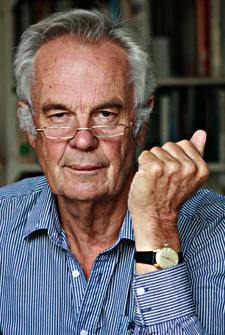
Toward a new geopolitics?

By Richard Falk

During the Cold War the main geopolitical optic relied upon by policymakers and diplomats was associated with a bipolar structure of hard power. There were supposedly two superpowers with overwhelming military capabilities compared to all other sovereign states, and each controlled an alliance of subordinate states that staked their survival on global crisis management and territorial containment skills of either the United States or the Soviet Union.

This framework was an extreme version of the balance of power system that had sustained global order in the West with mixed results during prior centuries. The Cold War nuclear version of the balance of power was frighteningly vulnerable to accident or miscalculation creating a lingering illusion that the current possession of nuclear weaponry on the part of nine sovereign states is a tolerable and stable situation in global affairs.Read More »

Hunting down the war criminals

By Jonathan Power

There can be no question that if President Bashar al-Assad of Syria falls the International Criminal Court will want to put him on trial for war crimes. The long arm of international law will reach him wherever he flees to. The ICC has an unblemished record in bringing to The Hague, the Court’s headquarters, the people they want. As the great heavyweight boxer, Joe Louis, once said, “You can run but you can’t hide”.

This week a new term begins for the justices. Read More »

The Hexagon map of the multipolar world

By Johan Galtung

How do we come to grips, intellectually, with today’s world?

Some time ago the geopolitical map was based on the direct East-West conflict, the two superpowers USA/USSR with alliances, and the neutral-nonaligned treated as a residual category. The world was Bipolar. The implosion of the USSR made it Unipolar, “the only surviving superpower”, 2-1 = 1. Or so we were told.

Today we have four huge states: the three largest in population, China-India-USA, and the largest in area, Russia. And the EU, a region with five middle-range states: UK-France-Germany-Italy-Spain.

But there is one more pole on the geopolitical map: Islam.Read More »

The Nordic countries in a world in crisis

By Johan Galtung

Talk at the Nordic Peoples’ Parliament in Jondal, Norway

Let us start with the crisis.

It is not a world crisis but a Western crisis. The root is simple: the Rest is catching up, and partly overtaking the West; China is catching up, and partly overtaking the USA–recovering from the blow received around 1500 from the Portuguese and the English destroying 1,000 years of buddhist-muslim trade from East China to Somalia via the rest of Asia; ending in Macao-Hong Kong (there are no Chinese enclaves in Portugal-England).

The West is outcompeted. The crisis is partly economic and partly a desperate Western effort, indeed Obama’s effort, to cling to hegemony.Read More »

The politics of the economic crisis – class warfare

By Johan Galtung

From Jondal, Norway

Writes Eduardo Porter on The New York Times:

“Perhaps the most surprising aspect of the Libor scandal is how familiar it seems. Sure, for some of the world’s leading banks to try to manipulate one of the most important interest rates in contemporary finance is clearly egregious. But is that worse than packaging billions of dollars worth of dubious mortgages into a bond and having it stamped with a Triple-A rating to sell to some dupe down the road while betting against it? Or how about forging documents on an industrial scale to foreclose fraudulently on countless homeowners?”

A useful summary of the situation as of today. But, a summary of what? What is this?

We have been through many answers starting with credit squeeze, then a real estate bubble that burst, toxic assets, credit swaps, hedge funds, derivatives – bets with the money of other people, yours and mine – all finance and banking. A psychologism was added at an early stage; greed. Read More »

India-China cooperation in the Asian century

By Shastri Ramachandaran*

NEW DELHI – India had more than one message for China prior to Prime Minister Manmohan Singh’s three-day visit to Myanmar, the world’s newest darling of democracy being wooed with ardour by the two Asian giants and the US.

From New Delhi went the un-subtle message that the prime minister’s visit was actuated by the neighbourly intent of peace and prosperity; and, not by any expansionist design. Taking a dig at China comes naturally to some in New Delhi, even when it is inappropriate – as it was here, because it does not fit with Manmohan Singh’s style and persona.Read More »

Towards a Gandhian geopolitics: A feasible utopia?

By Richard Falk

There has been serious confusion associated with the widespread embrace of ‘soft power’ as a preferred form of diplomacy for the 21st century. Joseph Nye introduced and popularized the concept, and later it was adopted and applied in a myriad of settings that are often contradictory from the perspective of international law and morality.

I write in the belief that soft power as a force multiplier for imperial geopolitics is to be viewed with the greatest suspicion, but as an alternative to militarism and violence is to be valued and adopted as a potential political project that could turn out to be the first feasible utopia of the 21st century.Read More »

The violent dangers of “failed states”

By Jonathan Power

The current belief of the government of Barack Obama is that there are two major fault lines in the world – one in the Middle East and one in the so-called “failing states”. “From Africa to Central Asia to the Pacific rim nearly 60 countries stand on the brink of conflict or collapse. These failed states are the perfect incubators for extremism and terror”, President Obama has said.

But is this true? The evidence suggests it manifestly is not as a general case although obviously Al Qaeda’s operations in deeply troubled Afghanistan and Pakistan (which some say is heading towards becoming a failed state) suggest that there has been some truth in the assertion.Read More »

From Westphalia to World Domestic Policy

By Johan Galtung

Talk at the Federation of German Scientists – Berlin, Germany

We honor a great German and world citizen, Carl Friedrich von Weizsäcker, born 100 years ago, and his path-breaking motto, World Domestic Policy, Weltinnenpolitik. What might it look like?

But before that, some words about CFvW in meetings around the world of WOMP, the World Order Models Project, brilliantly conceived and organized by Saul Mendlovitz, who sends warm greetings, and Richard Falk, the European representative with CfvW (and me as non-territorial). And as a board member of the Max Planck Institut; close to 20 years older, a father, brother and colleague.Read More »