From regionalization to globalization: Problematic

By Johan Galtung

“Future of the World between Globalization and Regionalization”
European Center for Peace and Development
Belgrade, 2-29 Oct 2016

Summary
Most states are too small given the speeds of transportation and communication–hence regionalization of neighbors with cultural similarities. The biggest states, China-India-Russia-USA-Indonesia-Australia-Brazil, are in fact regions. The next step, globalization, is very problematic. We have overcome geographical distance but not cultural distance. And USA uses globalization for world hegemony financially. Better would be a North American region with Canada, for dialogue with other regions.
The Rest will work on globalization, but how?

We are witnessing these years a historical transition from a world state system to a world region system. There are about 7:

ELAC-Latin America-Caribbean, AU-African Unity, EU-European Union, SAARC-South Asian Association for Regional Cooperation, ASEAN-Association of Southeast Asian Nations, OIC-Organization of Islamic Cooperation, SCO-Shanghai Cooperation Organization. Mostly recent, so many believe the logical step from a region system to a global system, globalization, is around the corner. Two major problems, though.

First, humanity is very diverse. The state system, based on the cultures of their dominant nations, accommodates much diversity, less than the primitive tribal and traditional village systems. However, will globalization also accommodate diversity or impose uniformity?

Second, the USA may use globalization to impose a global market with no state and regional borders for financial objects, derivatives, through privatization of all central banks, coordinated by the Bank for International Settlements, BIS, the bank of banks in Basel, Switzerland.

Many states, adapted in size to 20 km/h means of transportation, not to what is now possible, have joined others with similar cultures within the same civilization. The civilizations are still different, giving rise to several and diverse regions. However, we have only one globe to globalize. There is something final about globalization. It may protect diversity. But it may also be uniform, one design only.

Such designs exist. They come from the religions claiming to be single and universal truths, for all, forever: Christianity and Islam.

They have messages about Read More »

“Humanity Knows No Borders”

By Hans Graf Sponeck

Freiburg, 1 October 2016

1. The global sky is full of dark clouds. There is reason, there must be reason, for concern. Humanity has to take time out to reflect. To-day is a good occasion to do so, especially since we have among us Haifa al Mansour and Solmaz Panahi who, together with her mother, has joined us on behalf of Jafar Panahi, her father.

The Kant Foundation is honouring two artists from the Middle East, one from Saudi Arabia, the other from Iran. They have taken Immanuel Kant’s demand of yesteryear seriously and have shown the courage to use their minds with all the consequences that this has entailed. They have been swimming against the currents, they have built bridges and they have climbed mountains that try to separate people.

2. The community of nations has created an impressive body of law which is as densely woven as the most magnificent carpets one can find in the Middle East. Life in all its facets is well protected by such law – or so it seems! The UN Charter remains the supreme road map for human life with peace. It echoes what many thinkers and humanists throughout centuries have proclaimed. Can there be any disagreement that the usefulness of a map lies in its use?

3. Emotions? Feelings? – important as they are, must be in harmony with reason! The irrational rejection of Europe by Britain would not have happened if feelings and reason had been in balance! How much more evidence do we need to accept that humanity knows no borders?

4. Let me pause here for a moment and interject… Read More »

TFF PressInfo # 391: Stockholm International Peace Research Institute, SIPRI, at 50. Now change name to SIMSI

By Jan Oberg

Is there a new cold war? And what steps can be taken by whom to reduce tension and make peace?

Indeed highly relevant issues in an era of European history where the characteristics of a new Cold War are becoming ever more significant. And a good intellectual way to celebrate an important research institute’s 50th Anniversary, namely SIPRI – Stockholm International Peace Research Institute.

Now, what was this SIPRI supposed to be 50 years ago as the brainchild of, among others, brilliant visionary sociologist and social democratic politician Alva Myrdal who later became Sweden’s disarmament ambassador, wrote an impressive book on disarmament and security and received the Nobel Peace Prize in 1982?

If you go to its entry at Wikipedia, it is very clearly spelled out in 1966 (my italics):

“A Swedish Royal Commission chaired by Ambassador Alva Myrdal proposed in its 1966 report to establish an institute, later named the Stockholm International Peace Research Institute, SIPRI. The Institute’s research should seek to contribute to “the understanding of the preconditions for a stable peace and for peaceful solutions of international conflicts” and the Commission recommended that research be concentrated on armaments, their limitation and reduction, and arms control. The Commission also recommended that SIPRI work be of “an applied research character directed towards practical-political questions [which] should be carried on in a constant interchange with research of a more theoretical kind”.”

However, here is today’s research programs of SIPRI – also from Wikipedia:

• The SIPRI Yearbook
• Euro-Atlantic Security and Arms Control
• Armed Conflict and Conflict Management
• Non-Proliferation and Export Controls
• Chemical and Biological Warfare
• Military Expenditure and Arms Production
• Arms Transfers
• IT Projects: “Facts on International Relations and Security Trends” and “An Internet-Based Early Warning Indicators System for Preventive Policy”

The character of this program is pretty obvious:

SIPRI studies wars and arms and very little, if at all, peaceful solutions to international conflicts and the – theoretical – conditions of a stable peace.

So here are Read More »

Den nye verden

Af Jan Øberg

Den nuværende periode i menneskehedens historie vil blive svær at forklare for fremtidens historikere – hvis der da findes nogle.

Hvordan kunne det gå så skridt så hurtigt og på alle fronter for dén Vestverden, der efter 2. verdenskrig stod med alle kortene på hånden? Hvordan kunne det amerikanske imperium, der byggede på frihed og demokrati, overhovedet styrte sammen dér tilbage i 2026?


Den vestlige NATO-baserede verden kunne ånde lettet op da Sovjetunionen og Warszawapagten var blevet opløst i 1989. Den havde vundet ideologisk – ingen ville siden have sovjetkommunisme – og økonomisk – Rusland producerede ingen attraktive forbrugsvarer – og militært.

Ruslands militærudgifter var bare 8% af NATOs mod Warszawapagtens 75% af NATO førhen.

Den Kolde krig forsvandt lykkeligt nok uden Varm Krig eller atomvåbenbrug. En ny verden blev mulig. Ondskabens imperium, som præsident Reagan havde kaldt Kreml-systemet, var borte. Alle talte om fredens ”dividende”.

Men kun godt 25 år senere var verden gennemsyret af angst,Read More »

TFF PressInfo # 390 – Ten articles on the new Cold War and a reflection

By Jan Oberg

Lund, October 26, 2016

Over the last four month, ten articles about the new Cold War have been published on the TFF Associates blog. And on our social media you’ll find hundreds of brilliant, informative posts written by others.

While this new Cold War is certainly different from the first Cold war that ended in 1989, we are not in doubt that there is a new such tragic war and that the risk of military confrontation between Russia and NATO countries in Europe has increased.

We also happen to think it could have been avoided.

This Cold War has to do with, among many other things, NATO’s counterproductive expansion since 1994, the way Yugoslavia broke down and was broken up, with Ukraine and now Syria as well as – perhaps surprisingly to some – the rapidly diminishing political power and legitimacy of the West in the emerging world order.

A reflection on how security politics and media contribute to the closing of the open society

The increasing symbiosis between the political and the leading mainstream media of the Western world implies that, grosso modo, Russia is blamed for having caused this new situation. While Russia is certainly not innocent and it usually does take two to conflict this blame is rather a sign of diminishing capacity (knowledge) and will (economic and intellectual independence and courage) to ask critical questions that now characterise the corporate media.

Defence and security political news coverage, journalistic processing, editing and commentaries have sunk to an intellectual level that is considerably lower than during the first Cold War. The entire field is given low priority by editors. Domestic issues, sports, entertainment, lifestyle etc. have made it to the top.

Out of sync with the globalising world, most media do with 1-2 pages about global affairs out of, say, 40-50 pages and they base this material on the same handful of Western news bureaus.

The double checking of a variety of sources, versatility and multi-perspective coverage are things of the past and we see more uniformity and more subjectivity in the news media coverage than ever.

Add to this that both Russia and NATO countries engage in media management, or propaganda (tax payers footing the bills) which squeezes out comprehensive knowledge and unbiased analyses as well as critical angles on one’s own policies and actions.Read More »

Trump visits Putin

By Jonathan Power

October 25th 2016

I have a fantasy. Donald Trump wins. He goes to Moscow on his first trip as president and gives President Vladimir Putin a bear hug and they go hunting in the forest, Soviet style.

When they emerge they have shot a couple of bears and have had a good lunch laid out for them by acolytes at which they have discussed the matters of the world.

They give a press conference. They have decided to re-start negotiations on major nuclear arms reductions and both say they unilaterally are immediately ridding themselves of a 1000 missiles each.

They have found a way to implement autonomy for eastern Ukraine, as done in Scotland, which Trump with his Scottish golf courses knows well. Ukraine can work towards both a trade agreement with the EU and the Russian-backed Eurasian Economic Union. Russia was always happy about such an arrangement, but many Ukrainians weren’t and only wanted an EU arrangement. This was the trigger for the uprising in Kiev and Western support for the powerful revolutionary movements that had a fascist pedigree.

Dealing with Syria is both simpler and more difficult – difficult because of the intensity of the fighting and the multi-nation interests and easier because neither Russia nor the NATO powers want to see a clash over a relatively small part of the global population – Syria’s population is 9 million, about the same as one of America’s eastern states.

In the forest they agreed to stop using Russian warplanes backing President Bashar al-Assad, the US to stop aiding anti-Assad guerrillas and both to concentrate on defeating ISIS. In return the US would invite Russia to share its airbase in Qatar. The civil war opponents would be left alone to fight. UN mediation would continue.

Trump has a point in wanting rapprochement with Russia.

At the moment Read More »

U.S. nuclear weapons – two very different world views

By Jan Oberg

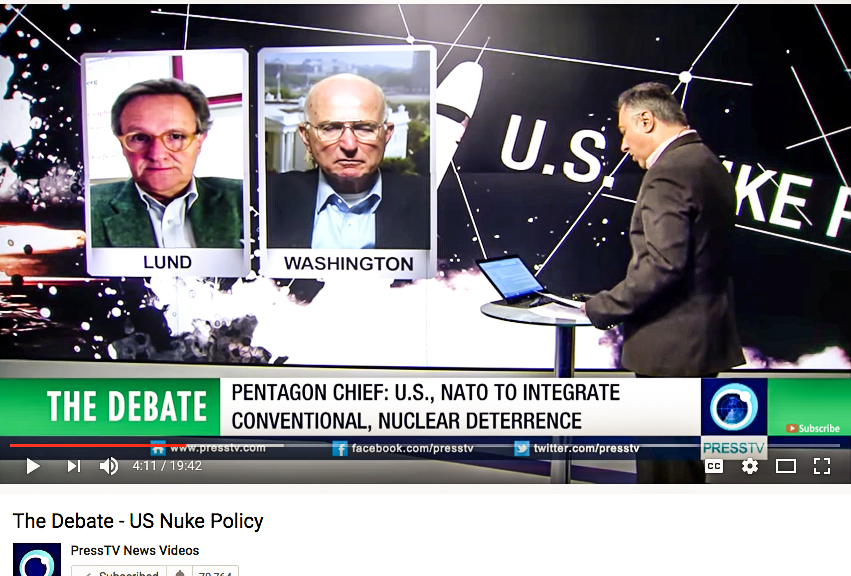
Last night I had the opportunity to discuss nuclear weapons with an experienced, high-ranking security analyst who has been both a military, a scholar, an assistant secretary of defence, presidential adviser, a corporate man and now a think tank member, Lawrence J. Korb.

We were discussing the issues touched upon in this and this article.

I would assume that the debate – facilitated by Iran’s PressTV in an excellent manner – is illustrative of the degree to which the world can be seen from different perspectives and how different we can perceive words such as law, legality, ethics, security, deterrence and peace.

I assume also that the debate illustrates the difference between a systems-embedded interpretation of the world and an independent or free perception, including what can and must be changed and what doesn’t have to change to make the world a better place.

Enjoy!

TFF PressInfo # 389: Ukraine as the border of NATO expansion

And why Russia doesn’t have to be a threat to the West

By Jan Oberg

TFF Series ”The New Cold War” # 7

If the Ukraine conflict is the centerpiece of the new 2nd Cold War, it is essential to ask: What really happened? What did NATO countries do to cause it? What did Russia do to cause it?
And – if you live in the West, in particular: Did we really have to end in this situation given Russia’s significant weakness over 25 years?
This article argues that the superior West could have played its cards differently and it’s time for self-critical soul-searching and just a little living yourself into the shoes of the other.
If peace rather than war is your true aim.

There was a beginning and a framework

The Ukraine conflict has a 25-years history. Instead of dissolving NATO, the alliance was expanded. Relieved from there being a Soviet Union and a Warsaw Pact, the alliance went as fast it could to do all it wanted. Remember, a series of WW III scenarios has been written in which that war would start with some uncontrollable event in Yugoslavia. Now it could be chopped up – freely and without risk. Serbia was bombed and Kosovo carved out without a UN mandate whatsoever (1999).

How did they think about that in the Kremlin at the time, one must wonder?

Clinton literally did not give a damn about all the promises made to Soviet leader Gorbachev by US leaders such as Bush, James Baker and German leaders including Hans-Dietrich Genscher. (Yes, they were not written down but confirmed by those involved and present).

He began the expansion of NATO in 1994 – in Georgia (see what I refer to elsewhere in this series). All around a Russia on its knees Americans were placed in the offices of prime ministers, defence and foreign ministers – I saw it myself in former Yugoslavia – and met CIA people in Croatia disguised as humanitarian workers. And had a long conversation with the representative of the US in Tblisi in 1994. Historical moment!

The bad Christians, the Orthodox, were the Serbs and Russians and Greeks – all should be antagonized and the good guys in Yugoslavia were those who had been on the fascist side in WWII – the leaderships in Croatia, Muslims in Bosnia and the Kosovo Albanians. The Serb minority that had lived 400 years as a minority in the Croatian republic were, in the common Western discourse, invaders masterminded by strongman Slobodan Milosevic – whom Clinton without hesitation called the new ’Hitler of Europe’.

Ukraine was – and remains – what its name says: the border areas (like Krajina in Croatia). This is where NATO can establish itself as little as Chruschev could get away with deploying nukes in Cuba – considerably further away from the US, but anyhow.

Imagine – with a little bit of empathy (not necessarily sympathy) how Washington would react if today Putin’s Russia was 12 times stronger militarily than the alliance-free US (NATO dissolved 25 years ago) and tried with his alliance of 27 other members to make Canada or Mexico the 29th member. Perhaps most people in the US and Europe would have some sympathy for the negative reaction of Washington. Rand remember, Trump wants to build a wall to Mexico…

The main reason, it is stated again and again, in the Western press, NATO and other political circles is: Ukraine and Crimea. The lie about Putin’s aggression on Ukraine is told so many times that it is becoming the truth. Just see these two recent articles by Newsweek as two of hundreds of articles.

Here’s the chosen story in politics and media alike

The narrative is simplified beyond recognition and goes like this:

Putin (there is always just one top guy in Western eyes and it is one leader at the top like Milosevic, Mohamed Farah Aideed, Saddam Hussein, Moammar Khaddafi, al-Assad) is a bad guy and you know that because out of the blue his suddenly annexed Crimea. By that he changes the borders of Europe and then he gets his disguised soldiers into Eastern Ukraine – a Ukraine that we, in contrast to Bush Senior, care very very much about today.

We care so much about it that Read More »

More US hostility towards China?

By Jonathan Power

September 20th 2016

The two American presidential candidates give the impression of being rather hostile towards China. This is counterproductive.

“The US should not adopt confrontation as a strategy of choice. In China, the US would encounter an adversary skilled over the centuries in using prolonged conflict as a strategy and whose doctrine emphasizes the psychological exhaustion of the opponent. In an actual conflict both sides possess the capabilities and ingenuity to inflict catastrophic damage on each other. By the time any such hypothetical conflagration drew to a close, all participants would be left exhausted and debilitated. They would then be obliged to face anew the very task that confronts them today: the construction of an international order in which both counties are significant components”.

Henry Kissinger who wrote this four years’ ago, was the architect, along with his boss, President Richard Nixon, of the US’s rapprochement with China which led to Communist China taking up its seat on the Security Council and to full diplomatic recognition.

But these days China has begun to feel the old Soviet paranoia that it is being not only contained but encircled. The US of President Barack Obama has been giving it a hard time. The dispute over the ownership of the islands in the East and South China Seas is profoundly threatening for most members of China’s governing elite. Indeed they are right to feel partially encircled.

China has no friends to the east and to the south, except North Korea. To the west it has Read More »

The Global Right and Left and Immanuel Wallerstein

By Johan Galtung

Immanuel Wallerstein is unique. Nobody else has presented such a coherent theory of what he calls the modern world-system, from “the long 16th century” up till today; essentially capitalist. There are ups and downs during those four centuries. He is very much at home in the economic Kondratiev cycles–A for up, B for down, but not that much down–and in the political-military hegemonic cycles of the would-be hegemons in the same period.

Read Immanuel Wallerstein and become wiser.

He warns against the Global Right “Lampedusa tactic” of “changing things so that they remain the same”. And insists on Liberty, Equality and Fraternity for the Global Left–but sees the French Revolution more as normalizing change than as people’s sovereignty. Like faith in the middle classes: they are actually helping the Global Right, when in minority they are enlarged by the majority working classes, when in majority they neglect the working class minority left behind.

Right now Wallerstein sees capitalism in crisis with no remedy – of which I am not so sure – and the US hegemony also in a crisis with no remedy – a view I share – as the fall of an empire with local elites killing for them; now they have to do most of the killing themselves.

The Global Right, in power for a long time, is now faltering. Time for the Global Left?

Or, does Zizek’s brilliant formula “the left never misses a chance to miss a chance” apply?

Wallerstein offers six Global Left proposals:Read More »