
America’s imperialistic urge

By Jonathan Power

Woodrow Wilson, the president of the United States during the First World War, said that the U.S. world role came “by no plan of our conceiving, but by the hand of God that led us into this way”.

The Vietnam-induced pause in this historical march now seems to be a long time ago. The forward momentum of “the exceptional American spirit” continued with President Bill Clinton who expanded Nato’s frontiers right up to the Russian border. The US ignored its commitment conveyed personally to the Soviet president, Mikhail Gorbachev, not to do this.

Now, under President Barack Obama, the frontier has been stretched into Asia. A new base in Australia will allow forward deployments in this area to support those in Japan. At the same time the Administration has said that most of the US fleet will be moved to Asian seas. No wonder it makes China nervous.Read More »
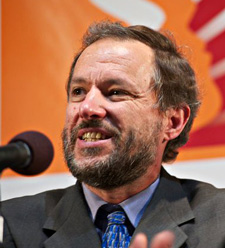
The U.S. is in no position to condemn Russian helicopters to Syria

By Stephen Zunes

U.S. Secretary of State Hillary Rodham Clinton has claimed that “there are attack helicopters on the way from Russia to Syria,” though the Russian government denies the accusation. If true, it would be highly disturbing, given the Syrian regime’s widespread use of such weapons against unarmed civilians. Amnesty International and other human rights groups have called for an immediate end of arms transfers to the Syrian regime, particularly of weapons that have been used to target civilians.

However, the United States is hardly in a position to criticize arms transfers to governments which use them to attack innocent civilians, particularly helicopter gunships.Read More »

A stronger ‘political Europe’ might save a stumbling ‘economic Europe’

By Richard Falk

It was only a few years ago that Europe was being praised as the savior of world order, and heralded as the hope for the future of world order. Books with such titles as The European Superpower and Why Europe Will Run the 21st Century were widely read. They celebrated the realities of a European post-colonial recovery, even a new type of ascendancy, results that were welcomed by many who hoped for a more peaceful and equitable world.

I shared much of this enthusiasm, believing that the European Union was a bold and generally progressive experiment in regionalism that was better suited to our era of intensifying globalization than a state-centric world of sovereign territorial communities habituated to the dynamics of warfare. Read More »

Is Europe’s far-right in decline?

By Jonathan Power

The French elections are almost over with the National Front, the party of the Far-Right led by the Le Pen family, losing strength. As recently as 2002 it did well enough to promote Jean-Marie Le Pen into the final round of the presidential election, up against Jacques Chirac. Needless to say in the final round even the left voted en masse for Chirac to ensure that Le Pen was thrashed.

One might expect that the Far-Right with its pool of support from the disaffected working class might do well in these troubled times. But in fact the overwhelming majority of the working class is staying put in its traditional home on the left. Read More »

The Arab Spring and the image of Islam

By Johan Galtung

The multi-season Arab Spring is the third anti-imperialist Arab revolt in less than a century: against the Ottoman empire, the Western Italian-French-English empire, and now the US-Israel empire. The empires hit back. The Ottomans were weak, but England-France-Israel even invaded Egypt in 29 October 1956 – in the shadow of the Hungarian revolt against the Soviet empire that crumbled 23-25 years later. And now it is the turn o USA-Israel to try to maintain an illegitimate structure.

So much for the background. In the foreground is class, pitting the powerless at the bottom against the powerful at the top. Read More »

UN Alliance of Civilizations, Istanbul Partners Forum

By Richard Falk

The UN Alliance of Civilization (AOC) was initiated by Kofi Annan in 2005 while he was Secretary General of the UN with the joint sponsorship of Turkey and Spain, with its principal center of operations in Istanbul. It was formed under the dark skies that existed after the 9/11 attacks, and seeks to provide an alternative narrative to that of inter-civilizational war, that starkly negative scenario of Islam versus the West associated with the inflammatory views of Bernard Lewis and Samuel Huntington that continues to provide fuel for Islamophobia that burns ever more brightly in Europe and North America.

It was several years since I had heard as many references to Huntington’s ‘clash of civilizations’ thesis as I did during the discussions and presentations at the Istanbul Forum, which was opened by speeches made by Recep Tayyip Erdogan, the Prime Minister of Turkey, and Ban Ki Moon, the current UN Secretary General.

The primary rationale for the AOC is to provide a ‘platform’ for inter-civilizational dialogue that explores differences among civilizations, but seeks to promote mutual undertstanding and respect, even affection and celebration. Read More »

A law of the sea?

By Jonathan Power

Last week as we watched Mitt Romney win the right to challenge Barack Obama in November’s general election the last thing that most people were thinking about were sea and oceans. Yet the last Republican president, George W. Bush, at this point in the electoral cycle announced that, if elected, he would move to ratify the UN’s Law of the Sea. He never did. But also last week Secretary of State Hillary Clinton flanked by the senior brass from the military announced that this Administration was immediately going to push Congress to vote for the long delayed ratification of the treaty.

All the road blocks of the last thirty years since President Reagan decided to torpedo the treaty have been removed and Congress is poised to give the White House the green light on ratification. Read More »

Breivik – A victim of collective psychosis (1)

By Johan Galtung

An individual psychosis setting him apart from others, also in daily life, does not seem to fit his case. But there is another form of psychosis that fits his narcissistic hatred and paranoid violence so removed from the average. His psychosis is produced and triggered by the polarization-escalation aspect of conflict, not easily captured by individualizing psychiatry as his daily life attitude and behavior may be (near) normal.

His psychosis is collective, shared. His ego is part of a real or imagined collectivity that may include those higher up; not an individual disorder associated with the deviant lower down. There is a class aspect to psychosis, marginalizing the individual cases, catapulting extremist collective psychopaths into top power.Read More »

What can be done about Syria? Tragedy and impotence

By Richard Falk

The Houla Massacre of a week ago in several small Muslim villages near the Syrian city of Homs underscores the tragic circumstances of civilian vulnerability to the brutal violence of a criminal government. Reliable reports confirm that most of the 108 civilians who died in Houla were executed at close range in cold blood, over 50 of whom were children under the age of 10.

It is no wonder that the Houla Massacre is being called ‘a tipping point’ in the global response to this latest horrifying outbreak of Syrian violence, a process that started over 15 months ago. The chilling nature of this vicious attack that refused to spare the most innocent among us, young children, does seem like a point of no return. Read More »

Bipartisan assault on Middle East peace

By Stephen Zunes

Earlier this month, the House of Representatives passed a dangerous piece of legislation (H.R. 4133) which would undermine the Israeli-Palestinian peace process, weaken Israeli moderates and peace advocates, undercut international law, further militarize the Middle East, and make Israel ever more dependent on the United States.

The margin was an overwhelming 411-2, with eight abstentions.

House minority leader Steny Hoyer (D-MD) and Howard Berman (D-CA), the ranking Democrat on the House Foreign Affairs Committee, joined House Majority leader Eric Cantor (R-VA) and House Foreign Affairs Committee chair Ileana Ros-Lehtinen (R-FL) in co-sponsoring the bill, an indication of how closely the Democratic Party leadership aligns with the most right-wing Republicans when it comes to U.S. Middle East policy.Read More »