School in an Aleppo factory

The occupiers denied children education. Now they get it

School in an Aleppo factory by Jan Oberg on Exposure

TFF’s first four photo series from Aleppo have been seen by 95,000 people so far and been featured in online magazines from Vietnam to California, among them a German site with a million visitors daily.

Above is the fifth story.

It’s about the terrible, systematic destruction of this UNESCO World Heritage site but also about an Aleppo businessman who turned his damaged factory into a school for 1500 children.

It had been damaged by the Free Syrian Army and al-Nushra who looted it and then used it as HQ.

It’s situated in the Sheikh Najjar Industrial City outside Aleppo that – before the militant/terrorist occupation – represented no less than 50% of Syria’s total industrial production.

During two years, these children received no education. Now they do. And hope is slowly coming back.

This photo story ends with some “civilisational questions” by Jan Oberg who also took the photos.

This is the kind of story Western mainstream media don’t bring for reasons one must assume are political.

But TFF does. Because it is a free research think tank.

We focus on the conflict and civil society where media are obsessed with violence and war criminals.

We look at peace opportunities where others spend their energy on blaming one or the other but have no ideas on how to solve underlying conflicts and make peace.

TFF doesn’t work for this or that violent party but for the UN Charter norm of peace by peaceful means. That is, for the innocent, suffering people in Syria – the largest humanitarian crisis since 1945:

Such as these wonderful, innocent children whose story deserves to be told.

The Trump Presidency: The first week

By Johan Galtung

Attacking the Affordable Care Act; the “global gag rule” against abortion; the federal regulation and hiring freeze; canceling the TPP; restarting the Keystone XL and Dakota Access Pipeline; limiting entry with the Mexican Wall; the 90-day travel ban on seven countries; more undocumented people prioritized for deportation; no federal funding for cities refusing to cooperate; communications blackout from federal agencies; Guantánamo torture continued:

What does it add up to?

A very strong white state centered on a president with absolute power and control over life (birth) and death (care) of the citizens. Not regulating police racism. So far, no order on the military.

Fascism? Too early to say; but in that direction. It opens for questions about the inner workings of Donald J. Trump. Who is he?

A Johns Hopkins psychologist sees Trump suffering from “malignant narcissism“. A Norwegian historian, Öystein Morten, in a detailed analysis of Norwegian king crusader Sigurd Jorsalafare (1103-1130) – clearly crazy – has a Norwegian psychiatrist diagnose him as suffering from “bipolar depression”, manic-depressive. Is Trump only manic?

This column early on saw Trump as suffering from “autism”, living in his own bubble, speaking his babble with no sense of reciprocity, the reaction of the other side. The column stands by that.

However, this column drew a line between his words and deeds; denouncing his rhetoric as grossly insulting and prejudicial, but pinning some hope on his deeds. Wrong, and sorry about that. After one week, Trump clearly means every word he says, and enacts them from Day 1; even what he once retracted in a New York Times interview.Read More »

The more I wonder about Aleppo…

By Jan Oberg

I shot this simple video out of the window on December 13, 2016. I wonder about Aleppo and say #keepfocusonaleppo

© Jan Oberg 2016

Here in the Sheikh Najjar Industrial City outside Aleppo lived and worked 40,000 people. It had 50% of Syria’s industrial capacity.

Today – after the occupation by Western-backed militants and terrorist groups, this is what is left.

I wonder why the Syrian government did not destroy this industrial city between 2000 and 2012. We are told that all this destruction is caused only by that side and the dictator kills his own.

I wonder where the terrorists used the weapons and spent the money they got from NATO countries – Turkey in particular – Saudi and Qatar since they did not do any of this here – according to Western media and the White Helmet reporters and a series of humanitarian organisations.

I also wonder where the Western left is? Solidarity with the workers who lived here?

No, many among them defend this and want to arm this or that group even more.

The more I study, the more I wonder.

And something doesn’t seem right.

Will Ukraine hold referendum on NATO membership?

By Jan Oberg

Here is the background to an interview in which I question the validity of the opinion poll that President Poroshenko refers to as an argument for holding a referendum on NATO membership for Ukraine.

There are strong indications that it is a commissioned research, financed by neo-cons at the International Republican Institute, IRI, in the US of which Kiev mayor and Poroshenko ally, Vitali Klitschko is member of the international advisory board. IRI is funded by, among others, USAID and the National Endowment for Democracy (NED) which is believed to be close to CIA.

The video interview, details and links here.

Trump’s backing for torture is a yes and then a no

February 1st 2017

In a press conference last week President Donald Trump said he believed in the worth of torture but then added most surprisingly that using it wasn’t going to be his decision. It would be decided by the Secretary of Defence, General James Mattis, who, as Trump said, is against torture.

Three years ago the US Senate Intelligence Committee published a summary of a thorough report on the recent American use of torture. Its chairwoman, Dianne Feinstein, said the 6,000 page report is “one of the most significant oversight efforts in the history of the US.”

The report showed that the CIA did not provide accurate information on torture to Congress and also provided misleading information. The report also concluded that the CIA impeded effective White House oversight and decision-making. While the report was being prepared the CIA penetrated the Senate Committee’s computers, arousing the fury of its members.

Bush and and his vice-president Dick Cheney were deeply involved in initiating the torture program. The Administration claimed that the waterboarding 183 times (the dipping of the head in water so that the prisoner feels he is drowning) of Khalid Sheikh Mohammed, the 9/11 mastermind, led to the foiling of a terror plot against Los Angeles’s Library Tower. But the Senate report concludes that the information could have been learnt without using torture.

The report’s primary focus is on discerning whether the use of torture gained valuable intelligence. It concluded that it did not.

When President Barack Obama was elected he swiftly moved to ban waterboarding and other torture techniques. However, he refused to authorize a full, in depth, Justice Department investigation which, if it had taken place, would doubtless have pointed a finger at Bush and Cheney.

In the UK it is alleged that Prime Minister Tony Blair Read More »

TFF PressInfo # 402: Trump’s Pre-Fascism and Progressive Populist Opportunities

The Dismal Cartography of the Pre-Fascist State

January 25, 2017

Points of Departure

Listening to Donald Trump’s inaugural speech on January 20th led me to muse about what it might mean to live in a pre-fascist state. After reflecting on key passages and conversations with friends, I came to the view that all the elements were in place, although set before us with the imprecision of a demagogue.

Yet I do not doubt that there are many ideologues waiting in the wings, perhaps now comfortably situated in the West Wing, ready to cover the conceptual rough spots, and supply an ideological overlay, and add the semblance of coherence.

Considering the daily outrages emanating from the White House since the inaugural jolt, the coming years will be rough riding for all of us, with many cruelties being readied for those most vulnerable.

Of course, the Woman’s March on January 21st was temporarily redemptive, and if such energy can be sustained potentially transformative. It is odd to contemplate, but there just may be tacit and effective cooperation between the national security deep state and a progressive populism converging around their divergent reasons for being deeply opposed to the shock and awe of the Trump presidency. Trump may invent ‘alternative facts’ to restore his narcissistic self-esteem, but when it comes to program he has sadly so far been true to his word! This alone should encourage a unified, energetic, and determined opposition. If the Tea Party could do it, why can’t we?

The Pre-Fascist Moment

First, it is necessary to set forth the case for viewing Trump’s Inaugural Address as a pre-fascist plea:

1) Locating power and legitimacy in the people, but only those whose support was instrumental in the election of the new president; the popular majority that were opposed are presumed irrelevant, or worse;

2) Denigrating the political class of both political parties as corrupt and responsible for the decline of the country and the hardships inflicted on his followers;

3) Presuming mass and unconditional trust in the great leader who promises a rupture with the past,Read More »

On Trump endorsing torture

Comment by Jan Oberg on PressTV’s Top Five

This is nothing new, the US has used it all the time. But isn’t it tragic that almost 70 years after torture was prohibited in the Universal Declaration of Human Rights, we see 141 countries still using torture – according to Amnesty International.

Is violence-war a cause or a symptom?

By Johan Galtung

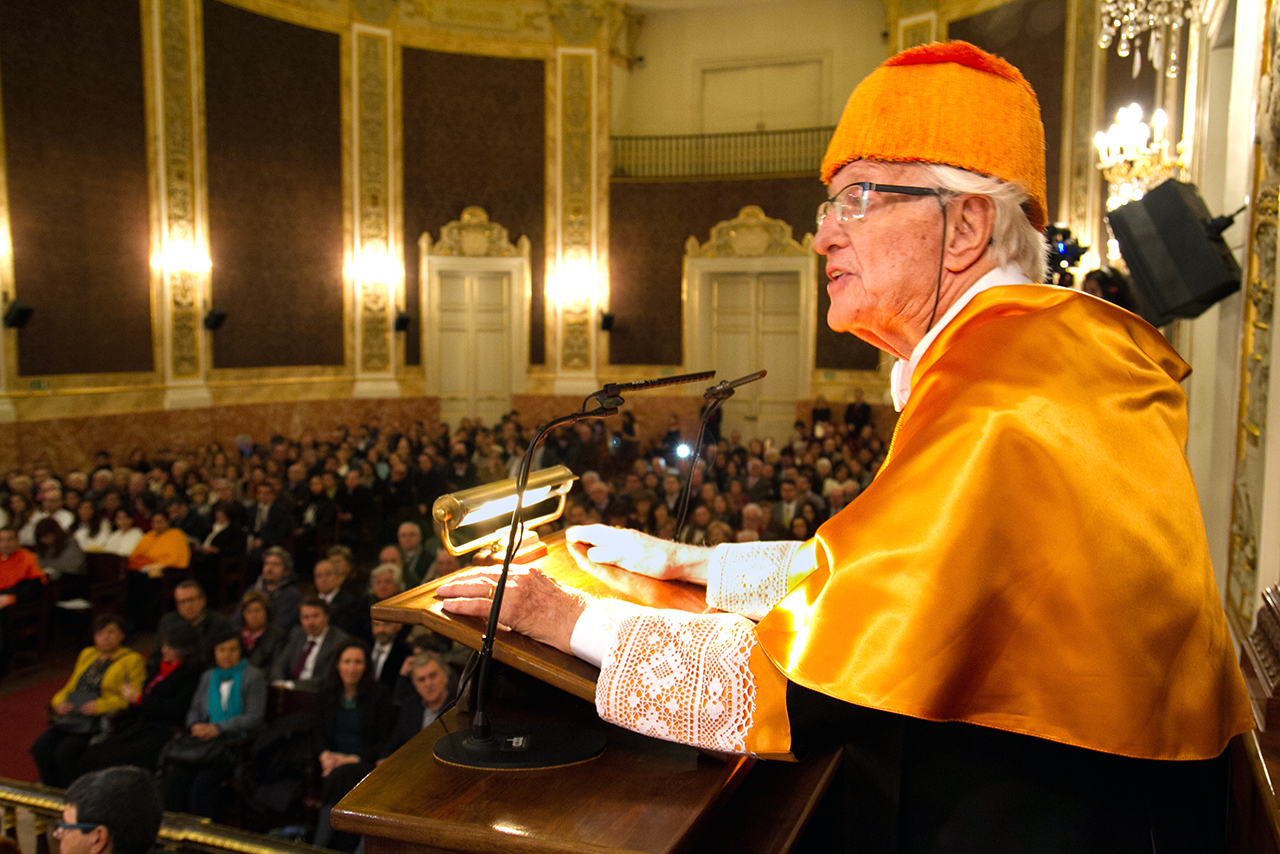
Receiving Dr Honoris Causa, Universidad Madrid Complutense, 27 Jan 2017

Dear Rector, dear Jury!

I receive this great honor bestowed upon me in deep gratitude and pride, promising to try to live up to it.

I will now share with you some words about how I got launched on the track for which you honor me, peace studies and peace practice.

Like so many, I felt desperate about the wars in our enlightened century and continent and asked, Why? What can we do to avoid this suffering, not only the wounded and dead, but the countless bereaved?

From my family I knew a little about health studies and had been struck by the fruitful distinction between cause and symptom. The symptom is on the surface of the body, like fever; but the root cause is deeper down, inside, a sepsis. A major breakthrough. “Treat the cause, not the symptom” became a new rationality. Cooling the body makes some sense, but it isn’t the cure; and even less treating a swollen ankle that could be a symptom of a serious heart illness.

My illness was war, my wellness was peace.

Was war a cause with horrible effects with nobody really winning, or could war be a symptom of something deep down in the “body politic”, a “root cause”? Of something preceding war and violence in general, which if removed would also remove, or at least reduce, war and violence? But what?

This was important because if we accept violence as the root cause then we link it to the human body or humanity as such, not only as innate, but as inevitable. We would have to learn to live with it and with its effects, some of them summarized in “war breeds war”.

War rhetoric actually pointed in two directions: “someone blocking what we are entitled to” and “revenge for unjust wars against us”. The first points to conflict, “incompatible goals”; the second to trauma, “wounds from past violence”. I have stayed with those two.

This liberates human nature from being the cause Read More »