Marx and Freud, Daoism and Gandhi

By Johan Galtung

Johan Galtung

The two giants did something unusual for Western thinkers: they were very holistic. Nothing less than the whole society and the world, and much more than the economy, for Marx; nothing less than the whole body-mind complex, with excursions into culture, for Freud.

Equally unusual: they were very dialectical. There were forces and counter-forces. Means vs modes of production for Marx, simplified to Capital vs Labor; Super-ego vs Id, values from the outside vs drives from the inside for Freud. For Marx the dialectic was inside Structure–of Culture and Nature there was little–for Freud between Culture and Nature–of Structure there was little.

Holism and dialectics are the pillars of daoist thought, giving rise to a dynamic theory of organic systems like societies and humans. Calling the forces yin and yang, over time they will both be vexing and, waning, the dominant will recede and the dominated will grow. In this process there may be some balance point, but it is not stable. Nothing is stable in this perspective, nor is anything–Nazi Germany, Soviet Union, USA–monolithic with only one force. There is yin/yang everywhere, also inside yin and yang, and new dialectics emerging.

Here the great Westerners show their limitations. Marx was an optimist seeing conscious and organized Labor break the shackles of Capital, moving on to socialism and communism; Freud was a pessimist seeing “reality” (his word for structure?) as unchanging, impeding compromises between Super-Ego and Id. They used only the dialectic of their primary contradictions; beyond that they became deterministic.

Moreover, with two forces there are five outcomes: one or the other prevails, neither-nor–like in social or individual death–a compromise is identified–social capitalism, capi-communism, Freud’s maturity–and both-and, transcending, beyond the compromise. They, however, saw only one outcome, the triumph of Labor, or the compromise.

Whatever happens it will be unstable. For stability a stabilizer is needed, but even so any equilibrium is unstable. The State is the social stabilizer freezing the dialectic in favor of Capital, Labor, neither, a compromise or both; but where is the individual stabilizer?Read More »
Vesten bør reagere på Irans åbne vindue

Af Birgitte Rahbek

Trykt i Kristeligt Dagblad 11. juli 2014

Birgitte Rahbek

Lige fra den syriske krigs begyndelse har det været et standende emne, om krigen kunne vindes – og dermed standses – ved at sende våben til oprørerne eller ved at gribe ind med flyveforbudszoner eller direkte intervention. På et meget tidligt tidspunkt gjorde NATO det klart, at en intervention ikke kunne komme på tale; det er der megen fornuft i, bortset fra at det måske havde været klogere ikke at sige det højt, for det fremmede ikke just det syriske regimes fredsvilje.

I mellemtiden har den overvejende holdning været, at Vesten hverken kan eller skal gribe ind, og at vejen til en fredelig løsning går gennem forhandlinger. FN har to gange sat erfarne diplomater til at føre forhandlingerne, men uden at de har kunnet komme igennem med en fredsplan, især fordi der blandt vestlige ledere og mellemøstlige autokrater hersker en stærk uvilje mod at forhandle fred med fjenden, som i denne forbindelse – ud over den syriske præsident og hans klan – har været Iran og Rusland. Read More »

Putins Rusland er ikke som Sovjet

Af Jens Jørgen Nielsen

Billedet af Rusland i de vestlige medier er i dag næsten mere dystert end under den kolde krig. Mange tror, at russerne lever i fattigdom og ufrihed i evig angst for Putins rædselsregime, præget af få censurerede medier. Rusland skulle angiveligt være ved at falde sammen og borgerne længes efter de friheder, som vesten kan tilbyde.

Putin skulle angiveligt være nervøs for, at den ukrainske ’demokratiske’ revolution skulle sprede sig til Rusland. Derfor skal vi i vesten entydigt støtte Kiev regeringen og den ikke-parlamentariske opposition i Rusland. Mange vestlige politikere mener, at vi økonomisk skal isolere Rusland.

EU og USA fokuserer i disse tider på at straffe Rusland og Read More »

TFF PressInfo: Cold War warnings 1998 – 2014

By Jan Oberg

Jan Oberg

Lund, Sweden August 11, 2014

Quality research leads to better predictions

One criteria of quality research is that it predicts the future better than incompetent research.

Because TFF is independent of governments and coroporations it doesn’t have to take political considerations or exclude certain theories, concepts or values. This free research enabled it over the years to make fairly precise predictions about for instance former Yugoslavia, the Iraq war and East-West relations.

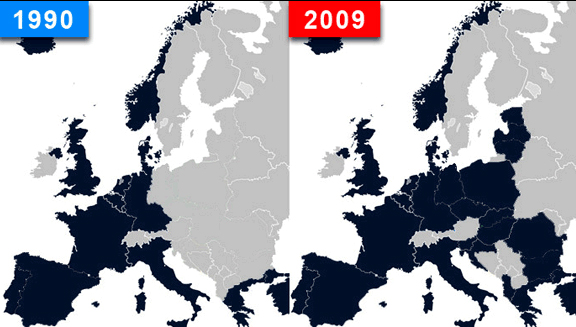
In 1998 – 16 years ago – we warned that NATO’s expansion would lead to future problems with Russia. Read it here.

NATO should never have been expanded

We backed this prediction up with 46 arguments and argued that so many other things would be wiser than containing Russia from the Baltic republics to Georgia – a strategy pursued by Bill Clinton in contravention of all promises given to the Soviet Union/Russia at the end of the Cold War about ten years earlier.

That counterproductive and insensitive expansion has now hit Ukraine. A new Cold War is gathering over Europe. It should have been predicted by advisers, intelligence agencies, big research institutes and columnists.

But it wasn’t.

At the end of the Cold War, NATO/the West got everything it could ever wish – and without war. But it wanted more: keeping Russia down, making NATO bigger and “peace-making” as well as finding new enemies to keeping its Military-Industrial-Media-Academic Complex (MIMAC) alive and well: Saddam, Milosevic, the Muslim world, terrorism and – now re-cycling – Russia.Read More »

TFF PressInfo: Nuclear abolition now !

By TFF’s Board

Lund, Sweden August 6, 2014 – Hiroshima Day

The Nuclear Age – risk of omnicide and our new responsibilities

Nuclear weapons came into the world and were used for the first time in 1945. Their specific feature as weapons of mass destruction and “omnicide” – able to kill us all – has changed what it means to be alive on this earth and to be responsible for its existence.

Until nuclear weapons, human beings could not decide whether or not to end project humankind and project planet earth.

Today we know that the arsenals and missile projection methods are such that a few decision-makers, or a technical malfunction, could blow up enough of the world to make the living – if any – envy the dead.

We live in the Nuclear Age. It means living with the permanent daily threat of extinction.Read More »

TFF PressInfo: Wow, Hillary Clinton as moral philosopher

By Jan Oberg, TFF director

Jan Oberg

Lund, Sweden July 31, 2014

Responsibility for wars and killing

A number of Western/NATO politicians – Hillary Clinton foremost among them – and media people have recently introduced a new ethical principle in international affairs:

When A delivers weapons to B, A is responsible for what B does with these weapons. The former Secretary of State and perhaps future U.S. President presents this new ethical principle here on CNN.

This makes a lot of sense to me. Look at it this way:

Here is a young confused boy who has little to look forward to – and less to lose – because his country is falling apart in nasty civil war. He’s been told by some commander, or by his President, that he must hate the enemy; he gets paid for killing off as many as he can. And so he does.

He believes also in what he’s been promised: Fame as a hero upon return – that is, if he returns – and a comfortable life.

So he kills people, Read More »

The West is threatening Russia

By Jonathan Power

What would the conservative president, Ronald Reagan, have done if the Ukraine debacle had happened on his watch? I suspect he would have made sure it didn’t devalue relations between the US and Russia.

It wasn’t him nor his vice-president, George W.H Bush, who inflamed relations with a post-Cold War Russia, it was his successor the liberal, Bill Clinton, who, together with a supine EU membership, decided to expand NATO right up to Russia’s doorstep, despite a solemn US promise given personally to the Soviet president, Mikhail Gorbachev, by George H. W. Bush’s secretary of state, James Baker, that it wouldn’t.

And today President Barack Obama won’t say clearly and out loud that the US doesn’t expect that Ukraine will ever join NATO, a move that could de-escalate the crisis faster than you could say: “At last Obama understands where President Vladimir Putin is coming from”.Read More »

BRIC(K)S for a New World Economic Order!

By Johan Galtung
28 Jul 2014 – Kuala Lumpur

Johan Galtung

They made it, with constructive alternatives – the New Development Bank and the Contingency Reserve Agreement–to the US-dominated World Bank and International Monetary Fund. Those two parts of Bretton Woods were basic pillars in the economic infra-structure of the US Empire in the hands of the US Congress. Loans were disbursed in return for “structural adjustment” –privatization, budget cuts, devaluation, repatriation of profit, also against BRICS countries. US companies were commissioned for huge jobs serving local elites. Untold damage was done in spite of some recent changes in rhetoric.

The USA used them to export the US economic–and with it the social, political, cultural, military–order through loans, grafting it upon social bodies that after some time rejected the implants as foreign and incompatible. Even a decaying order however brilliant it may have looked to the untrained eye as late as the 1990s.

What remains today of that US “order” is the military part Read More »

When BBC calls, don’t answer…

By Richard Falk

Richard Falk

That is, don’t answer, if you are a certified critic of Israeli policies and practices.

The siren lure of big time media is partly a romancing of the ego, partly a rare moment to intrude a moment or two of truthfulness into the endless spinning of the Israel’s narrative that stresses its extravagantly humane response to Hamas flurries of rockets and alleged human shield tactics.

Four times in the past week I have received invitations to be a guest on BBC programs dealing with Israel’s military operations in Gaza. Each time the female producer, with charming British intonation, expressed her strong interest in arranging my participation at such and such a time.

And each time I agreed, although Read More »

Cruelties of ceasefire diplomacy

By Richard Falk

Richard Falk

Prefatory Note

The post below is a revised text of an article published in AlJazeera America on July 26, 2014. Devastation and violence has continued in Gaza, with Palestinians deaths now numbering over 1000 (overwhelmingly civilians) and Israeli deaths latest reported at being 43 (almost all military personnel).

Such casualty figures and disparities raise questions of state terrorism in a stark manner. Also, it should be appreciated that if Israel were to do what it is required by international law to do there would be no rockets directed at its population centers – lift the blockade, negotiate peace on the basis of the 2002 Arab proposals and Security Council 242. Yet this would require Israel to give up once and for all its expansionist vision embedded in the settlement phenomenon and the version of Zionism embraced by its leaders and reigning political parties.

The best that the UN has been able to do is to call for an “immediate and unconditional ceasefire” to allow the delivery of humanitarian aid at an emergency meeting of the UN Security Council; such an unseemly balancing act is not what the UN Charter had in mind by aligning the international community in opposition to states that break the peace and act aggressively in disregard of international law; a victimized people deserves protection, not some sort of display of deforming geopolitical symmetry.

So far, the diplomatic effort to end the violence in Gaza has failed miserably, Read More »