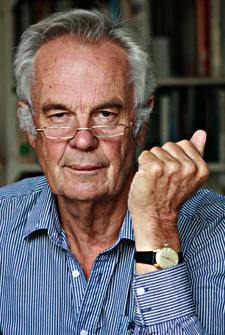
TFF PressInfo: Violence against children has become an epidemic

By Jonathan Power

Three Israeli teenagers murdered on Palestinian soil. One Palestinian boy burnt to death whilst alive in an apparent retaliation. Over the years of conflict thousands of children have been killed although many more on the Palestinian side than the Israeli.

According to the Old Testament’s Book of Numbers, Moses, when leading the trek to the “Promised Land”, once ordered all the women and children in one hostile tribe in their way, the Midianites, to be killed. Moses is as an important figure to Muslim theologians as he is to Jewish yet I’ve never come across the writings of a major theologian in either religion loudly condemning this mass murder.

The killing of the innocents in the “Promised Land” goes on three thousand years later. Last year eight Palestinian children (six boys and two girls) were killed and 1,265 were injured in the occupied Palestinian territories either by Israeli settlers by Israeli security forces. No Israeli children were killed in 2013.

Four Palestinian boys were killed by Israeli security forces in the Al Jalazun, Jenin and Ayda refugee camps. Incursions into the camps increased by 60 per cent compared with 2012. The 1,235 children injured in the West Bank (155 under the age of 12) are more than double the number injured in 2012 (552). 49 children were injured directly by Israeli settlers. Eight Israeli children were injured in Israeli settlements by Palestinians. Read More »

The world right now: A Mid-Year Report

By Johan Galtung

Time to take stock. The shot in Sarajevo 100 years ago inspires narratives of 19-year old Gavrilo Princip killing the successor to the throne of an empire and his pregnant wife as the event unleashing mutual mass murder (INYT, FAZ 28-29 June 2014). Not the empire annexing Bosnia-Herzegovina on October 6, 1908 (Art. 25 of the 1878 Berlin Congress of “great powers”).

Maybe the inhabitants did not like it?

Moral of that stock-taking: watch out for terrorism, not for empires and occupation-colonialism; and protect leaders, not people.

ISIS (Islamic State of Iraq and the Levant, alternatively translated as Islamic State of Iraq and Syria and Islamic State of Iraq and al-Sham) comes up. TIME 30 June: The End of Iraq. Maybe Iraq – that highly artificial English colonial entity encasing Shia Arabs, Sunni Arabs and Sunni Kurds–never started?

Like its French colonial neighbor Syria – adding Alawite Arabs, Christians, Jews and others? Ever heard about Sykes-Picot and their czarist Russian allies?

Can such crimes just pass, with no counter-forces?

Watch out, a key point about ISIS – now comprising a major part of IS – is as a bridge over the English-French colonial divide, in favor of a Sunni Arab caliphate. Like it or not, these are very strong forces from the past in the daylight of the present. Read More »

Spain 2050 – Ten predictions

By Johan Galtung

Alfaz; History group, Municipio, Spain

Can we know the future? Rhetorical answer: can we know the past?

We rewrite history all the time, not because facts become dubious and new facts appear, but because our angle, perspective, changes. Say, from a series of kings, presidents etc. and their exercise of military and political power to economic and cultural changes in the life of common people, in their wellbeing and identity. Quite some change.

Will we arrive at that single, true, objective perspective?

No, objectivity may be multi-subjective, not inter-subjective. This is why Al Jazeera is so much better for knowing the present than CNN, which presents the US angle, and if there are other angles a US “expert” will give the final interpretation. Al Jazeera presents many angles of many parties and leaves final interpretations to the viewer.

How can we shed some light into the future? Basically there are two approaches: the Cartesian based on extending trends, and daoism based on holism and dialectics. They do not exclude each other.

Thus, there are three world trends that certainly affect Spain…Read More »

TFF PressInfo: What to do now in Iraq?

By Jonathan Power

June 17th 2014

Is it “you reap what you sow”? The US electorate that voted twice for President George W. Bush should ask itself the question. The growing strength of ISIS and Jabhat al-Nusra, represents a grave threat to the future of the Middle East and the US has no one to blame but itself.

ISIS (The Islamic State of Iraq and al-Sham), it is being said, could eventually reconfigure the Middle East if it is able to seize significant chunks of Iraq and Syria, the Arab world’s two strategic centrepieces, spanning the Mediterranean to the Persian Gulf.

ISIS has begun setting up a proto-state in parts of Syria and Iraq, with its own courts, police and public services. According to the well-informed Middle East watcher, Robin Wright, “ISIS has become the most aggressive and ambitious extremist movement in the world. It is also the most deadly and the most accomplished, dwarfing its parent, al-Qaeda, in influence and impact”.

US policymakers understand from painful experience that military aid will not simply pressure Iraq’s Shia prime minister, Nurial al-Maliki, with his autocratic sectarianism, to make serious concessions to Iraqi Sunnis, and thus help dry up the waters in which ISIS swims.

But what else can President Barack Obama do? Read More »

Force-feeding Palestinian hunger strikers

By Richard Falk

Palestine Hunger Strike and Israeli Force-Feeding Pending Legislation

The highly respected Israeli human rights NGO, Adalah, has issued an urgent appeal on behalf of a reported 125 Palestinian prisoners who are engaged in a hunger strike protesting their being held in Israeli jails on the basis of ‘administrative detention’ procedures.

It is the longest collective hunger strike in Palestinian history.

Administrative detention is an objectionable practice by which individuals are held in prison, sometime for months or even years, without being informed of charges or facing trial. According to international law reliance on administrative detention is regarded as prohibited unless there are overwhelming reasons in the form of imminent and severe security threats to justify the failure to produce criminal charges and hold a trial.

Israel has made no such appeal, and appears to use administrative detention procedures routinely and against individuals who cannot be considered security threats.

The current hunger strike commenced on April 24, over 50 days ago. Continue reading here.

Prosecuting Syrians for war crimes now

By Richard Falk

A major undertaking of the victorious powers in World War II was to impose individual criminal accountability upon political and military leaders for alleged crimes committed during wartime before a tribunal convened by the victors that gave those accused a fair opportunity to present a defense.

This application of this idea of accountability to German and Japanese surviving leaders at trials held in Nuremberg and Tokyo was hailed at the time as a major step in the direction of a ‘just peace.’

International law was treated as binding upon sovereign states and those that represented the government, conceived to be a major step in the direction of a global rule of law. The final decisions of these tribunals also produced a narrative as to why World War II was a necessary and just war. Such an outcome was both a vindication of the victory on the battlefield and a punitive repudiation of those who fought and lost. Significantly, this criminal process was formally initiated only after the combat phase of the war had ended and Germany and Japan had surrendered.Read More »

TFF PressInfo – Why Obama’s speech should make us think

By Jan Oberg

Lund, Sweden – May 29, 2014

In a speech by the President of the United States of America – read by millions in all corners of our world in minutes – rest assured that every single word has been weighed with utmost care.

With this in mind, Obama’s speech can be analysed as both offending to the rest of us and – exceptionally – weak.

It caused no enthusiasm among the future army officers he spoke to and no enthusiasm among leading Western media.

I will argue that

• Intellectually and morally the speech doesn’t have the basics – full of contradictions and imbued with unbearable self-praise.

• While there is a recognition of ”mistakes” such as ”our” war in Iraq and a potential step-back from interventionism, there is neither an adequate analysis of the past nor of what the future may need in terms of leadership.

• Little had I anticipated that my analysis in the TFF PressInfo on ”Psycho politics in the age of imperial decline” just a few days ago would be confirmed so quickly and so strongly. Read More »

Pope Francis visit to Palestine

By Richard Falk

Pope Francis’ visit to the Holy Land raises one overwhelming question: What is the nature of religious power in our world of the 21st century? Can it have transformative effects’?

Media pundits and most liberal voices from the secular realm approve of this effort by Francis to seek peace through the encouragement of reconciliation, while dutifully reminding us that his impact is only ‘ceremonial’ and ‘symbolic’ and will not, and presumably should not, have any political consequences beyond a temporary cleansing of the political atmosphere.

The June 6th prospect of Mahmoud Abbas and Shimon Peres praying together in the Vatican as a step toward a peaceful end of the long struggle is, I fear, an ambiguous sideshow. For one thing, Peres as President of Israel is about to leave the office, and in any event, his position exerts no discernible influence on the head of state, Benjamin Netanyahu, or the approach taken by Israel in addressing Palestinian concerns.

It has long been appreciated that Peres is less than he seems, and beneath his velvet globe is a steel fist. Also, Abbas, although the formal leader of the Palestinian Authority and Chair of the PLO, is a weak and controversial leader who has yet to establish a unity government that includes Hamas, and finally provides political representation for the long suffering population of the Gaza Strip within global venues.

Yet it would be a mistake to ignore the significance, symbolically and materially, of what Pope Francis’ visit to Palestine heralds. Read More »

Peace Studies: Ten Basic Points

By Johan Galtung

Foreign Policy Studies, University of Malmö, Sweden

Thanks for wanting a summary of key points in “Galtung Peace Studies”. I was just honored with a “Lifetime Award” by world sociology, 60+ years; in short, time for summary with an author’s caveat: no substitute for reading books.

[1] 1951: Peace studies=peace theory+peace practice; applied science, with an explicit value–peace–with practice-indicative theories and theory-testing practice; like health studies, unlike social sciences. Model: peace to violence as health to illness; Diagnosis-Prognosis-Therapy produced health by weakening pathogens-strengthening sanogens; try the same for peace by weakening bellogens-strengthening paxogens. Mantra: through interdisciplinary, international, interlevel research.

[2] Like in illness violence=suffering of body-mind-spirit, also of the bereaved; unlike in illness, an intended act of commission, a perpetrator-victim relation, a crime, epitomized by aggressive war. Body wounds may be healed but stigma, shame, humiliation, hopelessness, hatred, fear, revenge may settle in mind and spirit as trauma. To judicial approaches, sentence and punishment–against theft of cherished property, violence to the body and sexual violence – add victim – and context-oriented approaches like having less property, more company, no provocation and context-oriented approaches as for instance un-uniformed citizens as vigilantes in public space, etc.

But the antidote to violence is peace: a structure of positive interaction, a culture of nonviolence, focus on the positive in the yin/yang of others and on change from violent to peaceful relations, rather than on party attributes; relations carry more causal weight and are irreducible to attributes: see relation logic-buddhism-daoism.

[3] Peace was liberated from the state focus to cover five levels:Read More »

TFF PressInfo: GCC Military Command or a More Open Society

By Farhang Jahanpour*

Short e-mail PressInfo version here.

Saudi Military exercises

On 30th April 2014, Saudi Arabia staged its largest-ever military exercises codenamed “Abdullah’s Shield” after the kingdom’s 91-year old ruler and coinciding with the ninth anniversary of his ascension to the throne. The exercises involved 130,000 Saudi troops and showcased some of the latest weapons purchased by the kingdom from the United States and China, including the Chinese CSS-2 intermediate-range ballistic missiles with a range of 2,650 kilometers (1,646 miles) which are capable of carrying nuclear warheads. The Chinese version of these missiles is already equipped with nuclear warheads. This was the first time that these missiles had been seen in public in Saudi Arabia.

Crown Prince Salman presided over the exercises, which were also watched by a number of prominent foreign guests, including King Hamad of Bahrain and more pointedly by Gen. Raheel Sharif, the Pakistani chief of the army Staff. There have been persistent rumors over many decades that in return for Saudi funding of the Pakistani nuclear weapons’ program, Pakistan had committed to provide nuclear warheads for CSS-2 missiles, should Saudi Arabia decide to have them. Earlier in the year when Prince Salman visited Pakistan, he personally invited Gen. Sharif to be his guest at the exercises. Pakistani media stressed the point that Gen. Sharif had gone to Jeddah “on the invitation of Crown Prince Salman bin Abdulaziz al Saud to witness the military exercise…” (1)

With the exception of Bahrain’s ruler, none of the other GCC rulers watched the exercises. The guests included the crown prince of the UAE, the prime minister of Jordan and military commanders from some GCC states, but Qatar pointedly did not send any representatives. This was yet another sign of a growing rift between Saudi Arabia and Qatar.

A unified GCC Command and Monetary Union

At the GCC summit held in Kuwait in December 2013, the Saudis called for a unified GCC military command to have 100,000 forces, half of which would be contributed by the Saudis. (2) However, other GCC members opposed the idea as they saw it as a way of consolidating Saudi domination of other GCC states and affirming Saudi Arabia’s position as the big brother. Many smaller GCC states value their independence, and while they would like to cooperate with other GCC members, they do not wish to be absorbed into a unified military alliance as junior partners. Oman openly expressed its opposition to the proposal and Qatar and Kuwait also followed suit. Read More »