Edward Said’s humanism versus the US State Department’s Anti-semitism

By Richard Falk

Prefatory Note
This post consists of my written text for a public presentation on the theme of “Edward Said’s Humanism and the Rejection of the State Department’s Definition of Anti-Semitism” at a conference at Fresno State University, Nov. 6, 2015 bearing the title “Universities at the Crossroads: The Assault on Academic Freedom,” which was the last event of the “Edward Said Lecture Series” organized by Professor Vida Samiian of the Department of Linguistics at FSU. My talk as given departed considerably from this text.

In these remarks, I will present the following analysis:

(1) The most ardent Zionist forces have longed tried to conflate criticism of Israel and Zionism with hatred of Jews, the traditional understanding of anti-Semitism, but this effort has intensified recently, and even has been endorsed by the US Government and is currently under consideration by the University of California and elsewhere;

(2) Examine the definition of anti-Semitism adopted by the U.S. State Department, and discuss briefly why it has pernicious implications for academic freedom, and indeed even for an understanding of the genuine nature of anti-Semitism;

(3) Show why Edward Said despite his intense opposition to anti-Semitism would nevertheless be vulnerable to allegations of being an anti-Semite if the State Department definition were to be applied to his writings and activities;

(4) And finally to point out that according to the imperatives most influentially expressed by Noam Chomsky and Said, the ‘responsibility of the intellectual’ would perversely require them to be ‘anti-Semitic’ according to this pernicious wider conception.

My personal experience with this theme of anti-Semitism and Israel can be summarized by recalling two different occasions:

The first was in Greek Cyprus more than a decade ago at a meeting of the Inter-Action Council (composed of ex-heads of states) devoted to conflict resolution in the Middle East. I had been invited as a resource person. At a session devoted to Israel/Palestine the Israeli ambassador to Greece spoke at some length, insisting that it was anti-Semitic to express strong criticisms of Israel and Zionism. As the only other Jew at the table I felt it to be almost a duty to clarify what I believed to be a mischievous manipulation of ideas.

In my intervention I explained that Zionism was a project or ideology, Israel was a state, and that Jews were a people or persons. I attempted to explain that to disagree with Zionism or to criticize Israeli policies and practices as a state was not at all anti-Semitic, but to exhibit hostility, hatred, and discrimination against Jews as a people or as individuals was indeed anti-Semitism. Recall that Hitler did not persecute Jews for being Zionists, but for being Jews, for partaking of a race or ethnicity.

After the meeting recessed, several participants thanked me for my comments, indicating that only a Jew could offer this kind of clarification, which they found persuasive.

In contrast, the Israeli ambassador and his NGO sidekick Read More »

China versus Russia versus USA: Xi versus Putin versus Obama

By Johan Galtung

From very high up three major countries-states stand out clearly: China, the most populous; Russia, the largest; USA, the most military. With three leaders, Xi, Putin, Obama, with much power on their hands.

And here is the key hypothesis, presumably more right than wrong: China-Xi: positive peace; Russia-Putin: negative peace; USA-Obama: war.

We have in mind China – also a region – building relations for reasonably mutual and equal benefit with China all over the world, spinning Asia-Europe-Africa together in a road-rail-ship-air Silk network available to all (with major mistakes in the South China Sea).

We have in mind Russia – itself also a region – calling to Russia leaders in violent conflict from all over the world, seeking cease-fires and accommodation (making itself a major mistake in Syria).

And we have in mind USA – more than a state, less than a region – since WWII ended killing more than 20 million people in 37 countries:

Afghanistan, Angola, Argentina, Bangladesh, Bolivia, Brazil, Cambodia, Chad, Chile, China, Colombia, Cuba, Democratic Republic of Congo, Dominican Republic, East Timor, El Salvador, Grenada, Guatemala, Haiti, Honduras, Hungary, Indonesia, Iran, Iraq, Israel-Palestine, Korea North-South, Laos, Nepal, Nicaragua, Pakistan, Panama, Paraguay, Sudan, Vietnam, Yugoslavia Not included: daily USA mass shootings.

And weaving the world together with the incredible internet (making a major mistake, using it for spying, betraying us all).Read More »

What drives religious extremism?

By Jonathan Power

What drives people to extremes? Why do the people behind Al-Qaeda or the Islamic State (IS) get so charged up and angry?

Perhaps to understand we should go back to the 16th century in Europe and the furious debate about the “divine right of kings”. For decades the royal houses of Europe had been becoming less accessible to their subjects. William of Orange, ruler of the powerful Netherlands, said he had “received his power from God and God alone.”

Philip II of Spain was also a principle protagonist of this theme. Indeed, when Spain conquered Holland, Philip tried to squash the new Protestant “heresy”, using the brutal practices of the Spanish Inquisition.

It is no wonder that the Dutch were ready for a bloody revolt. They would no longer accept the prerogatives of rulers who claimed a “divine right”.

In 1581 the Dutch withdrew their allegiance from Philip II. Accountability of a ruler to his subjects not to his God was the new dispensation.

Meanwhile, England, under the rule of Elizabeth 1 and James 1, continued to believe in the divine right of the monarch. Only when James’s son came to the throne, Charles 1, was the belief overturned. Parliament raised an army. Seven years of war was followed by the king’s trial, conviction and execution in 1649.

The poet John Milton wrote at the time, “All men naturally were born free”. John Locke wrote 40 years later that “The very objective of government is setting up a known authority to which everyone of that society may appeal upon any injury received…The legislative power should be placed in collective bodies of men, call them senate, parliament, or what you please”.

From then on, over the course of two centuries, very much influenced by Locke and other Enlightenment thinkers, a constitutional form of government was slowly built across much of Europe. However, it was the United States that first became a full democracy, with separation of church and state.

But, despite the great advance from the days of “divine rule”, parliaments and governments regularly failed the people. Parliaments were often dominated, or at least greatly influenced, by those with inherited titles, people with money, the army and even criminal gangs.

Much of the struggle against the divine right of kings and the corrupt policies of the Pope in Rome had led Martin Luther in 1517 to nail his handbill to the doors of a church in Wittenberg in Germany. Faith in God, not in pope or king, was the only way to gain heavenly salvation, he preached. No wonder that Philip II savagely repressed the profession and declarations of Protestant faith in Holland.

It was in Holland that some Protestants became extremists. In the late 1560s Protestant iconoclasts went into the catholic churches and destroyed the statues of Mary and the saints. They also destroyed any manifestation of the wealth and riches that the church had been extorting for so long.

Their anger was such that we would call them today “violent, religious extremists”.

Sarah Chayes points out in her excellent new book “Thieves of State”, “We can see parallels between the 16th century struggles in Europe against the kings and Catholic Church and the religious militancy of Al Qaeda and IS. The resemblance between the language used to explain their violence and that of the earlier Protestant insurrectionists castigating the acute corruption of the Catholic Church and its royalist allies (with their belief in the divine right of kings) is unmistakable.”

Jonathan Power
jonatpower@aol.com

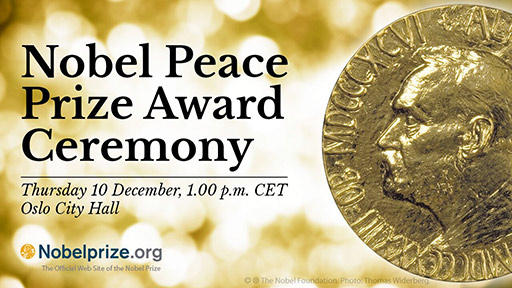
TFF PressInfo # 351: The Nobel Foundation taken to court on the Peace Prize

Lund, December 10, 2015

On the day of the Nobel Peace Prize Award Ceremony at Oslo City Hall

To whom it may concern, including the media

We know – and Alfred Nobel knew – how devastating war and arms races are, and how little security we get for all the money we spend on military forces.

The campaign to reclaim the Nobel Peace Prize is first and foremost a campaign to revive the idea that global peace requires global cooperation on disarmament and replacing the law of force with the force of law. Every day more and more of us see, from the Middle East warfare, from the refugee crisis, and many other chilling reminders, the mandatory urgency of a change in world politics.

Alfred Nobel decided to give one fifth of his fortune for a prize to promote disarmament and resolution of all conflicts through negotiations and legal means, never through violence.

Can such a prize, with a so clearly stated goal, be turned to serve the opposite idea and be given again and again to recipients who promote arms races and believe in militarism and war?

This question will soon be answered, after Mairead Maguire, Jan Oberg, Davis Swanson, and Lay Down Your Arms took the case to the Stockholm District Court on Friday 4th of December 2015. Here is the full text of the summons.
and all other relevant information is available at the Nobel Peace Prize Watch.

Test case: the award to the European Union in 2012

The court case will test one of the most obvious violations of the Nobel idea Read More »

Violence in and by Paris: Any way out?

By Johan Galtung

Atlanta, Georgia, USA

The atrocity in Paris seems to trigger the word “terrorism” with a higher frequency than ever, in the media, from the politicians. Doing so, they sign their intellectual capitulation: trust me, I am not going to try to understand anything. Watching politicians on 56 US TV channels in Georgia there was not a single word analyzing why?; like underlying conflicts and traumas.

Nor conciliation and solution. Only a description of what? – the horrible violence. And what to do: more violence, war. With a question mark though: Will it work?

The whole Western world was living up to the old French saying – Cet animal est très méchant, quand on le bat, il se defend. (That animal is very vicious, when you beat it, it defends itself). Look at centuries of French/Arab-Muslim relations and find one-way beating, killing, conquest, colonialism, exploitation, France using them in wars against Turkey and against Germany promising freedom and breaking their promises, raw post-colonial colonialism, no respect for their wishes to be the masters in their own house, like now in Mali.

Using them for menial jobs in France, if they speak French. At the bottom of society, shocked when the French school system treats them equally and they climb upwards, like African-Americans when they gained access to the US school system. And eventually to US society, after a century of Jim Crow and the civil rights movement.

France is now in that phase. Do not assume that 350 million Arabs – 1,650 million Muslims – will take more beating hands down. Read More »

TFF PressInfo # 349 – Burundi’s crisis and the world’s inability to prevent violence

By Jan Oberg

Lund, Sweden, November 9, 2015


The big – not great – powers of the world have embassies everywhere, plenty of intelligence services, special forces on the ground and satellites in space. They can even hit and kill individuals they don’t like.

They can intervene here and there and everywhere – particularly if they have economic or strategic interests or their own nationals are in danger.

These very weeks they can squander incredible sums of taxpayers’ money on new nukes and huge paranoia-based military exercises in a Europe – to which over a million refugees come because these big – not great – powers have contributed to the destruction of their houses, villages, life opportunities, whole countries and cultures.

So it’s amazing what the big ones can do. It would be impressive if it wasn’t so destructive and self-defeating. Again and again.

The only things they don’t seem capable of, however, is to:

a) fulfil their self-appointed mission called Responsibility to Protect and prevent violence where they have no interests and to

b) contribute to making life better for all and create genuine peace, justice and development.

Take Burundi.

There is a colonial history as well as a history of genocide, extreme poverty and corruption, ten years of economic and other mismanagement under the ever more authoritarian rule of Pierre Nkurunziza.*

Since April this year, there have been tons of indicators that something really bad could happen. The trained observer cannot fail to see the pattern, the incremental, systematic increase of repression of the people.

It’s all well summarised in this background article. 

And what do the big powerful do over 6 months with this potential crisis, possibly civil war or genocide – knowing full well about it?

Absolutely nothing!Read More »

Cultures of war, cultures of peace

By Johan Galtung

We have war and peace, theory and practice. And deeper down cultures of war and peace, notions of what the world is or could be. The latter is not necessarily peace, could also mean removing obstacles to war.

Timothy Snyder, “Hitler’s World” (NY Review of Books, 24 Sep 2015) and Greg Grandin, “The Kissinger Effect: The relentless militarism of the national-security state and its perverse justification begin with Henry Kissinger” (The Nation, 28 Sep 2015) are both on that line.

Hitler’s World derives from Darwinist struggle for niches, with survival of the fittest. His niche is not the whole world but what is needed to feed the German people, and here Ukraine plays a major role. The food chain is key to the image, with humans on top, eating animals and plants, but not eaten by them. So also for the human species, divided in races with the Aryan race on top, “fittest” as evidenced by domination all over; never slaves. On top of them are the Germans; their state not an end but the military arm obliged to be strongest.

To Hitler that world is natural, and inherently stable. Values, equality, human rights, equal right to life, Christianity, capitalism, communism, are anti-natural. For Hitler such ideas…

Continue here

School shootings in the USA: 10 points

By Johan Galtung

The Oregon community college was “the 45th school shooting this year in America; the 142nd school shooting since the Newton massacre in 2012”, Matthew Albracht–Peace Alliance–who adds: 25% of women experience domestic violence, 6 million children witness it every year, 28% of children are bullied during the year and they are 2 to 9 times more likely to commit suicide.

What can be done? Here 10 points:

Gun control, of course.
But the point is not only sales control but possession control with very strict laws for possession and making illegal possession a federal crime. With an average of at least one lethal weapon per citizen, there are enough arms to continue shootings; sales control is insufficient. States and municipalities can endorse this ahead of time for Weapons Free Zones in America, as places where life is safer. There will still be armed police around.

Less violent foreign policy, of course.
Believing that serious change in domestic violence is possible without serious change from violent to solution-oriented foreign policy is unspeakably naive. “If my government can kill whoever stands in our way so can I; if we think we are exceptional, above the law, so am I, as a US citizen” is a psycho-mechanism that can only be beaten by destroying the premise. A government solving problems instead of bombing their way through will have an equally strong effect on the citizens, but this time positive.

Less violent media, of course.
The point is not only less violence, with copycat danger. The point is deeper: media that focus on solutions; journalists who systematically ask politicians “what is Read More »

PlayforRights Celebration on International Artists Day

By Elías Abraham-Foscolo with Jan Oberg

We would like to count on your presence as well as people you may know interested in our activities.

PlayforRights Celebration on International Artists Day

PlayforRights organizes this event (see poster below) to raise awareness and consciousness about the following statement: “The arts contribute to the field of human rights by making visible the human dimension”.

Why do we do this in a celebrative way? 25th of October can be seen as any other ordinary day but for members of PlayforRights it is not. This date is very important moment of the year where we all, the civil society, shall meet together and raise awareness about the potential of the art expressions within processes of social change.

For this, we need to recognise that the arts are ways of nurturing love, that art is Read More »

The Columbia Peace Accords

By Johan Galtung

Bogotá, 30 Sep 2015

The accords were signed a week ago with still much work to do this coming half a year. 23 March 2016 is the deadline.

However, are they peace accords? Or absence of violence eliminating “that other army”, for Weber’s state monopoly on ultima ratio regis, even strengthening the government’s army? That Western concept of peace practiced recently in Sri Lanka and Nepal, against LTTE (Liberation Tigers of Tamil Eelam) and Maoists? Leaving untouched the problems that brought them into being unsolved?

And the word “peace” violated, as “conflict”, saying “post-conflict”, as if nothing more to solve. Words matter; handle them with care.

In all the Colombian conflict complexity, the focus is on only one conflict, between the violent parties: Read More »