TFF PressInfo # 405: Keep focus on Aleppo and global dimensions of Syria

By Jan Oberg

Three perspectives on the Syrian conflict formation

The Syrian conflict formation is hugely more complicated than we’ve been told by Western politicians (all mainstream in spite of democratic features) and mainstream/dependent media.

To some there are only internal aspects and it’s called a civil war only. That’s a necessary but not sufficient aspect.

The same goes for the only regional perspective focusing on e.g. the Israel-Palestine conflict, Iran’s, Saudi-Arabia’s, Turkey’s roles and policies.

To others, everything can be explained from the point of view of Western interventionism/imperialism. That’s also a necessary but not sufficient aspect.

To understand anything of the Syrian conflict formation – and there are very many layers, dimensions and participants over the last 100 years – we need all three basic approaches.

But given that Westerners are likely to have been informed by Western media and politicians they are likely to grossly underestimate the third, the Western-global dimension.

And that narrative is likely to be politically correct, to underestimate the nasty sides of the West the last good 100 years in the region and present the West as basically good guys interested in peace, democracy and freedom.

This bias has been reinforced by what is probably the most massive marketing/public relation effort in any modern war – in the style of the fake news story about Saddam’s soldiers throwing out babies from their incubators in Kuwait City. In order words, pure invention/lies/planted stories/rumours and PSYOPs – psychological operations selling unverifiable stories to influence our hearts and mind in a single policy-promoting direction.

The US/CIA involvement in Syria over the last 68 years is well-documented and easy to access – but never pointed out by the intellectually lazy who think it is enough to just point out that everything is the fault of the “dictator” and his “regime”.

The US worked on deliberately de-stabilising Syria years before 2011 (as documented by WikiLeaks and others) when the peaceful demonstrations took place. The Western military support to RIOTs (Rebels, Insurgents, Opposition and Terrorists – most of the latter) was stepped up and while many point out that the US under Obama didn’t “do anything”, it can be argued that NATO countries acted in a variety of ways, too many and wrong-headed ways – none of them serving a politically negotiated solution, peace or democracy in Syria.

The agenda was foreign interference, promoted military foreign presence (aggression) in international law terms and regime change. One more regimes change, that is, after the earlier completely failed ones in Iraq and Libya.

A series of Western NGOs – no longer Non but NEAR-Governmental Organisations – were part and parcel of the policy, increasingly involved and funded by the Western/NATO/Turkish-Saudi-Gulf-Israeli strategy of de-stabilization – such as US-based Avaaz and French foreign ministry manufactured media outfits such as the Syrian Media Incubator Aleppo Media Centre, the SMART News Agency, the media work of the White Helmets which did humanitarian work only among RIOT fighters and relatives (and stole the name of Syrian Civilian Defence from Syria’s own organisation with that name from 1953).

They came in on the civilian media narrative-creating side. And there are others. Since the days of Yugoslavia, think tanks, human rights and humanitarian organisations have been drawn in – and accepted – to serve specific political interventionist agendas in spite of calling themselves independent, not-for-profit etc. This co-optations spells, potentially, the end of civil society as well as of the open and critical debate about governments’ policies.

All of this continued and was stepped up also after it had become clear that the legitimate, peaceful, democratic, anti-govenment opposition in Syria had been completely sidelined and/or overtaken by Syrian militants and foreigners with guns in their hands.

The West did not get cold feet, it stepped up it regime-change policies in all kinds of ways, regrettably also by massive NGO-investments in proxi- and other pro-war campaigns.

No one thought of the consequences for the huge majority of the innocent Syrian people who had never touched a gun, or thought of doing so.
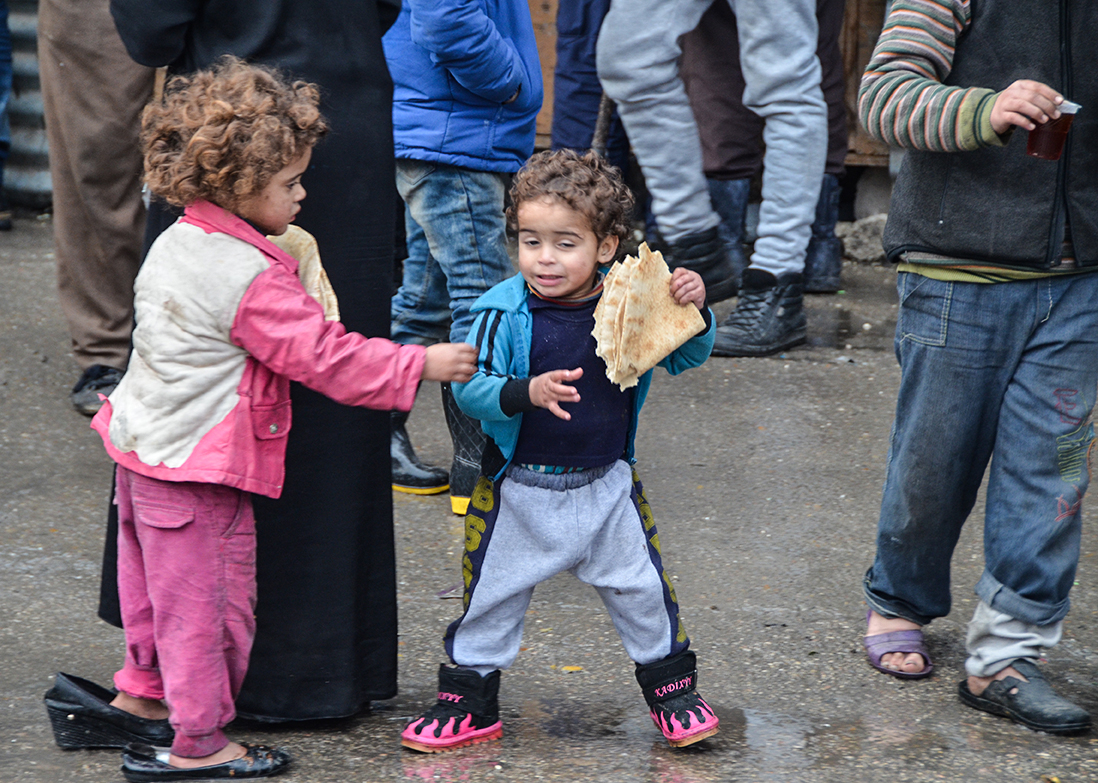
From the Jibrin Reception Center, note the footwear © Jan Oberg 2016

And two more perspectives: Don’t focus on the violence and the evil guy only – it’s war-promoting

No one seems to even have asked the question Read More »

TFF PressInfo # 404: Unique Aleppo photos seen by over 100.000 people but not in mainstream media

By Jan Oberg

It’s probably unusual that a research organisation’s photos go viral – and do so in spite of the mainstream media’s manifest lack of interest in their story.

But the photos I took in Aleppo in Syria December 10-14, 2016 have been seen here by well over 100.000 people around the world, exclusively by organic, non-paid online sharing.

In addition they’ve been linked to and presented by media in the alternative press and social media in about 20 countries, sites such as Telesur, Heise/Telepolis and Pressenza literally reaching millions.

I am proud of having helped bring out the story of these people unworthy, as it seems, of the attention of the West. Because they were the majority from Eastern Aleppo who were happy to be liberated and remained in what is now government-controlled areas.

Keep focus on Aleppo – #keepfocusonaleppo

Aleppo’s liberation was a local, national, regional and global event. Why?

Because of Aleppo’s history, beauty, architecture and industrial importance (50% of Syria’s industrial capacity within the huge Sheikh Najjar Industrial City).

Because, before the war, it had swelled from about 2 million to some 3 million people due to the environmental crisis that hit Syria.

Because its Eastern part was occupied in 2012 by what I call RIOTs – Rebels, Insurgents, Opposition, Terrorists – most of the latter – who over 4,5 years created a living hell for the innocent citizens in that part.

Because of the complete and systematic destruction of this cultural jewel, Aleppo, predominantly by street-to-street fighting (max 5-10% of it caused by bombardments from the air).

Because RIOTs were supported with money, weapons and ammunition by the US, France, Britain and Turkey in particular – i.e. most of NATO – plus Saudi Arabia, the Gulf States – and most media reports have come from that side of the war.

Because Aleppo’s liberation was a turning point in this six years’ long evil war that has created the largest humanitarian crisis anywhere in the world since 1945.

What happened didn’t fit the dominant, deceptive Western media narrative. The large majority of people in Eastern Aleppo went to the dictator’s (” “) government-controlled side while a minority – the RIOT fighters/occupiers and their families – went to Turkey, Idlib and other RIOT-controlled areas.

More about the importance of Aleppo in TFF PressInfo # 405.

But do see the pictures of the incomprehensible, surreal destruction and of the victims of Aleppo. The victims who were happy to have been liberated from 4,5 years of hell. About these victims you have heard almost nothing since mid-December last year.

The photos are unique since I was among the first twenty or so to get in there and talk with and photograph these people – freely. I was the only person from Scandinavia.

No leading Western mainstream media were present there and then. They sat in Beirut, Istanbul and Berlin telling you stories about the likely “new Srebrenica”, massacres and even ‘genocide’ that would follow when Syria’s dictator again controlled Aleppo.

It turned out to be just that. Fake news.

My photos were Real news. You won’t see them at CNN, BBC, New York Times, Reuters, AFP, AP and those who repeat them.

The destruction of Eastern Aleppo, Syria

Humans in liberated Aleppo

Aleppo’s evil humanitarians

Faces of Aleppo

School in an Aleppo factory

(Please respect the © provisions of these images)

And more photo stories to come from Syria.

Why Europe conquered the world

By Jonathan Power

February 21st 2017

Eleven hundred years ago Europe was a backwater. There were no grand cities, apart from Cordoba in Spain which was Muslim. The Middle East was much further ahead, still absorbing the intellectual delights and challenges of Greek science, medicine and architecture which Europeans were largely ignorant of. In southern China agriculture advanced and trade in tea, porcelain and silk flourished.

By 1914 it was a totally different world. The Europeans ruled 84% of the globe and they had colonies everywhere. How was it that Europe and its offspring, the United States, became the dominant dynamic force in the world, and still are today in most things?

If I walk round my university town and stop the first ten students I meet and ask them why this was so they would probably say because of the Industrial Revolution. But in 1800 when the Industrial Revolution was only just beginning Europeans already ruled 35% of the world and had armed ships on every ocean and colonies on every continent.

If they didn’t say that, they might say it was the way the Europeans spread their fatal diseases, smallpox and measles, to which they had gained a good deal of immunity, and this enabled them to lay low native peoples. But in fact all the major Middle Eastern and Asian civilizations had this same advantage. In Africa it was local diseases that attacked the Europeans more than vice versa.

Maybe one of the ten students would say it was because the Europeans were ahead in the development of gunpowder technology. After all the military revolution preceded the Industrial Revolution. But I doubt that, even though on the right track, this one student could explain why.Read More »

Evolving democracy

By Johan Galtung

February 13, 2017

What is the essence of democracy?

“Rule with the consent of the ruled” implies two classes of people, Rulers and Ruled; concretely State and People, Statism. “Free and Fair Elections” implies voting for a Parliament; Parliamentarism. Together, a three-tier power structure State-Parliament-People; with People controlling Parliament, and Parliament controlling State.

In 2016 some voting differed from what State-Parliament expected; leading to talk about elitist vs populist democracy – from statism and parliamentarism to peopleism. A crisis. And talk about post-democracy.

Another answer about democratic essence is “one-tier self-ruling units”; no rulers vs ruled, and decisions are made by general assemblies for all. This is often referred to as Anarchism, “no structure”. A misnomer: there is no State and no Parliament, but many assemblies. A concrete interpretation would be Localism, the units being local authorities – LAs, municipalities; the assemblies being their municipal councils.

A key dimension then becomes the level of state control of LAs. In Spain, with an anarchist ideological tradition, the LAs are strong.

A different, not institutional – more philosophical, intellectual in general – answer would pick up words like transparency and dialogue.

Democracy is a context with everything in the open, no closed doors, available to everlasting people dialogue: by way of the word, logos. Fine for people who are good with words.

How about those who are not, Read More »

TFF PressInfo # 403: Discussing NATO with a former US Assistant Secretary of Defence

By Jan Oberg

On the occasion of NATO’s defence minister meeting on February 15-16 discussing NATO, Ukraine, Crimea, Syria and the eternal threat images which are fake – with former Assistant Secretary of Defence of the United States, Mr. Lawrence J. Korb.

I’m afraid he got some stuff wrong such as the establishment of NATO and whether or not Kosovo is part of the Balkans.

He also believed that NATO’s 1999 bombing of Serbia-Kosovo had a UN Security Council mandate.

Enjoy those small moment and the rest where I am trying to present some more general thourght on why the whole NATO philosophy is outdated – the only point where I agree with President Trump…

Media experience and policy

Lots of people in the debate seem to believe there is something strange about being in the “propaganda” media of “enemies of the West” – read the global Iran’s PressTV and Russia’s Russia Today.

What they don’t seem to have acknowledged is that tons of Westerners are being interviewed and do commenting (like myself for years) at these media. Here is Mr. Korb with me at Iran’s international TV channel.

What they also don’t know is something I am sorry to report: I’ve met attempts at manipulation and “editing” and censorship with a series of Western mainstream media, not the least in my native Denmark, but I have not experience any of that even once with Russia Today and PressTV. Very decent professionals!

So much for the free press and for the propaganda channels. My personal problems is, which is which?

About my policy vis-a-vis the media.

Nonviolent economy

By Johan Galtung

Two important words enriching each other. “Nonviolent” easily becomes bla-bla, and “economy” is too general. But, does “nonviolent” make a difference for the better to the economy? And vice versa, can “economy” make “nonviolent” more positive, beyond resistance to evil?

Let us start with “economy”, here conceived of as a cycle with three poles: Nature, Production, Consumption. And three processes: Extraction from Nature, Distribution from Production to Consumption, and Pollution from Production-Consumption back to Nature. The cycle flow is in that order: Nature → Production → Consumption → Nature.

A simple summary of the economy: humans extract resources from nature, produce-process for (end) consumption, and sends what they cannot consume back to nature (but economists, like book-keepers, left out the Nature part). And we want it all to be nonviolent!

“Do no harm!”, nonviolent, is insufficient. “Peace”, “peaceful” include positive peace–Peace Economics, A Theory of Development are my books (TRANSCEND University Press, 2012, 2010)–with “do good!”.

And: Nature can evolve better without us, not we without Nature.Read More »

If you want peace, don’t focus on the violence and the evil guy

A personal pledge provoked by the debates about Syria

Summary

About 95% of all debates about conflicts and war that we see in politics, mainstream media, the Internet and social media focus on the violence, who uses more or less of it and who is, therefore, the evil party.

This approach places direct violence – such as human rights violations, killings, bombings etc. – in the centre of the attention and that is unfortunate because violence is always only a symptom. I call this the simplifying or reductionist approach; invariably it has populist connotations too and usually ends up in mud-slinging.

I argue in this analysis that this reductionist approach is counterproductive and that – because of the defining characteristics of these debates – the underlying conflicts/problems that cause the violence are never in focus and that no international complex conflict can be explained even rudimentarily by asserting that one single individual’s personality or behaviour is the root cause, the problem or the conflict itself.

Secondly, I explain what makes the reductionist approach so typical and ‘natural’ in the eyes of Westerners. We have to be aware of the deficits of this entire approach to conflict which, I argue, is also related to Western ways of thinking, including Christianity. (You may jump this section if you are more attracted to practical implications than to philosophy).

The third section deals with the conflict and peace approach as an alternative – arguing that only through that can we arrive at the necessary dimension: How can the violence stop and how can the conflicting parties change their perceptions, attitudes and the problem/conflict that stands between them so that peace can unfold. Like the science of medicine, it has a focus on the disease and we do a Diagnosis, Prognosis and Treatment by finding the root causes rather than just treating symptoms.

Finally I make the pledge to never again participate in discussions within the reductionist discourse of the violence and who-is-good-and-who-is-bad. I will spend my energy, instead, on the constructive conflict and peace approach that is also the only one that will benefit the innocent victims in conflict zone, the people who have never even thought of taking up arms.

In short, it is a refusal to let the violence and ‘evil’ individuals take centre stage in any discourse and instead look at problems and their resolution together with peace-building and thus – Gandhian style – let non-violence and peace-making by peaceful means take centre stage:

Since this author is a peace and future researcher, I shall no longer participate in any discussion or debate about a conflict or war in which the main focus is on the direct violence and one or more participants point out that they know who the bad guy is and seek to frame or place me on this or that or the other side.

Under “PS” you’ll find my four-part view on matter of justice which of course is part and parcel of peace-building.

• • •

I’ve experienced it repeatedly over the last good 20 years, since the bad old days of Yugoslavia’s dissolution wars and I see it now, only more viciously, in the discussions about Syria in the old media as well as the social media:

If you are not clearly supporting party A to a conflict you must be a supporter of B.

From that follows:

Since I am in favour of the good guy A, you are a bad guy because you side with B (or don’t side with A).

This approach can be categorised as simplistic and reductionist. It prevents an understanding of what a conflict is about and hinders peace thinking and proposals.

It also amounts to legitimating more war.

This approach is wrong and counterproductive because invariably it:

1) builds on the assumption that there are only two sides in a conflict; that is never the case in complex international conflict;

2) builds on the either/or fallacy that you must be pro-B since you are not pro-A, overlooking the simply fact that one could also sympathize with party C and/or M and/or V; alternatively that all participants behave in such a manner that you sympathise with no one;

3) focuses on parties, or actors, and not on the underlying problems that make the parties fight each other;

4) satisfies people’s more or less narcissistic need for being right and being confirmed as being morally superior – irrespective of whether or not they understand the issues;

5) builds implicitly upon the assumption that the two parties represent Good and Evil and that all of the good ones are on one side, all of the bad ones on the other;

6) creates endless, sterile debates Read More »

TFF PressInfo # 402: Trump’s Pre-Fascism and Progressive Populist Opportunities

The Dismal Cartography of the Pre-Fascist State

January 25, 2017

Points of Departure

Listening to Donald Trump’s inaugural speech on January 20th led me to muse about what it might mean to live in a pre-fascist state. After reflecting on key passages and conversations with friends, I came to the view that all the elements were in place, although set before us with the imprecision of a demagogue.

Yet I do not doubt that there are many ideologues waiting in the wings, perhaps now comfortably situated in the West Wing, ready to cover the conceptual rough spots, and supply an ideological overlay, and add the semblance of coherence.

Considering the daily outrages emanating from the White House since the inaugural jolt, the coming years will be rough riding for all of us, with many cruelties being readied for those most vulnerable.

Of course, the Woman’s March on January 21st was temporarily redemptive, and if such energy can be sustained potentially transformative. It is odd to contemplate, but there just may be tacit and effective cooperation between the national security deep state and a progressive populism converging around their divergent reasons for being deeply opposed to the shock and awe of the Trump presidency. Trump may invent ‘alternative facts’ to restore his narcissistic self-esteem, but when it comes to program he has sadly so far been true to his word! This alone should encourage a unified, energetic, and determined opposition. If the Tea Party could do it, why can’t we?

The Pre-Fascist Moment

First, it is necessary to set forth the case for viewing Trump’s Inaugural Address as a pre-fascist plea:

1) Locating power and legitimacy in the people, but only those whose support was instrumental in the election of the new president; the popular majority that were opposed are presumed irrelevant, or worse;

2) Denigrating the political class of both political parties as corrupt and responsible for the decline of the country and the hardships inflicted on his followers;

3) Presuming mass and unconditional trust in the great leader who promises a rupture with the past,Read More »

Is violence-war a cause or a symptom?

By Johan Galtung

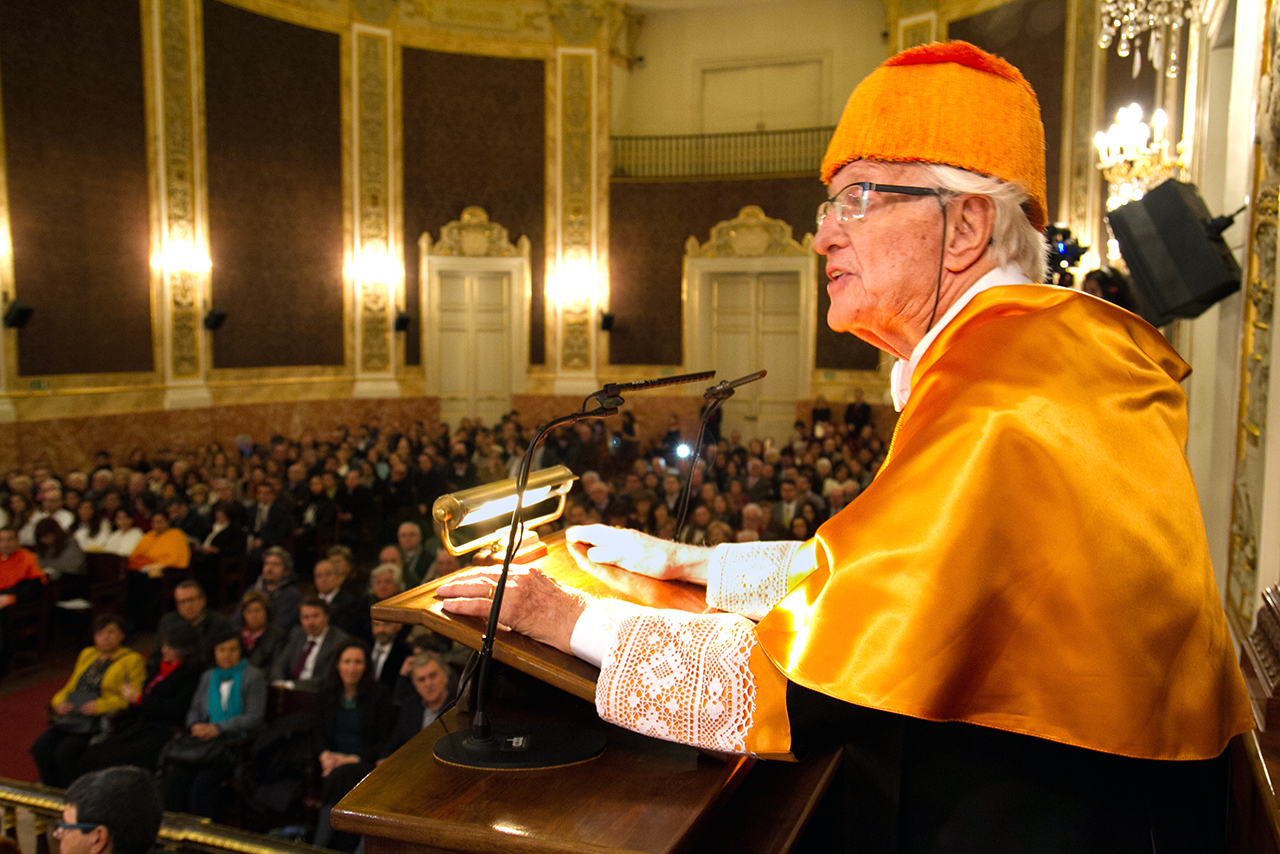
Receiving Dr Honoris Causa, Universidad Madrid Complutense, 27 Jan 2017

Dear Rector, dear Jury!

I receive this great honor bestowed upon me in deep gratitude and pride, promising to try to live up to it.

I will now share with you some words about how I got launched on the track for which you honor me, peace studies and peace practice.

Like so many, I felt desperate about the wars in our enlightened century and continent and asked, Why? What can we do to avoid this suffering, not only the wounded and dead, but the countless bereaved?

From my family I knew a little about health studies and had been struck by the fruitful distinction between cause and symptom. The symptom is on the surface of the body, like fever; but the root cause is deeper down, inside, a sepsis. A major breakthrough. “Treat the cause, not the symptom” became a new rationality. Cooling the body makes some sense, but it isn’t the cure; and even less treating a swollen ankle that could be a symptom of a serious heart illness.

My illness was war, my wellness was peace.

Was war a cause with horrible effects with nobody really winning, or could war be a symptom of something deep down in the “body politic”, a “root cause”? Of something preceding war and violence in general, which if removed would also remove, or at least reduce, war and violence? But what?

This was important because if we accept violence as the root cause then we link it to the human body or humanity as such, not only as innate, but as inevitable. We would have to learn to live with it and with its effects, some of them summarized in “war breeds war”.

War rhetoric actually pointed in two directions: “someone blocking what we are entitled to” and “revenge for unjust wars against us”. The first points to conflict, “incompatible goals”; the second to trauma, “wounds from past violence”. I have stayed with those two.

This liberates human nature from being the cause Read More »

Glenn D. Paige 1929-2017 – Pioneer of studies of nonkilling and peace

By Chaiwat Satha-Anand,
TFF Associate

At the 16th International Peace Research Association (IPRA) conference held in Brisbane, Australia in 1996 under the guidance of Ralph Summy with the theme” Creating Nonviolent Future”, Glenn D.Paige began his keynote address titled: “To Leap Beyond Yet Nearer Bring: from war to peace to nonviolence to nonkilling” by recounting another IPRA meeting held in Yokohama, in 1980.

At that meeting, a question was raised as to whether it would be possible for IPRA to take up the subject of “nonviolence”.

A distinguished European researcher responded in the negative saying that nonviolence “would discredit peace research”.

Six years later in 1986 at the IPRA conference held in Sussex, Theodore Herman convened what I believe to be the first IPRA nonviolence commission. Later in 1988 at the IPRA meeting held in Rio de Janeiro, Herman asked Paige to help convene the next nonviolence commission. Paige became the convenor of the nonviolence commission in the 1990 IPRA conference held in Groningen, Netherlands. [Papers from this conference were published in Gandhi Marg Vol.14 No.1 (April-June 1992)]

I attended the first IPRA conference in Rio de Janeiro in 1988. Glenn Paige was my teacher and mentor. Read More »