A theory serves comprehension, prediction and identification of conditions for change. Seven such historical-cultural pointers will be indicated for China; using the West in general, and the USA in particular, for comparisons. The presentation draws on countless dialogues in China over 40 years, since 1973.
* China: in time, as dynasties; West: in space as empires.
Look at a histomap combining world history and geography, time and space: China shows up through 4,000 years as relatively coherent dynasties with complex transitions – and the West as empires–birth-growth-peaking-decline-fall, like the Roman, UK and now US empires – duration vs bubbles that burst; as China-centric vs hegemonic.Read More »
It is misleading to describe ‘world order’ as consisting exclusively of sovereign territorial states. This misimpression is further encouraged by the structure of the United Nations, whose members are states, and only states. The UN was established in 1945 in the aftermath of World War II, reflecting a West-centric orientation that emerged at the time, quickly morphing into the Cold War rivalry between the two states that were geopolitically dominant and ideologically antagonistic: the United States and Soviet Union.
Even in the UN, however, this surface allegiance to statism is misleading. The geopolitical dimension was highlighted in the UN Charter by conferring a veto power on five winners in the recently concluded war, which amounted to the grant of a right of exception with respect to international law.
But there are differences in hard and soft power that make the interactions among states within the UN exhibit more inequality than is suggested by this still prevailing Westphalian myth of the equality among sovereign states. Some states contribute far more to the UN budget than others, and their views carry more weight; others are richer, bigger, more informed about some issues, are better at lobbying for support, and some play above their diplomatic weight by clever political maneuvers. And there are several kinds of non-states active behind the scenes that exert varying degrees of influence depending on the subject-matter.
Global policy is mainly shaped outside the UN by a bewildering array of formal and informal actors that participate in a bewildering variety of ways in international life. The world economy is substantially controlled by business oriented alignments such as the World Economic Forum that meets annually in Davos, Switzerland, or the gatherings of economically powerful states grouped together as the G-7, later becoming the G-8, and more recently the G-20 to accommodate shifts in trade and investment patterns, and give recognition to such new alignments as the BRICs.
As such, the shorthand designation of world order by reference to the 1648 Treaties of Westphalia that brought the Thirty Years War to an end serves as a convenient starting point for understanding the way authority and power are deployed in the world.
Yet it must be supplemented by the recognition that Read More »
A shorter version of this article was published by IPS
The Origins
When all of a sudden ISIS (Islamic State in Iraq and Sham) emerged on the scene, and in a matter of days occupied large swathes of mainly Sunni-inhabited parts of Iraq and Syria, including Iraq’s second city Mosul and Saddam Hussein’s birthplace Tikrit and called itself the Islamic State, many people, not least Western politicians and intelligence services, were taken by surprise.
This feeling of shock and repeated reversals in the past has been due to widespread ignorance or the willful neglect of history, and general unwillingness by politicians and pundits to look at the reality as it is or to explore the root causes of the issues in the Middle East from a historical, religious and ethnic point of view.
Most politicians have been afflicted by short-termism and they stumble from one crisis to the next without an overall strategy and without the ability to look beyond their noses.Read More »
The beheading of American and British journalists who were being held hostage by ISIS creates a truly horrifying spectacle, and quite understandably mobilizes the political will to destroy the political actor who so shocks and frightens the Western sensibility, which is far from being free from responsibility for such lurid incidents.
Never in modern times has there been a clearer example of violence begetting violence.
And we need to ask ‘to what end?’ Political leaders in the West are remarkably silent and dishonest about what it is that they wish to achieve in this region beset since 2011 by a quite terrifying outbreak of political extremism, whether from above as in the cases of Syria, Egypt, and Israel or from below as with ISIS and al-Nusra.
It is difficult to recall that at the start of 2011, just three years ago, progressive voices around the world were inspired by the Arab upheavals, especially in Egypt and Tunisia, that burst upon the political scene unexpectedly.
These extraordinary events appeared to repudiate the prevailing patterns of authoritarian, exploitative, and corrupt collaboration between oppressive domestic elites, neoliberal economic forces, and the regional imperial juggernaut that had kept this humanly disastrous reality stable for so long. Yet even during that time of optimism about the Arab future, a closer scrutiny of what was happening disclosed many reasons to be worried. It is helpful to look to this recent past to have some comprehension of the perplexing present.
A Revolutionary Spirit Without Revolutionary Action
The goals of these upheavals were far too ambitious to be realized by such limited challenges directed at the established order. These movements were essentially confined to getting rid of a hated ruler. Read More »
The two giants did something unusual for Western thinkers: they were very holistic. Nothing less than the whole society and the world, and much more than the economy, for Marx; nothing less than the whole body-mind complex, with excursions into culture, for Freud.
Equally unusual: they were very dialectical. There were forces and counter-forces. Means vs modes of production for Marx, simplified to Capital vs Labor; Super-ego vs Id, values from the outside vs drives from the inside for Freud. For Marx the dialectic was inside Structure–of Culture and Nature there was little–for Freud between Culture and Nature–of Structure there was little.
Holism and dialectics are the pillars of daoist thought, giving rise to a dynamic theory of organic systems like societies and humans. Calling the forces yin and yang, over time they will both be vexing and, waning, the dominant will recede and the dominated will grow. In this process there may be some balance point, but it is not stable. Nothing is stable in this perspective, nor is anything–Nazi Germany, Soviet Union, USA–monolithic with only one force. There is yin/yang everywhere, also inside yin and yang, and new dialectics emerging.
Here the great Westerners show their limitations. Marx was an optimist seeing conscious and organized Labor break the shackles of Capital, moving on to socialism and communism; Freud was a pessimist seeing “reality” (his word for structure?) as unchanging, impeding compromises between Super-Ego and Id. They used only the dialectic of their primary contradictions; beyond that they became deterministic.
Moreover, with two forces there are five outcomes: one or the other prevails, neither-nor–like in social or individual death–a compromise is identified–social capitalism, capi-communism, Freud’s maturity–and both-and, transcending, beyond the compromise. They, however, saw only one outcome, the triumph of Labor, or the compromise.
Whatever happens it will be unstable. For stability a stabilizer is needed, but even so any equilibrium is unstable. The State is the social stabilizer freezing the dialectic in favor of Capital, Labor, neither, a compromise or both; but where is the individual stabilizer?Read More »
John B. Sparks made a histomap in 1931—updated in 2010 (Metro Books) – a long, vertical chart covering “peoples and nations for 4,000 years”.
Time, history, is on the vertical axis, listing when of events and where in the space of peoples and nations. The chart starts with the Chinese, the Indians, Amorites (Babylon), Aegeans (Minoans and Mycenaeans), Hittites (Anatolia), Iranians and Greeks, goes on to the Romans, the British, the Huns (Mongols) and ends with Latin America, Europeans West and East (the EU is absent), the Middle East, sub-Sahara Africa, Russians and Americans, Asia as India, China and Japan; each part proportionate to their significance at the time. Debatable.
But let us focus on something crucial: the shape of the “peoples-nations” bubbles in world history, from a beginning to an end?
By and large exactly like that: a birth somewhere in this Einsteinian timespace, and a death. Two points, and between them: growth-maturity/flourishing-decline and fall. Expansion to a maximum, and contraction to a minimum. The law of anything organic? Given that they often thought they were forever, gifted with eternal life, history is about great expectations, glories–and great traumas.Read More »
He was a tall man and a great man, a visionary, pacifist, civil resister, educator and philosopher. He took life more seriously than most and he could be playful and fun like a child. His life’s guiding principle was ”Engage in your time!” and while he wrote and talked a lot he also did it. His name was Aage Bertelsen, he was born in Denmark in 1901 and died on August 15, 1980.
Bertelsen’s imprint on history is two-fold. First, with his wife Gerda he was a prime mover of one of the groups, the Lyngby Group, which organised the rescue of altogether 7.220 Danish Jews into safety in Sweden in October 1943 during the German occupation of Denmark – more here. The Lyngby Group – Lyngby is north of Copenhagen – got about 1.000 of these in safety by organising their nightly transport onboard small fisher boats over the Sound between Denmark and Sweden.
In this he deserves a place in international contemporary history for its humanity, civil courage and as an example of non-violent struggle against occupation.
Secondly, Bertelsen was an educator of and for peace. His life work educational efforts included his family and friends, his pupils over 22 years at the Aarhus Cathedral School in Aarhus, Denmark, the general public as well as national and international leaders.
He lived in pre-Internet times and very little is publicly available today about this renaissance man. From two rather different, but compatible, perspectives we’ve taken it upon us to remind the world about him – friends and colleagues of his as we happen to be.
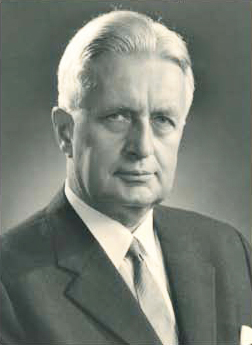
Headmaster Aage Bertelsen in 1961 Photo: Elfeldt, Copenhagen
Why now, over 30 years after his death? Read More »
Can we know the future? Rhetorical answer: can we know the past?
We rewrite history all the time, not because facts become dubious and new facts appear, but because our angle, perspective, changes. Say, from a series of kings, presidents etc. and their exercise of military and political power to economic and cultural changes in the life of common people, in their wellbeing and identity. Quite some change.
Will we arrive at that single, true, objective perspective?
No, objectivity may be multi-subjective, not inter-subjective. This is why Al Jazeera is so much better for knowing the present than CNN, which presents the US angle, and if there are other angles a US “expert” will give the final interpretation. Al Jazeera presents many angles of many parties and leaves final interpretations to the viewer.
How can we shed some light into the future? Basically there are two approaches: the Cartesian based on extending trends, and daoism based on holism and dialectics. They do not exclude each other.
Thus, there are three world trends that certainly affect Spain…Read More »
Governance is politics, power–political-economic-military-cultural; decisions-carrots-sticks-ideas. Politics is about problems of realizing one goal; about conflicts realizing incompatible goals. Contradiction = danger+opportunity; the art of the impossible.
Answer: Good Governance GG = CC Creative Conflict-transformation.
This includes diagnosis, who are the parties, their goals and the incompatibilities; prognosis, from frustration to aggression/apathy, from prejudice-discrimination to hatred-violence; therapy, conflict solution-transformation, proposing creative visions of a new reality where the goals are compatible and new conflicts more easily handled.
Two examples of creative, good governance from Norway and Europe: Read More »
Democracy is a core feature of Western society, normally understood as representative parliament – i.e. in free elections citizens vote for people to represent their interests for a parliament consisting of parties of which some form the government and some the opposition.
It’s not always included in the definitions that democracy requires a reasonable level of knowledge and information, freely available. For instance, one often hears that India is the world’s biggest democracy but 26% of the people are still illiterate (287 million people).
So the ”world’s largest democracy” also has the world’s largest population who can’t read and write. In comparison, China illiterate citizens make up about 3% and is regularly called a dictatorship.
Also, in a society where the persons running for office are – or have to be – extremely wealthy to pay for their campaign and where large corporations make multi-million dollar contributions to certain candidates (presumably not out of altruism), falls outside a reasonable definition of democracy – even though they may also not be dictatorships; there are many stations in-between the two.
Are young people giving up parliamentary democracy?
When I was in my high-school years – a few decades ago – and wanted to contribute to changing society for the better, the most natural thing to do – and the finest – was to join a political party. Not so today. My students in peace studies around the world often ask me at the end of a course and it is time to say goodbye whether I can help them somehow in making their career. Their career dreams may be to work for the UN, for human rights, the environment or starting their own NGO with a peace profile or set up their own consultancy firm for a better world.
Significantly, over all these years, only one single student asked me what I thought about contributing to peace and development by becoming a politician.
As is well-known, people today engage in social issues mainly through civil society and the use of social media as their primary tool. This is good from most perspectives and holds fascinating prospects for de facto global citizenship and action, but it does something to the old type of representative democracy.
When we talk about global crisis, people think much more of the environment, identity issues or warfare than of democracy being in crisis. I think it is in fundamental crisis for the the following reasons.Read More »




 TFF Associates Blog 2011-2017