Trump visits Putin

By Jonathan Power

October 25th 2016

I have a fantasy. Donald Trump wins. He goes to Moscow on his first trip as president and gives President Vladimir Putin a bear hug and they go hunting in the forest, Soviet style.

When they emerge they have shot a couple of bears and have had a good lunch laid out for them by acolytes at which they have discussed the matters of the world.

They give a press conference. They have decided to re-start negotiations on major nuclear arms reductions and both say they unilaterally are immediately ridding themselves of a 1000 missiles each.

They have found a way to implement autonomy for eastern Ukraine, as done in Scotland, which Trump with his Scottish golf courses knows well. Ukraine can work towards both a trade agreement with the EU and the Russian-backed Eurasian Economic Union. Russia was always happy about such an arrangement, but many Ukrainians weren’t and only wanted an EU arrangement. This was the trigger for the uprising in Kiev and Western support for the powerful revolutionary movements that had a fascist pedigree.

Dealing with Syria is both simpler and more difficult – difficult because of the intensity of the fighting and the multi-nation interests and easier because neither Russia nor the NATO powers want to see a clash over a relatively small part of the global population – Syria’s population is 9 million, about the same as one of America’s eastern states.

In the forest they agreed to stop using Russian warplanes backing President Bashar al-Assad, the US to stop aiding anti-Assad guerrillas and both to concentrate on defeating ISIS. In return the US would invite Russia to share its airbase in Qatar. The civil war opponents would be left alone to fight. UN mediation would continue.

Trump has a point in wanting rapprochement with Russia.

At the moment Read More »

TFF PressInfo # 388: The War On Terror – A predictable fiasco

By Jan Oberg

This coming Sunday marks the 15th anniversary of what could be called the most counter-productive, if not stupid, war in modern history: The War On Terror. Today that war is much much more dangerous to the world’s future than the terrorists it is allegedly supposed to hunt down. And it has caused thousands of times more suffering, death and destruction – at least a million innocent people killed.

It’s not a war on terrorism but on terrorists and that is as smart as trying to fight all diseases by killing patients. It’s a war fought without any consideration of the one big question: Why did they do it and why do they do it? Media and politics only asking: Who did it? How was it done? Where? How to respond?

Without an intelligent, comprehensive diagnosis of 9/11 it could only go wrong. And it has.

The next problem was that ‘terrorism’ was suddenly defined by states as anything non-state that threatens society and states. Governments and the UN (which consists of them) conveniently omitted terrorism as a term for what states do and have done on a regular basis and on a much larger scale. Such as the nuclear balance of terror.

About 400 people were killed annually and worldwide before 9/11 according to US State Department statistics – reporting of that stopped in 2004 when figures soared after the War On Terror gained momentum. However, according to the 2015 Global Terror Index – the number is now 32,000 – and the far majority killed outside the West. So, the problem has increased exactly 80 times(!)

And the Western leaders who continue this war has no idea about how to stop it or do something more productive and intelligent to the world. Primitive tit-for-tat and disproportional responses has substituted what was once called statesmanship.

And it was predictable that it would be a fiasco!

Many both inside and outside the U.S. came up with Read More »

Vem kan tro på historien om Nine Eleven?

Av Ola Friholt

Det är nu 15 år sedan den ödesdigra dagen 11 september 2001. Sedan dess har kriget mot terrorismen utvecklats och krävt minst två miljoner liv och lika många psykiskt och fysiskt skadade, allt enligt en utredning från USAs läkarsällskap, ”Physicians for Social Responsibility” (med 50 000 medlemmar och medlem av Läkare mot kärnvapen).

Resultatet av kriget mot terrorismen är dessutom negativt även för väst. Idag har attentaten och offren i väst mångdubblats.

Lika anmärkningsvärt är att medborgarnas fri- och rättigheter i väst dramatiskt har urholkats. Kontrollen uppifrån är närmast total med avlyssning utan praktisk begränsning.

Hemliga fångläger med tortyr av godtyckligt fängslade har avslöjats i Polen, Tjeckien, Kosovo och Egypten, utöver de öppet erkända på Guantanamo, i Afghanistan och Pakistan. Ett sextiotal personer har suttit på Guantanamo i fjorton år utan rannsakan och dom från USA, som förr kallats ”Världens största demokrati”.

Den 11 september kan alltså kopplas till urholkning av demokratiska fri- och rättigheter, utomrättsligt dödande i stor skala, godtyckligt fängslande, officiellt påbjuden tortyr m m. Till detta kan läggas intensifierade rustningar och nya krig på bekostnad av fredlig dialog och konfliktlösning. Sveriges regeringar har följsamt godtagit både den officiella bilden av händelserna den 11 september 2001 och dess såväl militära som civila konsekvenser.

Det är ingen tillfällighet att avlyssningsstationerna på Lovön och Lerkil hör till världens största och att rymdforskningsstationen Esrange i Kiruna förmedlar satellitdata till USA/Nato för deras krigföring.

Och Sverige deltog i förmenta antiterrorkrig i Afghanistan och Libyen.

Det finns anledning att omvärdera hela utvecklingen under femton år och ifrågasätta själva den åberopade grunden för denna utveckling: raserandet av World Trade Centre.

Ifrågasättandet av den officiella beskrivningen av den händelsen började nästan omedelbart. Idag finns en hel litteratur som smular sönder den bild som är officiellt accepterad i väst. Vad var det som egentligen skedde, och vem låg bakom?

Betydande analyser gjordes av Andreas von Bülow, tidigare minister för teknologi och forskning i Helmut Schmidts regering i Tyskland, med boken ”CIA och 11 september” (2003) på Alhambra förlag. Professor David Ray Griffin har publicerat flera böcker, på svenska ”Motsägelser om 11 september”, Alhambra 2008, och ”WTC 7 och dess mystiska kollaps”, Alhambra 2010. Dessutom omfattande analyser på Internet, t ex Wood & Reynolds: ”The Star Wars Beam Weapons and Star Wars Directed Energy Weapons” (2006) och D A Khalezov: ”911thology: The Third Truth about 9-11” (2013), 1092 sidor.

För en sunt tänkande människa ter det sig orimligt att makthavare skulle kunna bedriva en politik som drabbar det egna folket. Ändå är detta vardagsmat sedan århundraden, med nittonhundratalet som eländets höjdpunkt. Då offrades långt över 100 miljoner liv även av ledare som kallade sig demokratiska. Det ansågs självklart att utkämpa världskrigen så som de utkämpades.

Likaså krigen för och emot kolonial befrielse och krigen för kontroll över råvarutillgångar och marknader. Och sedan årtionden dör cirka hundratusen människor varje dag i sviterna av världens orättvisor utan att särskilda insatser görs för att förhindra det.

De senaste åren har destabilisering och förstöring av stater stått på stormaktsprogrammet under uppenbart falska förevändningar men utan att väcka förvåning. Ansvariga är främst USA och England under medverkan av övriga Nato. Detta hindrar inte att majoriteten av Sveriges politiska partier och riksdagen liksom regeringen alltmer närmar sig Natomedlemskap, utan att gå in i den debatt som borde vara självklar i en demokrati.

Att ledare är beredda att offra tusentals av sitt eget och andra folk för tvivelaktiga mål är således väl belagt.

Det finns all anledning att tvivla på de förklaringar en stormakts ledare ger.

Den 11. 9. 2001 sägs alltså 19 muslimska flygkapare ha flugit in i World Trade Centres två högsta skyskrapor och därigenom fått dem att rasa till grunden. Read More »


America, the threatened?

By Jonathan Power

September 6th 2016

The French ambassador to the US from 1902 to 1924, Jean-Jules Jusserand, observed that distant powers could not easily threaten the US because “On the north, she has a weak neighbour; on the south, another weak neighbour; on the east fish and on the west, fish”.

The coming of the submarine-based nuclear missile has not changed that. Apart from the fact that no enemy would dare use them for fear of retaliation, and that there is no country in the world that feels that hostile to America (accept North Korea), the fact is America is too big and too far away to be invaded and dominated. There could not be a blitzkrieg by a foreign army across the mid-west or a Vichy America.

The real tragedy of 9/11 is just as a majority of the US electorate had settled into a post-Cold War comfort zone with the new president, George W. Bush, not being overly pushy or confrontational in foreign affairs, America was jolted so badly that a large proportion of its electorate – maybe half – has been paranoid ever since. Enemies are once again seen under the bed.

Enough of the electorate have persuaded themselves that they are insecureRead More »

The sky above Turkey has much blue in it

By Richard Falk

August 10, 2016

Prefatory Note
An earlier version was published by Middle East Eye on August 10, 2016. It seems so important at this time for the sake of the future of Turkey that the West look at the country and its political circumstances in a far more balanced way than how the situation has been portrayed since the coup. How to explain this imbalance is another matterthat should be explored at some point, but for now is largely put aside.

Much uncertainty remains in Turkey, but there is enough evidence of positive tendencies to raise a tentative banner of hope. Being a witness to the political atmosphere in Turkey that has emerged after the failed coup of July 15th puts me at odds with the secular consensus in the West, which looks up at the sky and sees only dark, ominous clouds of human rights abuse and autocratic leadership.

What I have experienced and observed so far is quite different, a sky with much blue in it.

There are two opposed, although overlapping, tendencies present that seemed to be responsive to the political priorities that top the post-coup government agenda: sustaining the anti-coup unity by shifting political gears within the AKP leadership circles in the direction of “inclusive democracy” and pragmatism, and with it, a retreat from the polarizing claims of “majoritarian democracy” that greatly intensified after the 2011 national elections and were particularly evident in the clumsy, unacceptable way the Turkish government handled the Gezi Park demonstrations two years later.

The most important concrete embodiment of this post-15 July move toward inclusiveness has been a series of initatives intended to create a common front between the three leading political parties in the country, including the CHP (secular mainstream) and MHP (nationalist rightest) opposition parties.

This has been reinforced by several other developments,Read More »

The Unlikely AMEXIT: Pivoting away from the Middle East

By Richard Falk

The Case for Disengagement

A few years ago Barack Obama made much of an American pivot to East Asia, a recognition of China’s emergence and regional assertiveness, and the related claim that the American role in Asia-Pacific should be treated as a prime strategic interest that China needed to be made to respect.

The shift also involved the recognition by Obama that the United States had become overly and unsuccessfully engaged in Middle Eastern politics creating incentives to adjust foreign policy priorities. The 2012 pivot was an overdue correction of the neocon approach to the region during the presidency of George W. Bush that reached its climax with the disastrous 2003 intervention in Iraq, which continues to cause negative reverberations throughout the region.

It was then that the idiocy of ‘democracy promotion’ gave an idealistic edge to America’s military intervention and the delusion prospect of the occupiers receiving a warm welcome from the Iraqi people hit a stone wall of unanticipated resistance.

In retrospect, it seems evident that despite the much publicized ‘pivot’ the United States has not disengaged from the Middle East. Its policies are tied as ever to Israel, and its fully engaged in the military campaigns taking place in Syria and against DAESH.

In a recent article in The National Interest, Mohammed Ayoob, proposes a gradual American disengagement from the region. He makes a highly intelligent and informed strategic interest argument based on Israel’s military superiority, the reduced Western dependence on Gulf oil, and the nuclear agreement with Iran.

In effect, Ayoob convincingly contends that Read More »

America Menaced: An Impending Police State

By Richard Falk

Prefatory Note
I am posting some reflections on Gerry Spence’s Police State, an ominous book, finely wrought, that we should all read. Besides being my close friend, Gerry is a lawyer par excellence, as well as being someone possessed of deeply artistic, humanistic, and ethical disposition. The book pertains to the situation here in America, but as recent events in Paris, San Bernidino, and Colorado Springs confirm, we are in danger of moving without realizing it toward some kind of ‘global police state,’ all in the name of security, trampling on the rights and self-esteem of billions of people and extinguishing the freedom of all. Such a devastating scenario cannot be separated from the predatory features of global capitalism in its present neoliberal phase.

Gerry Spence
Police State: How America’s Cops Get Away with Murder
New York: St. Martin’s Press, 2015
$27.99 hardcover
Amazon $19.43; Kindle $14.99.

In an America gripped by one story after another of culpable police violence, it is hard to imagine a more timely book than Police State. Not only is the topic of urgent relevance, the author is supremely qualified by a long life of experience and reflection to give us an authoritative bird’s eye view.

Gerry Spence, a trial lawyer par excellence, with the extraordinary credential of never having lost a criminal case, which is some achievement, considering that he has been practicing law for well over half a century. Here on the West Coast, splitting his residence between native Wyoming and California, Spence is as close to being a celebrity as a lawyer can get.

He was a nightly TV commentator of the notorious O. J. Simpson trial and has been the lead lawyer in a whole series of high profile criminal cases whose vivid style of oratory creates unforgettable impressions on the part of those lucky enough to have Spence on their side or those so unfortunate as to have him as their adversary.

Somehow, Spence also finds time to write novels, publish books of superb photographs, compose poems, and even paint pictures and photomontages that no art gallery would be ashamed to display. Additionally, he founded a Trial Lawyers College in Wyoming that has over the years trained hundreds of criminal defense lawyers to become more effective in judicial settings, not primarily by knowing the law better, but by learning how to win the battle of hearts and minds of juries and judges.

It is Spence’s strong conviction that gaining the psychological edge in judicial cases decides many more cases than what is learned in even the best law schools.

In short, Spence is a remarkable polymath who both defies the imperative of specialization that haunts our age and dispenses wisdom in a manner that only a modern folk hero from Wyoming can do. And this is not all. Spence’s personality (and ego) overflows any container, whether it be geographic borders or the walls of a courtroom.

Such a vivid and fascinating presence creates a temptation to talk endlessly about this exceptional man rather than the compelling story he is telling in Police State. While struggling to resist the temptation, I should disclose that Gerry Spence is a cherished friend, we share intimacies over lunch whenever we both happen to be in Santa Barbara at the same time, which unhappily for me is not often enough.

We agree on most core issues, and fight about how to interpret the trivial ones, which is I think which is what always allows deep friendship to flourish.

Now to the book Police State. And in this 6 min video Spence talks about the book.Read More »

Can China threaten the West?

By Jonathan Power

August 2nd 2016.

How far behind the West is China? Is its economy still booming so it could within 20 years overtake America? Is its military becoming of such a strength it will take the big decision to confront the US navy in the South China Sea?

While it is obvious that the Chinese leadership is much more far sighted and cautious than, say, Donald Trump, can one conclude with 100 % certainty that potentially dangerous clashes won’t occur?

The communist leadership believes that before long it will be the world’s biggest economy. Yet if one looks at national income per head it is way down the league table of economic achievers. Size is not everything. Moreover, if one starts from a low base, as China did before the paramount leader, Deng Xiaoping, introduced capitalism in 1978, fast rates of growth, as reported in government statistics, overstate what is happening in many parts of the country.

Away from the booming coastal areas China is extraordinarily backward, with the countryside and smaller towns looking like, at best, Central America, at worst India.

The US, Japan, South Korea and Europe will always have the technological edge. It’s true for most things that the West can do better whatever China does. Compared with past rising powers – Read More »

Hillary Clinton and Her Hawks

By Gareth Porter

Focusing on domestic issues, Hillary Clinton’s acceptance speech sidestepped the deep concerns anti-war Democrats have about her hawkish foreign policy, which is already taking shape in the shadows, reports Gareth Porter.

As Hillary Clinton begins her final charge for the White House, her advisers are already recommending air strikes and other new military measures against the Assad regime in Syria.

The clear signals of Clinton’s readiness to go to war appears to be aimed at influencing the course of the war in Syria as well as U.S. policy over the remaining six months of the Obama administration. (She also may be hoping to corral the votes of Republican neoconservatives concerned about Donald Trump’s “America First” foreign policy.)

Last month, the think tank run by Michele Flournoy, the former Defense Department official considered to be most likely to be Clinton’s choice to be Secretary of Defense, explicitly called for “limited military strikes” against the Assad regime.

And earlier this month Leon Panetta, former Defense Secretary and CIA Director, who has been advising candidate Clinton, declared in an interview that the next president would have to increase the number of Special Forces and carry out air strikes to help “moderate” groups against President Bashal al-Assad. (When Panetta gave a belligerent speech at the Democratic National Convention on Wednesday night, he was interrupted by chants from the delegates on the floor of “no more war!”

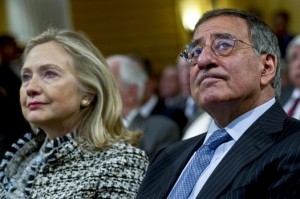
Defense Secretary Leon Panetta with Secretary of State Hillary Clinton at NATO conference in Munich, Germany, Feb. 4 (Official Defense Department photo)

Flournoy co-founded the Center for New American Security (CNAS) in 2007 to promote support for U.S. war policies in Iraq and Afghanistan, and then became Under Secretary of Defense for Policy in the Obama administration in 2009.

Flournoy left her Pentagon position in 2012 and returned to CNAS as Chief Executive Officer. She has been described by ultimate insider journalist David Ignatius of the Washington Post, as being on a “short, short list” for the job Secretary of Defense in a Clinton administration.

Continue reading here…

The – sad – US nominations

By Johan Galtung

The US mountain, so rich in human talent, labored and produced the two dwarfs for the huge job. A radical Republican strongman[i] and a conventional Democrat, disliked by 62% and 67%–bad for electing the president of a country that still puts some stamp on the world.

Trump challenged, successfully, the Republican machine. The Democratic machine got a Hillary who challenged absolutely nothing. In both parties, in the name of unity, a veil was drawn over these basic US conflicts today, not between the parties, but within. Cruz did not give in, Sanders did–maybe bribed by some verbal rephrasing.

Take the issue-complex “foreign policy-war”.

An isolationist Trump could save American lives” (and many more non-American lives). But doing so to save money is not good enough; take the issues head on. “Clinton and Trump jostle for a position over North Korea” is more to the point: Trump is open to negotiate directly with Kim Jung-un, Hillary sticks to conventional isolation-sanctions-multilateralism. Trump might become the first US president to take North Korea on the word: “peace treaty-normalization-a nuclear-free Korean peninsula”. Hillary’s line leads nowhere.

What is missing is an open debate on the two untouchables: US foreign policy and the US right and duty to war.

So there they are… Continue reading here.

Comment from Birgitta Hambraeus:

”To the point as usual, Johan! I appreciate your analysis!
What do you think will happen to Nato if Trump is elected president?”
Varma hälsningar!
Birgitta