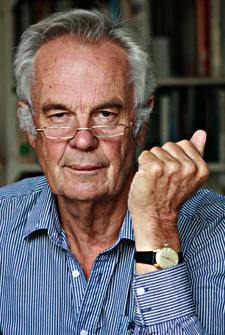
Five Palestinian futures

By Richard Falk

For years, perhaps going back as far as the Madrid Peace Conference of 1991, influential international debate on the future of Palestine has almost exclusively considered variations on the theme of a two-state solution. The American Secretary of State, John Kerry, stampeded the Palestinian Authority and Israel into negotiations that ‘failed’ even before they started a year ago. At least Kerry was prudent enough to warn both sides that this was their do or die moment for resolving the conflict.

It was presumed without dissent in high places anywhere that this two-state outcome was the one and only solution that could bring peace. Besides the parties themselves, the EU, the Arab League, the UN all wagered that a resolution of the conflict required the establishment of a Palestinian state. Even Benjamin Netanyahu became a reluctant subscriber to this mantra in his 2009 speech at Bar-Ilan University, although always in a halfhearted spirit.Read More »

The world right now: A Mid-Year Report

By Johan Galtung

Time to take stock. The shot in Sarajevo 100 years ago inspires narratives of 19-year old Gavrilo Princip killing the successor to the throne of an empire and his pregnant wife as the event unleashing mutual mass murder (INYT, FAZ 28-29 June 2014). Not the empire annexing Bosnia-Herzegovina on October 6, 1908 (Art. 25 of the 1878 Berlin Congress of “great powers”).

Maybe the inhabitants did not like it?

Moral of that stock-taking: watch out for terrorism, not for empires and occupation-colonialism; and protect leaders, not people.

ISIS (Islamic State of Iraq and the Levant, alternatively translated as Islamic State of Iraq and Syria and Islamic State of Iraq and al-Sham) comes up. TIME 30 June: The End of Iraq. Maybe Iraq – that highly artificial English colonial entity encasing Shia Arabs, Sunni Arabs and Sunni Kurds–never started?

Like its French colonial neighbor Syria – adding Alawite Arabs, Christians, Jews and others? Ever heard about Sykes-Picot and their czarist Russian allies?

Can such crimes just pass, with no counter-forces?

Watch out, a key point about ISIS – now comprising a major part of IS – is as a bridge over the English-French colonial divide, in favor of a Sunni Arab caliphate. Like it or not, these are very strong forces from the past in the daylight of the present. Read More »

Worse world or better world?

By Jonathan Power

War is all over the place. It seems. Not just Syria and Iraq but now inside Pakistan. Not to mention Somalia and Sudan. Yet paradoxically there has never been less war.

Sweden’s Uppsala University Conflict Data program is about to publish its results for 2013. It reports that the number of conflicts in the world increased by one between 2012 and 2013 – pace all the press and TV coverage which sometimes gives the impression that half the world is going up in smoke.

Since the Cold War ended the number of conflicts claiming more than 1,000 deaths has declined by 50%. There were 15 conflicts of this size in the early 1990s. Today there are only seven.

In 2013 six peace agreements were signed – which is two more than the year before.

The number of democratic countries was 69 at the end of the Cold War. Today there are around 120. The number of autocracies has declined in that time from 62 to 48.

The American foreign policy elite appears unaware of these trends. Read More »

Spain 2050 – Ten predictions

By Johan Galtung

Alfaz; History group, Municipio, Spain

Can we know the future? Rhetorical answer: can we know the past?

We rewrite history all the time, not because facts become dubious and new facts appear, but because our angle, perspective, changes. Say, from a series of kings, presidents etc. and their exercise of military and political power to economic and cultural changes in the life of common people, in their wellbeing and identity. Quite some change.

Will we arrive at that single, true, objective perspective?

No, objectivity may be multi-subjective, not inter-subjective. This is why Al Jazeera is so much better for knowing the present than CNN, which presents the US angle, and if there are other angles a US “expert” will give the final interpretation. Al Jazeera presents many angles of many parties and leaves final interpretations to the viewer.

How can we shed some light into the future? Basically there are two approaches: the Cartesian based on extending trends, and daoism based on holism and dialectics. They do not exclude each other.

Thus, there are three world trends that certainly affect Spain…Read More »

Do Russia and China threaten the West?

By Jonathan Power

In recent months the scare-mongers have been at it again – Russia’s foray into Ukraine and China’s behaviour in the South China Sea have set their alarm bells ringing. But why?

Big power politics is not back. Indeed in the round it is rather subdued. Take the Russian-EU-US fracas over Ukraine at the moment. Does this compare with the Cold War when the West prepared itself for a Russian invasion of Europe, nuclear missiles were targeted on each other, and when the Soviet Union along with the US stirred up proxy civil wars in Central America and Africa?

Do the US and NATO fear such threats as these today? Of course not. Critics of President Barack Obama and denigrators of President Vladimir Putin badly need a sense of perspective.Read More »

Good, innovative governance – what is that?

By Johan Galtung

Pretoria, South Africa, Keynote

Governance is politics, power–political-economic-military-cultural; decisions-carrots-sticks-ideas. Politics is about problems of realizing one goal; about conflicts realizing incompatible goals. Contradiction = danger+opportunity; the art of the impossible.

Answer: Good Governance GG = CC Creative Conflict-transformation.

This includes diagnosis, who are the parties, their goals and the incompatibilities; prognosis, from frustration to aggression/apathy, from prejudice-discrimination to hatred-violence; therapy, conflict solution-transformation, proposing creative visions of a new reality where the goals are compatible and new conflicts more easily handled.

Two examples of creative, good governance from Norway and Europe: Read More »

Prosecuting Syrians for war crimes now

By Richard Falk

A major undertaking of the victorious powers in World War II was to impose individual criminal accountability upon political and military leaders for alleged crimes committed during wartime before a tribunal convened by the victors that gave those accused a fair opportunity to present a defense.

This application of this idea of accountability to German and Japanese surviving leaders at trials held in Nuremberg and Tokyo was hailed at the time as a major step in the direction of a ‘just peace.’

International law was treated as binding upon sovereign states and those that represented the government, conceived to be a major step in the direction of a global rule of law. The final decisions of these tribunals also produced a narrative as to why World War II was a necessary and just war. Such an outcome was both a vindication of the victory on the battlefield and a punitive repudiation of those who fought and lost. Significantly, this criminal process was formally initiated only after the combat phase of the war had ended and Germany and Japan had surrendered.Read More »

TFF PressInfo: Democracy’s crisis – 10 points

By Jan Oberg

Democracy is a core feature of Western society, normally understood as representative parliament – i.e. in free elections citizens vote for people to represent their interests for a parliament consisting of parties of which some form the government and some the opposition.

It’s not always included in the definitions that democracy requires a reasonable level of knowledge and information, freely available. For instance, one often hears that India is the world’s biggest democracy but 26% of the people are still illiterate (287 million people).

So the ”world’s largest democracy” also has the world’s largest population who can’t read and write. In comparison, China illiterate citizens make up about 3% and is regularly called a dictatorship.

Also, in a society where the persons running for office are – or have to be – extremely wealthy to pay for their campaign and where large corporations make multi-million dollar contributions to certain candidates (presumably not out of altruism), falls outside a reasonable definition of democracy – even though they may also not be dictatorships; there are many stations in-between the two.

Are young people giving up parliamentary democracy?

When I was in my high-school years – a few decades ago – and wanted to contribute to changing society for the better, the most natural thing to do – and the finest – was to join a political party. Not so today. My students in peace studies around the world often ask me at the end of a course and it is time to say goodbye whether I can help them somehow in making their career. Their career dreams may be to work for the UN, for human rights, the environment or starting their own NGO with a peace profile or set up their own consultancy firm for a better world.

Significantly, over all these years, only one single student asked me what I thought about contributing to peace and development by becoming a politician.

As is well-known, people today engage in social issues mainly through civil society and the use of social media as their primary tool. This is good from most perspectives and holds fascinating prospects for de facto global citizenship and action, but it does something to the old type of representative democracy.

When we talk about global crisis, people think much more of the environment, identity issues or warfare than of democracy being in crisis. I think it is in fundamental crisis for the the following reasons.Read More »

TFF PressInfo: EU elections – To perform rather than live democracy

By Jan Oberg

Lund, Sweden, June 3, 2014

Fears has been expressed in Europe about the recent EU parliament voting pattern. Instead of the fear and denouncing the winners we should ask: What causes such an outcome?

My short answer is this: Democracy itself is in deep crisis. It has become performance or ritual rather than something genuinely lived.

Two things stand out – one, the increase in votes going to nationalist, populist, right-wing and anti-Muslim parties as well as Euro-skeptics – particularly in Denmark, France, Greece and Britain.

Secondly, the voter turnout has fallen from 62 per cent in 1979 to 43% in 2009 and this year it increased only 0.09% in spite of the EU Commission’s attempt to increase it.

So while people struggle around the world for democracy, only 43% of the EU citizens find it meaningful to go and vote every 4th year. How tragic for an EU that tries to promote democracy everywhere, even by military force.

It is understandable that the two mentioned factors is a combination that make many in Europe – the seat of two world wars, NATO and some of the most armed and two nuclear-weapons states – concerned. Perhaps the rest of the world should be at least as concerned? Other countries such as Hungary and Spain have, on different dimensions, moved in a worrying authoritarian political direction.Read More »

TFF PressInfo – Why Obama’s speech should make us think

By Jan Oberg

Lund, Sweden – May 29, 2014

In a speech by the President of the United States of America – read by millions in all corners of our world in minutes – rest assured that every single word has been weighed with utmost care.

With this in mind, Obama’s speech can be analysed as both offending to the rest of us and – exceptionally – weak.

It caused no enthusiasm among the future army officers he spoke to and no enthusiasm among leading Western media.

I will argue that

• Intellectually and morally the speech doesn’t have the basics – full of contradictions and imbued with unbearable self-praise.

• While there is a recognition of ”mistakes” such as ”our” war in Iraq and a potential step-back from interventionism, there is neither an adequate analysis of the past nor of what the future may need in terms of leadership.

• Little had I anticipated that my analysis in the TFF PressInfo on ”Psycho politics in the age of imperial decline” just a few days ago would be confirmed so quickly and so strongly. Read More »